

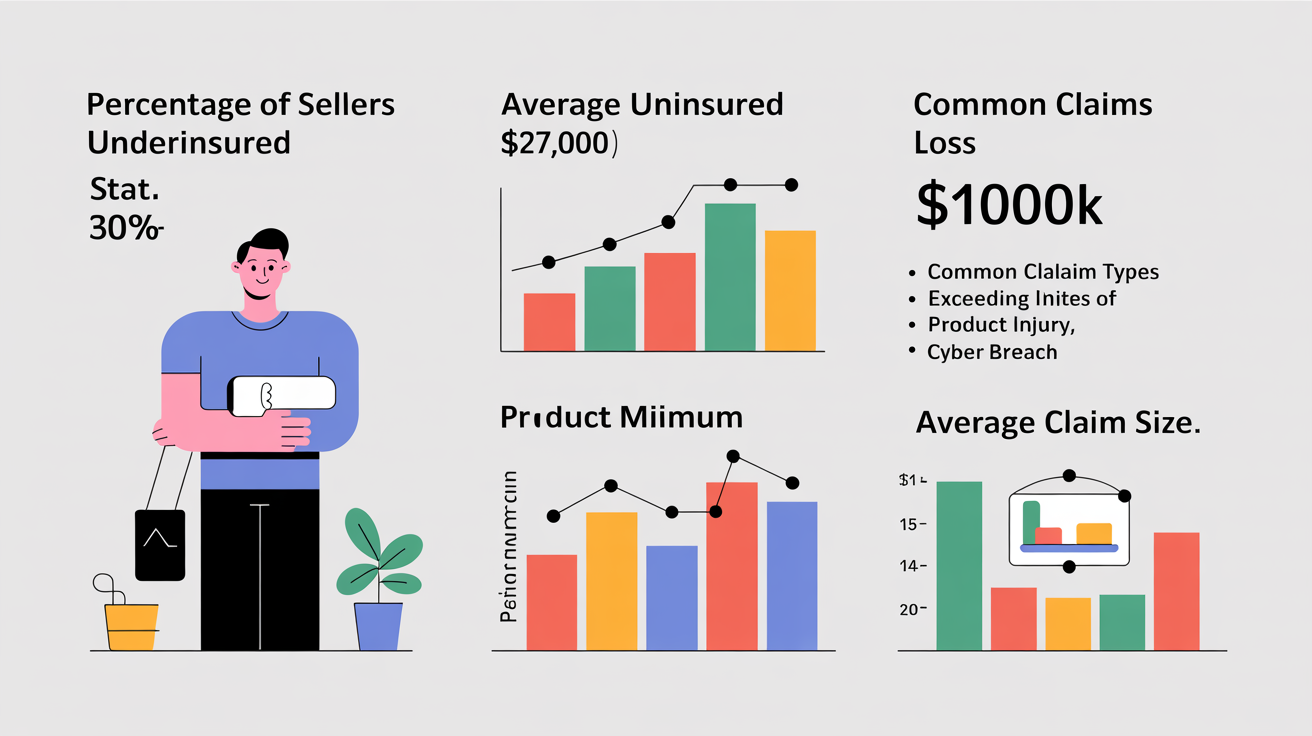
Over 30% of eCommerce sellers with $100,000 or less in liability coverage pay out of pocket when claims exceed their policy, with the average uninsured loss at $27,000, enough to erase a year’s profit for many stores. A single product injury, judgment, or legal defense can easily exceed $100,000 as sales scale, so sellers must reassess risk regularly and raise limits (doubling coverage typically costs far less than doubling premiums) to avoid catastrophic out-of-pocket losses.
$100,000 Liability Insurance: Why Cutting Corners on Limits Costs eCommerce Sellers More
Over 30% of eCommerce sellers with $100,000 or less in liability coverage end up paying out of pocket when claims exceed their policy. The average uninsured loss? $27,000, enough to erase a year’s profit for many stores.
Low policy limits look affordable at first. But as your business grows, those limits rarely match real-world risks. One serious product injury or property damage claim can drain your coverage in a single incident. After that, you cover the rest. Cash flow takes a direct hit. Some sellers never recover.
Underestimating coverage needs is common, and costly. Sellers often learn too late that $100,000 doesn’t stretch far. Larger claims aren’t rare; court judgments and legal fees add up fast. Even a single claim can upend your finances or force a shutdown.
Review your risk exposure as your sales climb or you expand into new categories. Higher limits usually cost less than you expect, doubling coverage doesn’t double your premium, but it adds significant protection. See our guide on insurance cost budgeting and how liability impacts your online store's bottom line for practical strategies.
3 Costly Mistakes Sellers Make With $100,000 Liability Limits (And How To Fix Them)
Most sellers underestimate how quickly a $100,000 liability limit can disappear. One injury claim or lawsuit can exceed your coverage, forcing you to pay the difference, sometimes hundreds of thousands out of pocket.
Mistake 1: Assuming $100,000 Is Enough for Real-World Claims
Many sellers treat a $100,000 policy as a catch-all, often because that's the minimum their platform or state requires. This creates a false sense of security. Courts don't care about marketplace requirements, they base judgments on actual damages, medical bills, and legal fees. Product liability cases often exceed $100,000, especially with multiple injured customers or faulty products affecting entire shipments.
Check recent claims in your category. Look at what similar product cases actually settle for, especially if you import or private-label. Adjust your limit based on real risks, not just what the platform says. For practical steps, see our guide on the most common liability insurance mistakes for online sellers.
Mistake 2: Ignoring How Sales Growth Increases Your Exposure
Sticking with the same $100,000 limit while your business scales leaves you exposed. More sales means more products in circulation, raising both the chances and costs of claims. Many sellers delay updating coverage, missing the link between sales growth and risk.
- Review your sales every quarter. If revenue jumps, so does your liability.
- Increase policy limits at least once a year, or sooner if you add higher-risk products or categories.
- Ask your insurer about pay-as-you-sell coverage that tracks your actual revenue.
- Weigh the extra monthly cost for a higher aggregate limit against the potential expense of a single large claim. Usually, the price difference is small compared to the protection gained.
Mistake 3: Overlooking Policy Exclusions That Reduce Real Coverage
Sellers often believe a $100,000 policy covers every risk. Most general liability policies have exclusions, like certain materials, design flaws, or specific product types. If your claim falls under one of these, coverage can be denied, and your stated limit won't matter.
Read your exclusions carefully. Find any gaps tied to what you sell now or plan to add. For example, if your policy excludes electronics with lithium batteries and you launch that line, you’re exposed for the full claim amount. Close these gaps before a claim hits. Request endorsements for your products and check with your insurer about new SKUs. For more on how exclusions work, see our resource on common liability insurance coverage issues and costs.
Hidden Risks: 3 More Traps With $100k Coverage That Could Sink Your Business
Cyber liability is the most expensive blind spot for sellers sticking with basic $100,000 general liability. A single breach can drain years of profit, even if your store is digital-only. But digital gaps aren’t the only threat. Relying on umbrella bundles or letting your policy limits stagnate can quietly put your business at risk.
Mistake 4: Trusting Bundled Business Policies to Fill Every Gap
Umbrella and bundled policies create a comfort zone that doesn’t actually exist. Many sellers assume their business owner’s policy or general liability add-on protects against everything, including cyber events. Most don’t. General liability packages typically exclude cyber, data breach, and privacy claims. If a hacker locks your systems or leaks customer data, you’ll cover legal fees, notification, and regulatory fines yourself. Sellers have absorbed six-figure losses after finding out too late that general liability won’t pay for digital incidents.
Check every policy exclusion and endorsement. If you handle payments, customer records, or inventory online, a separate cyber liability policy is essential. For specifics, see what isn't covered by most CGL policies. Ask your insurer for written confirmation about which digital incidents are covered. Don’t guess, confirm.
Mistake 5: Allowing Liability Limits to Fall Behind Your Growth
Revenue and order volume go up, but your $100,000 insurance limit stays put. Many sellers keep renewing old limits without realizing they’re far too low for their current risk. One lawsuit, property claim, or digital incident can wipe out that original limit instantly. Sellers who scale quickly often see settlement costs overrun coverage by hundreds of thousands, because limits never kept up.
- Review coverage every time your average monthly revenue jumps 25% or more.
- Tally total inventory shipped and estimate how many claimants you’d face in a worst-case event.
- Update your insurance limit yearly, or sooner if you add new products or expand abroad.
- Choose a pay-as-you-sell policy that automatically tracks growth and adjusts premiums monthly.
Mistake 6: Ignoring Dedicated Cyber and Data Breach Coverage
General liability isn’t designed for cyber threats. Standard CGL policies address physical risks, not the digital exposures that eCommerce faces daily. If hackers access your customer database or compromise a payment page, your CGL carrier will probably deny the claim, for both direct losses and regulatory penalties. Many sellers only learn this after a breach, as forensic, legal, and notification costs pile up. The core issue: assuming physical coverage extends to online operations.
Dedicated cyber insurance covers breach notification, credit monitoring, legal costs, business interruption, and PR. Example: one merchant with 45,000 exposed customers used their cyber policy for $2.8 million in notification and response costs after a payment processor breach. That payout kept the business afloat. For specifics on cyber liability coverage and choosing the right limits, see our guide to cyber insurance for eCommerce sellers.
A Seller’s Framework: How To Avoid The Most Common Low-Limit Insurance Errors
Waiting until renewal season to adjust insurance limits leaves you exposed. Build checks into your sales process so compliance and risk control become routine, not a scramble during claims or audits.
- Set a quarterly reminder to review your trailing 12-month revenue, order volume, and any major product changes. Your risk profile shifts with every new product or sales spike.
- Choose a sales growth trigger, say, a 20% jump in revenue, that prompts an immediate insurance review. Don’t wait for year-end.
- Compare your current limits to real loss data in your product category and recent claims trends. If a multi-claim event would exceed your coverage, raise limits before expanding to new channels.
- Schedule an annual insurance checkup to review platform requirements and updated compliance rules. Last year’s policy might not meet this year’s standards.
- Document every policy change in a central tracker. You’ll have proof of compliance when Amazon, Shopify, or any platform asks. It also prevents accidental lapses.
These habits build on each other. Quarterly reviews and sales-based triggers catch gaps early. Tracking claims benchmarks and compliance rules keeps your costs and coverage in sync. For practical cost benchmarks, see our guide to pricing and lowering your coverage costs. For step-by-step purchase details, read about efficient purchase workflows. This framework cuts down on fire drills and lets you run stress-free insurance that matches your growth.
The Takeaway: Don’t Let $100k Coverage Be a False Safety Net
Assuming a $100,000 liability policy keeps you safe, just because it matches last year’s sales or meets an old platform minimum, can leave your business exposed. Claims, settlements, and legal costs for product liability, cyber incidents, or class actions often exceed these limits. One breach or lawsuit can easily hit six figures or more. Underinsuring gives a false sense of security and can be more dangerous than having no policy at all.
Real protection requires regular, disciplined reviews of your actual risks. Set clear sales growth triggers to revisit coverage. Check compliance every year. Benchmark your policy limits against the size of your customer database and inventory. Aligning coverage with your real exposure, not a generic minimum, keeps you compliant and protects your cash flow if claims hit.
Insurance works when it’s part of your operating routine, not just a checkbox. Not sure where to begin? See our guide to structuring your coverage and decision-making. It’s far less costly to stay proactive than to scramble after a loss.

Frequently Asked Questions
How do I calculate the liability limit I actually need for my ecommerce business based on revenue, product type, and order volume?
Calculate your limit as the “maximum plausible loss” = worst single‑claim payout + simultaneous/aggregate claims from the largest exposed batch + defense/legal + recall/replacement + business‑interruption (gross profit for expected downtime). Estimate each: worst single claim (medical/legal/settlement) by product severity (e.g., $100k, $1M+ for severe injury products), multi‑claim exposure = number of units in the market or a single shipment × per‑claim estimate, recall costs = unit replacement × units affected, and add ~20-50% for defense; sum those numbers to set your per‑occurrence and aggregate limits. As a practical guide, don’t buy less than the common $1M/$2M GL for low‑risk sellers, choose $2M, $5M for food/children/electronics or high order volumes, and add a $5M, $10M umbrella if a recall or catastrophic event could produce multi‑million losses.
How much does it typically cost to increase coverage from $100,000 to $1,000,000 for a small-to-midsize ecommerce seller?
Typically an extra $200, $2,000 per year to raise a limit from $100K to $1M for a small‑to‑midsize ecommerce seller, depending on coverage type, product risk, revenue and claims history. Cyber limits trend toward the higher end if you handle lots of customer data (for example one small quote was $250/year for $250K aggregate), while general/product liability increases often translate to a 20-100% premium bump; shop at least three carriers and bundle coverages to save ~15-25%.
What is the difference between per-occurrence limits and aggregate limits, and which one matters most for product liability exposure?
Per‑occurrence is the most your insurer will pay for one incident; the aggregate is the most it will pay for all incidents during the policy year. Per‑occurrence usually matters most for product liability because a single catastrophic injury or wrongful‑death suit can exhaust that limit (industry standard is often $1M per occurrence / $2M aggregate). The aggregate still matters for multiple claims or a recall, so higher per‑occurrence and aggregate limits are prudent for high‑risk products.
Does a standard general liability policy cover product recalls or contamination events, or do I need a separate product recall/contamination policy?
No, a standard Commercial General Liability (including products/completed‑operations) will cover third‑party bodily injury or property damage from your products but does not pay for product‑recall or contamination‑related expenses. For recall testing, disposal, remediation, public‑relations and business‑interruption costs you need a separate product recall/product contamination (or specialized pollution/product‑withdrawal) policy from a specialty insurer and should verify any pollution/contamination exclusions or endorsements on your CGL.
If a lawsuit or judgment exceeds my policy limits, will my insurer still cover legal defense costs or will I be responsible for defense once limits are exhausted?
It depends on your policy wording and state law: if your policy treats defense costs as part of (inside) the policy limits, once those limits are exhausted the insurer’s duty to pay defense costs usually ends and you become responsible; if the policy expressly pays defense costs outside the limits (or the insurer agrees to continue defending), the insurer will continue to fund your defense even after indemnity limits are met. Check your policy’s “duty to defend” and “defense costs”/“outside the limits” language and consult your agent or an attorney because state law and reservation‑of‑rights or settlement decisions can change who pays.
Can I buy an umbrella or excess liability policy to top off a $100,000 primary policy, and how does coordination between the primary and umbrella work in practice?
Yes, you can buy an umbrella/excess liability policy to cover amounts above a $100,000 primary policy, but most insurers will require you to carry specified minimum underlying limits (they may insist you increase the primary limits) before issuing an umbrella. In practice the primary policy pays first up to its $100,000 limit, then the umbrella (or excess) picks up eligible costs above that amount up to its own limit; umbrellas can be “follow form” (mirror the underlying policy’s terms) or broader and sometimes impose a self‑insured retention if an underlying policy doesn’t cover a loss.
What documentation and certificates do marketplaces (like Amazon) or retail partners require to prove higher liability limits, and how can I provide those quickly during onboarding or after a claim?
Provide an ACORD 25 Certificate of Insurance showing the required higher limits plus the policy declarations page and the actual Additional Insured endorsement (not just the COI); marketplaces commonly also require product liability/umbrella/excess schedules, a waiver of subrogation and primary & non‑contributory wording, and workers’ compensation evidence if you have employees. To supply these quickly, ask your broker/insurer to generate and ACORD 25 and email it with scanned declarations and the issued endorsement(s), use your insurer’s COI portal or a third‑party certificate service (e.g., myCOI/CertFocus) to produce instant certificates, or have the broker upload directly to the marketplace vendor portal, remember a COI is informational only, so if a partner requires legal rights you must obtain and provide the formal endorsement (typically issued in 1-3 business days).

Rohit Nair is the CEO and Founder of Assureful, an insurtech venture creating smart insurance products for ecommerce businesses. With a track record of launching and scaling successful ventures across health, wellness, ecommerce and consumer technology, with multiple exits and acquisitions, Rohit brings deep expertise in financial management, regulatory environments, and high-growth startups.
For more on this topic, see our guide to instant insurance calculator.
This sits inside the broader topic of eCommerce business insurance for online sellers.
Related: Commercial Insurance Online Quote? What Happened When We Tested 5.
Related: Instant Business Insurance Quote Free? How Instant Quotes Work And.
Sources
- piainsagency.com
- guardianlife.com
- esportsinsurance.com
- insureon.com
- checklistguro.com
- progressive.com
- forbes.com
- moneygeek.com
- aflac.com
- wsj.com
- wsj.com
- vpm-legal.com
- pattersonlawfirm.com
- noblepagroup.com
- dealhub.io
- biberk.com
- iii.org
- payoneer.com
- blog.hubspot.com
- levertylaw.com
- fitsmallbusiness.com
- business.com
- security.org
- embroker.com
- hotalinginsurance.com
- thehartford.com
- landesblosch.com
- insureon.com
- iii.org
- baldwin.com
- controlhub.com
- score.org
- forbes.com
- statefarm.com
- businessnewsdaily.com
- iwillteachyoutoberich.com
- dealhub.io
- eslaw.com
- bfg.law
- policyape.com
- shopify.com
- moneygeek.com
- vouch.us
- nerdwallet.com
- seo-pages-web.vercel.nerdwallet.com