

# Summary Most eCommerce sellers pay $42, $73 monthly for general liability insurance. The same coverage costs 30-40% more at some providers than others due to different risk calculations. Your state alone can shift your bill by $21 per month, Maine runs $64 while New York hits $85. Supplements and children's products cost 50-174% more than standard goods. You overpay when you forecast annual sales upfront, lock into fixed rates regardless of actual revenue, or skip bundling options. Smart sellers know their benchmark rates, bundle policies, and match their premium to actual sales volume rather than guesses.
Pay-as-you-sell general liability insurance designed specifically for eCommerce. Premiums starting from just $26 per mon...
Premiums from $26/month
Learn MoreeCommerce Insurance Pricing: What You Should Actually Be Paying
Most online sellers either overpay for coverage they don't need or underpay and leave themselves exposed. General liability insurance for eCommerce sellers averages $42, $73 per month, yet identical coverage can vary by 30-40% between providers depending on how they calculate risk and bill you.
Price hits your bottom line directly. Forecasting annual sales to get a quote, paying upfront premiums, or locking into fixed rates regardless of actual revenue, these choices drain cash you could reinvest. Knowing where your quote sits relative to the market helps you negotiate smarter and spot red flags in policy terms.
This guide walks you through the factors that move your premium up or down, benchmarks what you should expect to pay, and shows you the most effective tactics to reduce costs without sacrificing protection. You'll also find clarity on whether bundling policies saves money, how your sales volume affects your rate, and what questions to ask before you commit to a policy. Start with whether you actually need insurance for your eCommerce business, then use the detailed pricing breakdowns to build your budget.
The Pricing : Benchmark Rates Across Every Major Coverage Type
Your eCommerce insurance costs break down into four main coverage types, each priced separately or bundled together. General liability forms the foundation. Product liability protects against defects in what you sell. Cyber liability covers data breaches and ransomware. Business owner's policies (BOPs) combine general liability with commercial property coverage.
Pricing varies dramatically by state, product category, and business size. A seller in Maine pays $64 monthly for general liability while an identical business in New York pays $85. High-risk products like supplements or children's items command premiums 50-174% above the baseline. Enterprise operations with $20M+ revenue face completely different underwriting and cost structures. This section maps the so you know whether your quote is in the right ballpark.
General Liability Insurance
General liability covers third-party bodily injury, property damage, and legal defense costs. It protects you if a customer claims injury from your business operations, or if you damage someone else's property. For eCommerce sellers, this typically means coverage if you attend trade shows, conduct pop-up sales, or store inventory in a warehouse.
Pricing averages $42, $73 monthly depending on your provider, location, and business size. The median annual cost across the market sits at $850 per year. Your state location alone shifts your premium by $21 monthly, Maine averages $64 while New York hits $85. Bundling general liability into a business owner's policy typically costs less than buying it standalone. Learn more about what commercial general liability covers and pricing benchmarks.
Product Liability Insurance
Product liability responds to claims that something you sold caused bodily injury or property damage. You can be liable even if you didn't manufacture the product, importers and distributors are named in claims just as often as makers. Risk is highest for children's products, supplements, ingestibles, and electronics, where injury claims carry higher severity and cost.
Product liability is often bundled within general liability policies rather than sold separately, so it doesn't always appear as a distinct line item on your quote. High-risk categories see premiums 50-100% above baseline rates. Understanding how product liability affects your bottom line is critical if you sell anything with injury potential.
Cyber Liability Insurance
Cyber liability covers data breaches, ransomware attacks, and the costs of notification, credit monitoring, legal defense, and system recovery. Every eCommerce business handles customer credit card data, personal information, or payment processing, all activities that make you vulnerable to cyberattacks.
Cyber liability averages $500 annually or $57 monthly for online retailers. A single data breach triggers notification costs, legal fees, and credit monitoring that easily exceed $50,000. Skipping this coverage to save $500 per year is false economy. The math is straightforward: the coverage cost is negligible compared to the exposure.
Business Owner's Policy (BOP)
A BOP bundles general liability, commercial property coverage, and business interruption insurance into a single policy. It's typically available to businesses with fewer than 100 employees and annual revenue under $5 million. Bundling these coverages costs less than buying them separately, usually $88, $121 monthly depending on your state.
Your state location drives significant variation. Alaska averages $88 monthly while Pennsylvania hits $121 for the same coverage level. That $33 monthly difference adds up to nearly $400 annually. Bundling saves 15-25% compared to purchasing policies separately, and paying annually instead of monthly eliminates 4-10% in processing fees while qualifying you for an additional 5-9% discount. If you're paying $100 monthly, switching to annual payments could save $140, $190 per year.
Four Decisions That Determine Your Premium, And The Tradeoffs That Come With Each
Your insurance premium isn't fixed, it moves based on four concrete choices you make. Each decision trades cost against protection, and understanding those tradeoffs prevents you from overpaying for coverage you don't need or underbuying and facing gaps when claims happen.
Coverage Limits: $1M/$2M vs. Higher Tiers
The standard starting point for general liability is $1 million per occurrence and $2 million aggregate, the total your insurer will pay across all claims in a year. This covers most single-incident exposures. But if one accident injures multiple people or causes significant property damage, that limit can disappear fast.
Higher limits cost more, but the premium increase is proportional, not exponential. Moving from $1M/$2M to $2M/$4M typically adds 20-35% to your annual premium. The decision hinges on your risk profile: if you sell heavy items, operate a fulfillment center, or host in-person events, the upgrade is worth the cost. If you sell low-risk digital goods or lightweight apparel, the base limit often suffices. See how different coverage levels compare month to month to size the right tier for your sales volume and product category.
Bundling vs. Standalone Policies
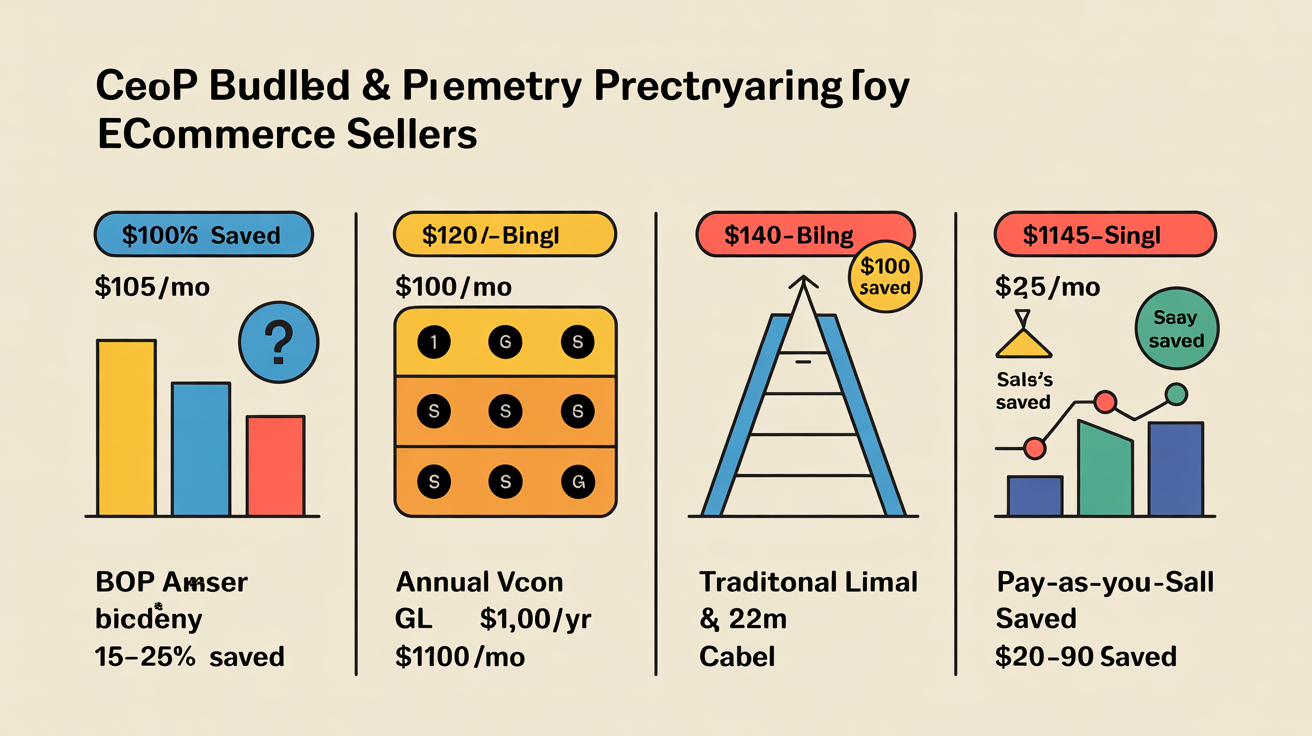
You can buy general liability, cyber liability, and commercial property as separate policies or bundle them into a Business Owner's Policy (BOP). Bundling saves 15-25% compared to buying policies individually. A typical bundled BOP costs around $105 monthly, while purchasing general liability ($73) and property coverage separately will run you $120, $135 combined.
The tradeoff is flexibility. A bundle locks you into one insurer's coverage terms across all three lines, while standalone policies let you shop each coverage type separately and mix insurers. For most eCommerce sellers under $5 million annual revenue, the savings from bundling outweigh the slight loss of flexibility. If you have unusual property needs or operate across multiple jurisdictions, standalone policies give you more control.
Annual vs. Monthly Billing
Monthly payment plans carry a processing fee, typically 4-10% of your annual premium. On a $100 monthly policy, that's $48, $120 per year in fees alone. Switching to annual billing eliminates those fees and often an additional 5-9% discount for paying upfront, saving you $140, $190 annually on the same coverage.
The catch is cash flow. Annual payments require a larger upfront outlay, which matters if your business runs on tight margins or seasonal revenue. Monthly billing spreads the cost and matches your cash cycle if sales are predictable. If you have the cash to pay annually, the math is clear, you're leaving money on the table paying monthly.
Pay-as-You-Sell vs. Annual-Forecast Billing
Traditional insurers require you to estimate your annual sales revenue upfront and charge a premium based on that forecast. If you underestimate, you're under-insured. If you overestimate, you overpay and get a partial refund later, if you remember to file for it. This model creates friction and often costs sellers an average of 42% more than necessary.
Pay-as-you-sell billing, like Assureful's model, charges you monthly based on your actual prior-month sales. No forecasts. No surprises. Your premium moves with your business, and you pay only for the coverage you actually use. This approach eliminates guesswork and reduces typical premiums by an average of 42% compared to traditional forecast-based insurance. See tactical ways to optimize your premium structure without cutting coverage.
Six Pricing Mistakes That Cost eCommerce Sellers More Than They Realise
Most eCommerce sellers don't realize their homeowner's or renter's insurance explicitly excludes business inventory and customer liability claims. A single product injury lawsuit or warehouse theft can wipe out your savings if you're relying on personal coverage, leaving you personally liable for tens of thousands in damages.
The six most costly mistakes:
- Relying on personal insurance. Product liability affects your bottom line in ways homeowner's policies won't cover. One injury claim can exceed your personal assets.
- Buying coverage piecemeal instead of bundling. Standalone policies cost 15-25% more than bundled coverage when cyber, product, and general liability are combined.
- Choosing monthly billing without accounting for fees. Processing surcharges add $48, $120 annually compared to annual payment options.
- Skipping cyber liability to save $500/year. A single data breach triggers notification costs, legal fees, and credit monitoring that easily exceed $50,000.
- Underestimating or overestimating annual sales. Traditional forecast-based insurance creates either a coverage gap or wasted premium. Pay-as-you-sell models eliminate this entirely.
- Failing to update coverage as your business scales. A policy adequate at launch won't cover $50K/month in sales, warehouse inventory, or employees.
The most expensive mistake is treating insurance as a one-time purchase rather than a living part of your business. Your coverage needs change as revenue grows, inventory accumulates, and operational complexity increases. Review your policy annually and adjust limits upward before you hit a revenue milestone. Red flags in liability policies that cost online stores walks through the specific policy language that hides gaps and surprises. Use a coverage checklist at renewal time to ensure cyber, product, and general liability all scale with your sales.
Where To Start: Route Yourself To The Right Resource Based On Your Situation
Your next move depends on where you are in your insurance journey. If you're ready to compare options and move toward a quote, start with how to compare online insurance options and pick the best one. That guide walks you through the full process, from gathering your business details to evaluating quotes side by side to activating coverage. It's designed for sellers who know they need protection and want a clear, step-by-step path forward.
If you're early-stage and unsure whether your current coverage is adequate, or if you're scaling and suspect your limits are now too low, your situation is different. A new seller launching on Amazon or Shopify needs different coverage than an established store doing six figures monthly. How coverage needs change as you grow helps you benchmark your policy against where your business actually stands. That clarity prevents both over-buying coverage you don't need and under-buying limits that leave you exposed.
If you want a stress-free baseline to test against other quotes, Assureful's pay-as-you-sell model removes the guesswork of annual sales forecasts and starts from $26 per month. You get instant quotes, immediate coverage, and the flexibility to cancel with 30 days' notice as your business evolves. Get an instant quote to see how your current premium stacks up, then use that number as your comparison benchmark when you evaluate other providers.

Pay-as-you-sell general liability insurance designed specifically for eCommerce. Premiums starting from just $26 per mon...
Premiums from $26/month
Learn MoreFrequently Asked Questions

Rohit Nair is the CEO and Founder of Assureful, an insurtech venture creating smart insurance products for ecommerce businesses. With a track record of launching and scaling successful ventures across health, wellness, ecommerce and consumer technology, with multiple exits and acquisitions, Rohit brings deep expertise in financial management, regulatory environments, and high-growth startups.
For more on this topic, see our guide to instant insurance calculator.
Related: Commercial Insurance Online Quote? What Happened When We Tested 5.
Related: Instant Business Insurance Quote Free? How Instant Quotes Work And.
Sources
- moneygeek.com
- insureon.com
- mailchimp.com
- co-opinsurance.com
- embroker.com
- shopify.com
Next best step
Match the article to the buying page.
If you are comparing coverage or preparing for a quote, start with the page that matches where you sell and what you sell.
eCommerce insuranceFull buyer's guide for online sellers.Amazon seller insuranceProof of insurance and COI guidance for third-party sellers.Shopify insuranceCoverage planning for Shopify and DTC brands.Product liability by stateState-specific product liability context and requirements.Compare insurersSee how Assureful compares with traditional carriers.
Related buying paths
Find the category page behind the risk.
Amazon categories
Product liability guides for Amazon sellers
Shopify categories
Product liability guides for Shopify brands
Best-fit comparisons