

Amazon.com requires commercial liability insurance within 30 days of exceeding USD $10,000 in gross proceeds in any month. From November 2, 2026, enhanced-safety listing categories require at least USD $1 million per occurrence and in aggregate regardless of sales. Because most general liability policies exclude product defects and average product-liability claims cost about $35,000 (with class-action recalls often exceeding $2M), specialized product liability coverage, including pay-as-you-sell models, is critical to stay compliant and protect a small ecommerce business from catastrophic legal and financial loss.
- Why 11.1 Million Product Injuries Make Specialized Coverage...
- Key Data: Product Liability vs. General Liability, Claims, Triggers,...
- When Should Product Liability Insurance Take Priority? Patterns...
- Trending Up: Rising Claims, Marketplace Rules, and Expanded...
- The Takeaway: Product Liability Risk Is Now the...
Pay-as-you-sell general liability insurance designed specifically for eCommerce. Premiums starting from just $26 per mon...
Premiums from $26/month
Learn MoreWhy 11.1 Million Product Injuries Make Specialized Coverage Critical for Small Business
11.1 million people landed in U.S. emergency rooms in 2021 because of consumer product injuries. That’s not a distant problem, it covers everything sold online, from toys to kitchen tools.
If you sell on Amazon, Shopify, or your own site, the risk is real. Even with third-party fulfillment, you can be named in a lawsuit if a product causes harm. From November 2, 2026, Amazon.com enhanced-safety listing categories require $1M per occurrence and in aggregate regardless of sales; the existing $10,000 monthly-sales trigger also remains. Miss that, and you risk immediate account suspension, lost sales, and legal bills you never saw coming.
General liability alone isn’t enough for most ecommerce sellers. From November 2, 2026, Amazon.com enhanced-safety listing categories require $1M per occurrence and in aggregate regardless of sales; the existing $10,000 monthly-sales trigger also remains. For practical steps, see our guides on when your business actually needs insurance and how to compare policies . Providers like Assureful offer pay-as-you-sell models that fit ecommerce’s unpredictability. Understanding the details is the difference between steady growth and a sudden stop.
Key Data: Product Liability vs. General Liability, Claims, Triggers, and Coverage Gaps
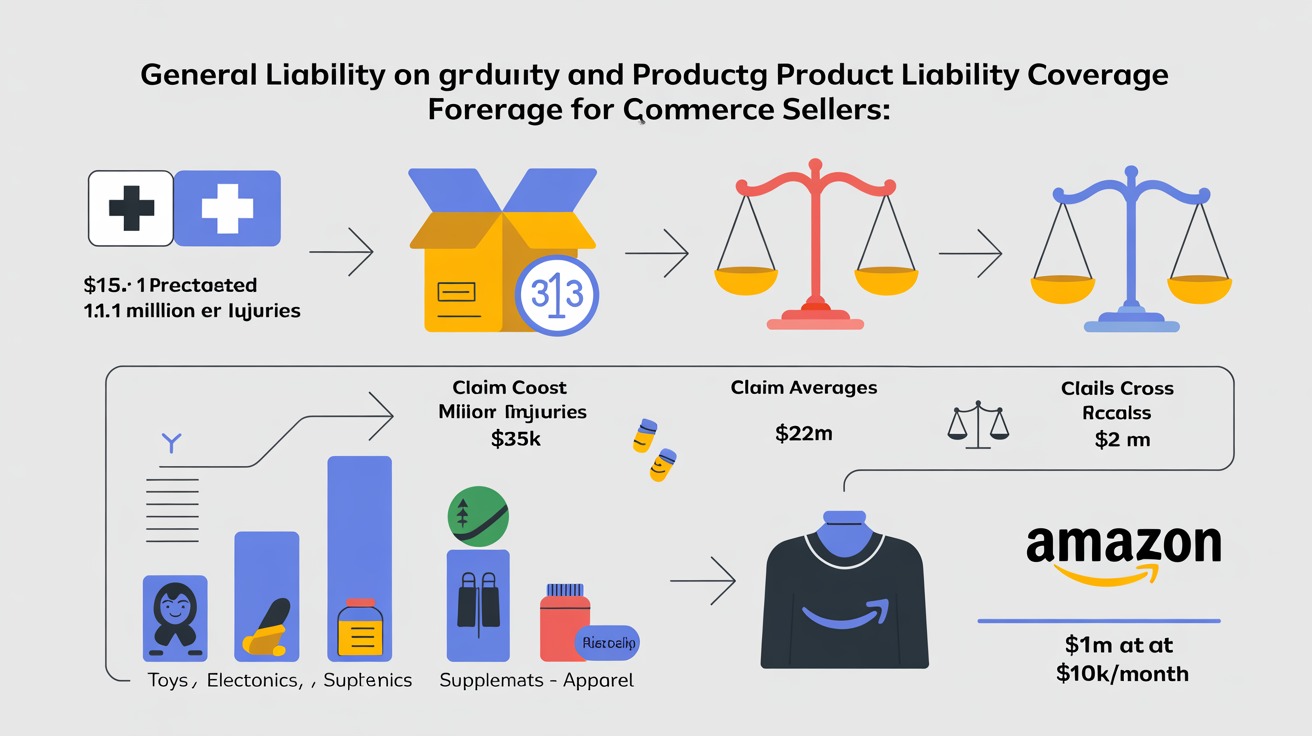
Product liability lawsuits cost small eCommerce retailers an average of $35,000 per claim, even for minor injuries. Class-action product recalls often settle above $2 million. General liability insurance won’t cover most product-related risks unless you’ve added specific endorsements. From November 2, 2026, Amazon.com enhanced-safety listing categories require $1M per occurrence and in aggregate regardless of sales; the existing $10,000 monthly-sales trigger also remains.
Claim Frequency and Financial Impact
Product-related claims have become the fastest-growing risk for online sellers. In 2021, over 11 million product-related injuries sent people to U.S. emergency rooms. Supplements and electronics see the most frequent, and expensive, claims. One lawsuit can threaten a business’s future: 68% of small business owners say a single $50,000 claim would be hard to survive. In contrast, slip-and-fall and premises liability claims remain less common for online-only retailers, but still average $20,000, $40,000 per incident.
Coverage Triggers and Marketplace Compliance
From November 2, 2026, Amazon.com enhanced-safety listing categories require $1M per occurrence and in aggregate regardless of sales; the existing $10,000 monthly-sales trigger also remains. Miss the proof of product liability coverage, and you risk immediate suspension or loss of selling privileges. For details by platform, see when stores actually need coverage .
General Liability vs. Product Liability, What’s Actually Covered?
- Most general liability policies, up to 78%, exclude injuries from defective products unless you buy a separate product liability endorsement. That leaves most online sellers exposed.
- “Products-completed operations” coverage addresses claims after a sale. Many basic policies skip this or restrict it to in-person services.
- Legal fees alone typically run $50,000, $100,000 per defended product liability case, even if you win. Coverage must specifically include defense outside policy limits to avoid burning through your protection too quickly.
Without a dedicated product liability policy, a standard general liability plan won’t address your core risk. See our comparison of policy impacts on eCommerce operations for real-world cost details.
Risk by Product Category
High-risk categories face higher claim rates and insurance premiums. Supplements and ingestibles top the charts for claim severity, with payouts often above $100,000 for allergic reactions or labeling mistakes. Toys, baby items, and small electronics see the most frequent claims, choking hazards, minor defects, recalls. Apparel and non-consumable home goods see fewer claims but still trigger strict liability suits if injury is alleged. Insurers like Assureful price these categories differently, so your monthly costs can rise or fall under pay-as-you-sell models.
Strict Liability and Seller Exposure
Strict liability means you can be sued for product injuries even if you didn’t manufacture the item. In 79% of eCommerce product liability suits, the seller, not the original manufacturer, is named, especially with imports or private label goods. Most platforms consider the seller the responsible party for compliance. Using third-party logistics doesn’t shield you from liability once the product ships. Review the full guide to coverages and exclusions before choosing a policy. The gap between general and product liability often surprises new online businesses.
When Should Product Liability Insurance Take Priority? Patterns from Claims and Platform Demands
For eCommerce sellers, claim costs and platform rules often push product liability insurance ahead of general liability. From November 2, 2026, Amazon.com enhanced-safety listing categories require $1M per occurrence and in aggregate regardless of sales; the existing $10,000 monthly-sales trigger also remains. Strict liability law puts you at risk even if a supplier or manufacturer is at fault, leaving gaps if you rely on bundled or generic policies.
Platform Insurance Demands Override Traditional Priorities
From November 2, 2026, Amazon.com enhanced-safety listing categories require $1M per occurrence and in aggregate regardless of sales; the existing $10,000 monthly-sales trigger also remains. Marketplace requirements have flipped the order of insurance planning. While general liability used to come first, Amazon now requires sellers above $10,000/month to show valid product liability coverage, usually with $1 million minimum per occurrence and aggregate limits. Miss this, and your account can be suspended or payouts withheld. Shopify and Walmart Marketplace enforce similar minimums. Revenue can stop overnight if you’re not compliant.
If your sales depend on a marketplace, insurance compliance isn’t optional. Even a single missing or expired certificate can pause your business immediately.
Claims Data Shows Product Risks Outpace Other Exposures
Product liability claims hit often, and hard. Defending a single product injury or property damage case typically costs over $50,000. Settlements frequently cross six figures, especially for children’s goods, supplements, or electronics. In 79% of eCommerce product liability lawsuits, the seller is named directly, regardless of involvement in design or manufacturing. General liability policies usually exclude these claims after the sale, so online merchants face a major protection gap.
See our breakdown of how product and general liability affect your online store's bottom line for detailed cost comparisons.
Strict Liability Laws Make Sellers Responsible for Supplier Mistakes
Strict liability law puts the legal risk on you if a product you sell causes harm, even if the defect started with your supplier or factory. This rule covers both private label and dropshipped goods. You’re exposed even if you never saw the inventory. Imported products and those without clear documentation are highest risk. Product liability insurance isn’t just paperwork, it’s the only way to manage unpredictable claims tied to your supply chain.
The full guide to coverages and exclusions by product type details how strict liability impacts eCommerce sellers as they grow.
Bundled or ‘General’ Policies Leave Risk Gaps
- General liability covers injuries tied to your operations or premises, but not harm from products after sale.
- Bundled small business policies often lack the “products-completed operations” endorsement Amazon and other platforms require.
- If product liability coverage is missing or excluded, you face legal costs and lost sales if you can’t show proper documentation during a claim or audit.
- For importers or sellers rebranding goods, the risk is bigger: you might be the only party a claimant can sue in the U.S.
Assureful’s model bills monthly based on real sales, removing guesswork and large upfront premiums. Always confirm your policy meets platform-specific requirements. One limitation: Assureful currently focuses on online sellers, so physical stores or hybrid businesses may need extra coverage elsewhere.
To see when insurance thresholds trigger, check the checklist that determines when you should buy. Ignoring product liability requirements risks both claims and sudden account suspensions on major platforms.
Trending Up: Rising Claims, Marketplace Rules, and Expanded Product Risk for Online Sellers
Product liability claims against online sellers have risen by over 33% since 2019. Electronics, supplements, and children’s goods show the sharpest spikes. Amazon, Shopify, and Walmart now demand stricter insurance verification and require documentation on a wider range of products. Compliance gets tougher each year. The pressure lands hardest on small and midsize sellers, especially those importing or private labeling inventory.
Product Liability Claims Are Rising Fast, Especially for Imports and Private Label
Insurer data shows product liability claim frequency up 33% in the U.S. since 2019. Over half involve imported goods or products sold under a seller’s own brand. Claims for electronics, supplements, and toys have doubled in five years. Median settlement? More than $330,000 for product injuries in these categories. Sellers sourcing overseas without solid documentation face outsized risk. Review the guide to coverages and exclusions by product type if you import or repackage goods under your own label.
Marketplace Compliance Rules Are Tougher and More Widespread
From November 2, 2026, Amazon.com enhanced-safety listing categories require $1M per occurrence and in aggregate regardless of sales. The existing requirement within 30 days of exceeding $10,000 in gross proceeds in any month also remains. Check each marketplace’s own policy rather than assuming their rules match. in 2026, over 40% of U.S. online sellers reported needing new or updated insurance to stay compliant. Automated verification is standard. Platforms suspend accounts if documentation lapses. The hub on platform-driven insurance requirements covers the latest rule changes and how providers like Assureful automate compliance.
State and Federal Laws Expand Seller Responsibility
California, New York, and Texas have tightened consumer protection statutes for eCommerce since 2020. New laws broaden strict liability for online sellers, especially if the manufacturer is unknown or untraceable. Multiple states now require sellers to respond quickly to product safety complaints. Delays can mean fines or criminal charges. Small businesses selling across state lines must track changing local laws or risk insurance gaps. For a compliance checklist, see the triggers for insurance requirements by state and platform.
Recall and Litigation Costs Continue Climbing
Average recall costs for consumer products now top $2.1 million for brands with over $5 million in annual sales, up from $1.4 million in 2019. Even small sellers face six-figure legal bills and weeks without sales during investigations. Cross-border eCommerce complicates jurisdiction, sellers can face lawsuits in both buyer and seller countries. Fast claims response and clear recall coverage matter as much as stress-free insurance. Assureful’s pay-as-you-sell model keeps premiums predictable, but check aggregate limits and recall coverage details before relying on any one provider.
- Strong trend: Insurance verification and enforcement is now continuous and automated on major platforms.
- Strong trend: Product liability claims, especially for imported goods, are rising well above historical averages.
- Emerging signal: State-level laws are making individual sellers and microbrands more liable, even when using third-party fulfillment.
- Emerging signal: Recall and litigation costs threaten business continuity unless coverage is tailored for cross-border sales and imported goods.
Margin impact is real. See our breakdown of how product and general liability affect your online store's bottom line for cost benchmarks and risk analysis. Comparing Assureful to traditional insurers? The instant quote and policy comparison guide details both advantages and limitations of the pay-as-you-sell model.

The Takeaway: Product Liability Risk Is Now the Gatekeeper for Ecommerce Sellers
Over 11 million product-related injuries happen each year in the United States. Product liability isn’t just a risk, it’s now the main barrier to selling online. Ignore it and marketplace rules or legal demands can remove your store overnight. Liability coverage sits at the entry point for any seller who wants steady ecommerce revenue.
Marketplace and state insurance requirements tighten every year, enforced with more automation and less warning. Sellers without updated coverage, especially those handling imported or regulated goods, face penalties, lawsuits, or sudden suspensions. You need policies that keep pace with shifting claim trends across channels, both for compliance and to protect your business operations.
Treat liability insurance as non-negotiable. Review your policy and coverage limits annually, don’t let gaps appear as you expand into new categories or regions. For details on policy types and key decisions, see our full guide to insuring your ecommerce business and buyer’s guide to comparing ecommerce insurance plans.
Pay-as-you-sell general liability insurance designed specifically for eCommerce. Premiums starting from just $26 per mon...
Premiums from $26/month
Learn MoreFrequently Asked Questions
Does product liability insurance cover product recalls?
No, product liability insurance typically does not cover product recall costs (such as customer notification, disposal, and lost inventory). You can usually buy a separate product recall policy or add a recall endorsement to cover those expenses, while product liability policies still cover lawsuits, defense costs, and damages for bodily injury or property damage from defective products.
How much does product liability insurance typically cost for small online sellers?
Typically about $500, $3,000 per year, with common averages near $700, $1,200 (AdvisorSmith reports an average of $1,192/year). From November 2, 2026, Amazon.com enhanced-safety listing categories require $1M per occurrence and in aggregate regardless of sales; the existing $10,000 monthly-sales trigger also remains.
If I use dropshipping or third‑party fulfillment, who is legally considered the 'manufacturer' or 'seller' in a product liability claim, me, the supplier, or the fulfillment service?
All three can be legally responsible: the actual manufacturer (maker), the supplier/distributor/importer, and the retailer/seller (you) can be named in a product‑liability claim. Even with dropshipping or a 3PL, courts routinely hold the online seller liable if the product is sold under your listing or brand or you control marketing/labels, while a fulfillment service or importer can be liable if it holds title, repackages/relables, or is negligent, importers are often treated like manufacturers under U.S. law. Contractual indemnities and product‑liability insurance are what actually shift financial risk in practice.
Will my product liability policy cover claims filed by customers outside the U.S., or do I need separate international coverage for marketplaces that sell globally?
Probably not: standard U.S. product liability policies commonly limit coverage by a "territory" clause and often exclude suits brought in foreign courts, so they do not automatically cover claims filed outside the U.S. If you sell globally you will typically need a territory endorsement, a global/master policy or local liability policies to meet foreign compulsory insurance and marketplace requirements. Check your policy declarations/territory clause and exclusions and contact your broker/insurer to add an international/foreign-liability endorsement or purchase local coverage and confirm limits and defense obligations.
What specific proof of product liability insurance (certificate wording, minimum limits, additional insured endorsements) do marketplaces like Amazon and Walmart require to avoid account suspension?
Provide a Certificate of Insurance showing Commercial General Liability with products/completed operations (occurrence form) and specified minimum limits per your agreement, typical floors are $1,000,000 per occurrence for Seller Central sellers (Amazon’s baseline) but Vendor/Wholesale contracts commonly require $10,000,000 (and some vendor agreements request $25,000,000 product liability), plus cargo/warehouse limits often in the $5-25M range. The COI must name the marketplace exactly (e.g., “Amazon.com Services LLC and its affiliates/assignees” or “Walmart Inc. and its affiliates”) as Additional Insured via an insurer endorsement (ISO CG 20 10 or equivalent), include contractual-liability/completed-operations endorsements and waiver of subrogation as required, be issued by an A‑rated carrier, and match the legal entity name/address on your account. Always confirm the precise limits and endorsement language in your specific vendor/seller agreement because failure to submit the exact COI/endorsements/timelines listed in the contract will risk account suspension.
How can I lower premiums or qualify for coverage if I sell higher‑risk items (supplements, electronics), for example through product testing, labeling, supplier agreements, or safety protocols?
Yes, insurers will often reduce premiums or agree to cover higher‑risk products if you document strong controls: get third‑party testing and batch Certificates of Analysis (NSF/USP for supplements; UL/ETL/CE for electronics), implement GMP/ISO 9001 quality systems, keep QC logs and a written recall plan, and use clear labels/warnings and instruction sheets to limit misuse. Require supplier contracts with indemnity clauses and Certificates of Insurance naming you as additional insured, maintain fast incident reporting and returns/inspection procedures, and exclude or limit the riskiest SKUs or geographies. Finally, shop specialty product‑liability carriers, consider higher deductibles or specific endorsements, and note that underwriters typically reprice favorably after 1-3 clean renewals.
How should I choose policy limits and deductibles for product liability, which factors (annual revenue, product risk, order volume) determine appropriate coverage amounts?
Start with the industry standard of $1 million per-occurrence / $2 million aggregate and increase to $2, $5+ million if you sell high-risk products (medical devices, car seats, food), have high annual revenue (e.g., > $1M) or very large order volumes/distribution channels, or must meet retailer/contractual limits. Set per-occurrence limits to cover a single worst-case claim (medical + defense) and the aggregate to cover multiple claims in a policy year; key determinants are product risk, annual sales/revenue (exposure scales with sales), order volume/distribution reach, your position in the supply chain, claims history, and regulatory/contract requirements. Choose a deductible you can comfortably pay per claim, commercial deductibles commonly range $0, $10,000, since a higher deductible lowers premium but raises out‑of‑pocket risk, and consider an umbrella/excess policy for catastrophic limits.

Rohit Nair is the CEO and Founder of Assureful, an insurtech venture creating smart insurance products for ecommerce businesses. With a track record of launching and scaling successful ventures across health, wellness, ecommerce and consumer technology, with multiple exits and acquisitions, Rohit brings deep expertise in financial management, regulatory environments, and high-growth startups.
Related: What Is Not Covered By The Commercial General Liability (CGL).
Related: How Much Is Commercial General Liability Insurance? What It Covers.
Sources
- ecom.insure
- payoneer.com
- forbes.com
- policyape.com
- fitsmallbusiness.com
- forbes.com
- nextinsurance.com
- insureon.com
- progressivecommercial.com
- piainsagency.com
- landesblosch.com
- vpm-legal.com
- allstate.com
- checklistguro.com
- thegeneral.com
- macombinjurylawyers.com
- ace.aaa.com
- biberk.com
- geico.com
- thehartford.com
- business.com
- directauto.com
- dairylandinsurance.com
- vouch.us
- hotalinginsurance.com
- flashpricer.com
- rangeme.com
- landesblosch.com
- 1800insurance.com
- seo-pages-web.vercel.nerdwallet.com
- nerdwallet.com
- regulaforensics.com
- chastain-assoc.com
- dealhub.io
- thelawspot.com
- insureon.com
- withpocket.com.au
- moensheehanmeyer.com
- controlhub.com
- uhc.com