

# Summary Standard Commercial General Liability (CGL) policies, designed for brick-and-mortar businesses, leave online sellers dangerously exposed to modern risks including cyber breaches, data theft, intellectual property claims, and issues with imported/dropshipped products, gaps that CGL explicitly excludes. The most critical gap is cyber liability: CGL provides zero coverage for hacks, ransomware, breach response costs, customer notification, credit monitoring, or regulatory fines, despite most eCommerce sellers handling sensitive customer payment and shipping data. Online sellers must identify where their CGL coverage ends and supplement with specialized policies to address these digital-age exposures.
Pay-as-you-sell general liability insurance designed specifically for eCommerce. Premiums starting from just $26 per mon...
Premiums from $26/month
Learn MoreYour CGL Policy Has Gaps, Here's What They Are (And Why It Matters For Online Sellers)
A standard Commercial General Liability policy covers a lot, but it was designed before eCommerce, cyber threats, and digital storefronts existed. This means sellers who rely on it alone may be exposed in ways they haven't considered.
By the end of this guide, you'll be able to identify the main exclusion categories in a CGL policy, understand why each gap exists, and take your first practical steps to address them. You won't need insurance expertise, just the clarity to spot where your coverage stops and where your risk begins.
This section walks you through the most common exclusions that affect online sellers: cyber liability, intellectual property claims, employee injuries, and gaps specific to imported or dropshipped products. We'll explain what each exclusion means in plain language, show you the real-world consequences, and point you toward the next steps.
What A Standard CGL Policy Actually Covers, And Where It Stops
Commercial General Liability (CGL) insurance covers third-party bodily injury, property damage, and personal injury claims that arise from your business operations. It protects you if a customer is injured on your premises, your product causes harm, or your advertising accidentally infringes someone's rights. But CGL was designed for brick-and-mortar businesses decades before eCommerce existed, which means it has significant blind spots for online sellers.
Understanding what your CGL policy excludes is as important as knowing what it covers. The gaps are where your real exposure lives.
What CGL Actually Covers
Your CGL policy steps in when a third party (someone outside your business) claims you caused them financial or physical harm. If a customer slips on your warehouse floor and breaks their leg, CGL pays their medical bills and legal costs if they sue. If your product injures someone and they file a claim, CGL covers defense and damages, up to your policy limits. If your advertisement accidentally uses someone else's name or likeness without permission, CGL covers that too.
The policy applies to incidents that happen during your policy period. Most online sellers carry occurrence-based policies, meaning coverage applies to incidents that happened while the policy was active, even if the claim comes in years later.
Cyber Liability and Data Breaches
This is the biggest gap for eCommerce sellers. CGL policies explicitly exclude all electronic incidents, hacks, data breaches, ransomware attacks, and the costs that follow. Nearly every online merchant handles customer payment data, email addresses, and shipping information. If your system is breached and customer data is exposed, your CGL policy will not cover the response.
What isn't covered includes incident response costs (hiring forensic investigators), mandatory customer notification expenses, credit monitoring services, public relations and reputation management, regulatory fines and penalties, and legal defense if you're sued by affected customers. In states like Nevada, federal law requires you to notify customers of breaches, often within 30 days. Those notification costs alone can reach thousands of dollars. Your CGL policy leaves you to pay these out of pocket.
Employee Injuries and Workers' Compensation
CGL does not cover your own employees. If an employee is injured while working, that's handled by workers' compensation insurance, not CGL. Workers' compensation is a separate policy (and legally required in most states if you have employees) that covers medical expenses, lost wages, and disability benefits for worker injuries. CGL only covers third parties, customers, vendors, and the public.
Professional Errors and Omissions
If you provide advice or professional services, whether that's product recommendations, consulting, or custom design work, and that advice causes a client financial loss, CGL doesn't cover it. These are claims for professional negligence or mistakes in service delivery. They fall under a different insurance category called errors and omissions (E&O) or professional liability insurance. For example, if you advise a customer on product specifications and they order incorrectly based on your guidance, resulting in wasted money, that claim is outside CGL scope.
Intentional Acts and Criminal Conduct
CGL explicitly excludes damage you intentionally cause or damage arising from criminal conduct. This is by design, insurance doesn't protect you from your own deliberate misconduct. If you knowingly misrepresent a product or intentionally damage a customer's property, CGL won't cover you.
Your Own Property and Inventory
CGL doesn't cover damage to property you own or control, including your inventory, equipment, warehouse, or office furniture. If a fire destroys your product stock, that's covered by commercial property insurance, not CGL. If a customer accidentally damages your equipment while on your premises, CGL covers their injury claim but not the equipment repair. You need separate commercial property coverage to protect your assets.
Intellectual Property and Domain Name Misuse
Using someone else's trademark, brand name, or copyrighted content in your domain name, metatags, email headers, or product descriptions can trigger IP infringement claims. Standard CGL policies exclude or severely limit coverage for unauthorized use of another's intellectual property. If you're selling imported or white-label products, this gap is particularly risky. You may unintentionally infringe if you use brand names in your product listings or marketing without explicit permission.
These exclusions exist because CGL was built for a different business model. The next section walks you through which gaps matter most for your specific situation and what specialized coverages exist to fill them.
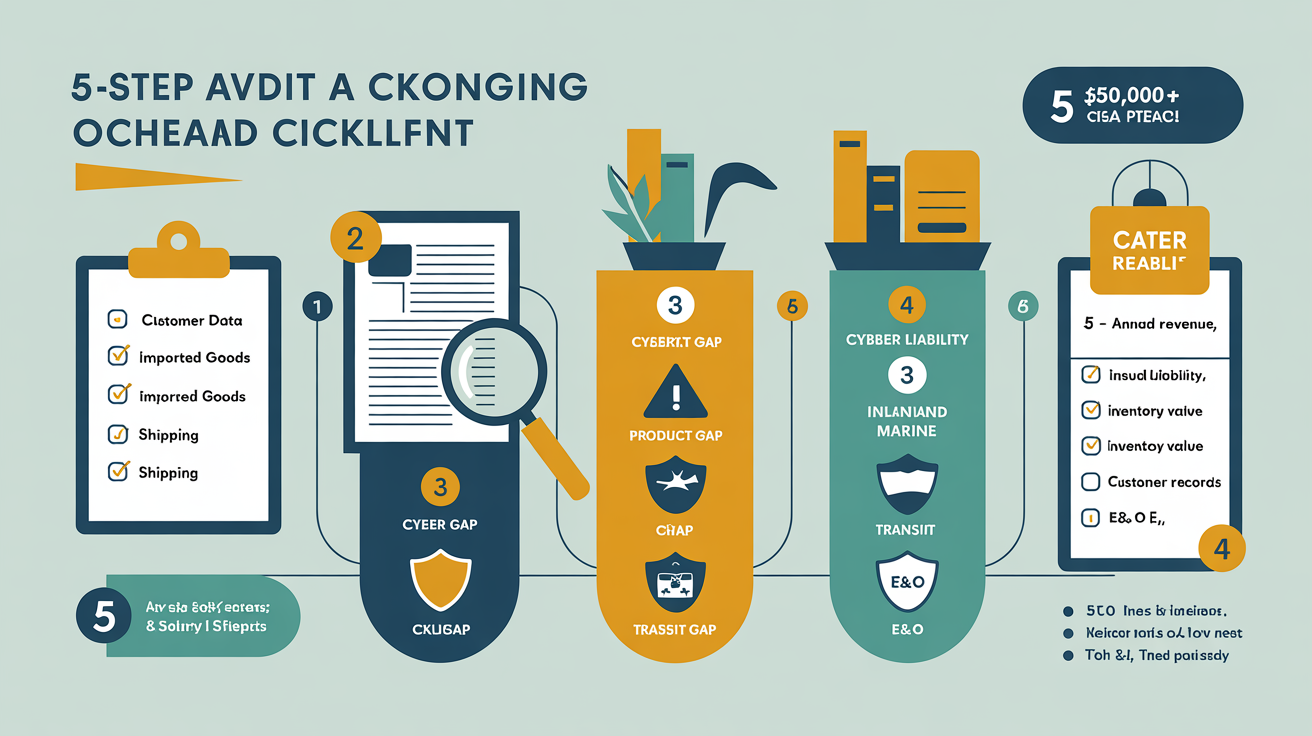
How To Audit Your CGL Coverage In 5 Steps: A Beginner's Gap-Spotting Checklist
By following this audit process, you'll identify exactly where your current or future CGL policy leaves you exposed and what supplemental coverage you actually need. You don't have to buy everything at once, but you'll know what gaps exist and how much they matter to your business.
- List your actual business activities and data flows. Open a blank document and write down everything your business does: Do you store customer payment data or email addresses? Ship goods internationally? Sell imported or white-label products? Process refunds? Offer product advice or recommendations? Handle customer returns? This list is your risk inventory. Success looks like having 8-12 specific activities written down, not generic statements like "we sell online." The more detailed you are, the better you'll spot gaps later.
- Pull your policy's exclusions page and cross-check it against your risk list. If you already have CGL coverage, request the full policy document from your insurer or broker, specifically the exclusions section. If you don't have a policy yet, you can ask for a sample policy when you request a quote. Go line by line and mark any exclusion that overlaps with an activity on your risk list. For example, if you sell imported goods and the exclusion says "products manufactured outside the United States," that's a red flag. Success is identifying at least 3-5 exclusions that directly affect how you operate.
- Identify the three most critical coverage gaps for eCommerce sellers. Research shows that 42% of small business owners have no cyberattack response plan, yet data breaches for small businesses cost $50,000 or more even for limited incidents. The three gaps that matter most are: (1) cyber liability, for data breaches, ransomware, and payment processing failures; (2) product liability for imported goods, especially if you source from overseas suppliers and don't have direct manufacturer liability coverage; and (3) property and business interruption, for inventory loss in transit, warehouse damage, or supply chain disruption. Success is understanding why each gap applies to your model, not just memorizing the list.
- Match each gap to its supplemental coverage type. Cyber liability insurance covers breach response costs, customer notification, credit monitoring, and ransomware recovery. Product liability insurance (or enhanced limits if your base CGL is weak) protects against injury or property damage claims from products you sell. Inland marine insurance covers goods in transit. Professional liability or errors and omissions (E&O) insurance covers advice-based claims. Business interruption insurance covers lost revenue during forced closures. You can reference which policy add-ons ecommerce stores should consider to match your specific gaps to the right coverage types. Success looks like a short list of 2-4 supplemental policies that directly address your identified gaps.
- Gather the business details you'll need to get quotes. Collect: your company name, years in operation, total annual sales figures, number of employees, physical operating addresses, warehouse or fulfillment locations, and estimated inventory value (especially peak season value). If you sell imported products, note the countries of origin. If you process customer data, note how many customer records you store. Have this information ready before you contact an insurer. Success is having a one-page summary you can paste into a quote request without searching for details later.
Once you've completed these five steps, you're ready to move forward. Start with your primary coverage gap, usually cyber liability or product liability, and get a quote. You don't need to buy all supplemental policies on day one. Instead, prioritize based on which risk would hurt most if it happened tomorrow. If a data breach would shut you down, cyber liability is urgent. If a product injury lawsuit could drain your cash reserves, product liability limits matter. Use this audit as your roadmap, then pressure-test the coverages that match your specific business model before committing to any premium.
The Minimum Toolkit For Filling CGL Gaps: Which Supplemental Policies eCommerce Sellers Actually Need
Your commercial general liability policy has significant gaps. The three most critical ones, cyber liability, product liability, and inventory in transit, require separate or bundled coverage to protect your business from losses that would otherwise come out of your pocket.
Cyber Liability Insurance
Cyber liability covers breach notification, forensic investigation, legal defense, and regulatory compliance costs when your customer data is compromised. If you store payment card information, login credentials, or email addresses, you need this coverage. A data breach can cost $5,000 to $50,000 in notification and forensic expenses alone, depending on the number of affected customers and your response protocol.
Basic cyber liability policies for small ecommerce sellers start around $250, $500 annually and typically cover first-party costs (your forensics and breach notification) and third-party costs (customer credit monitoring). Look for policies that include regulatory defense costs, since state attorneys general often investigate breaches. The alternative is self-insuring these costs, a risky choice if you're holding customer data.
Product Liability Insurance
Product liability covers bodily injury or property damage caused by products you sell, including imported goods. You can be liable even if you didn't manufacture the product. In 2021, approximately 11.1 million consumers were treated in emergency rooms for product-related injuries, and many of those claims named retailers in the distribution chain.
Basic product liability coverage runs approximately $500 annually for low-risk products like apparel or home décor. Higher-risk categories, electronics, children's products, supplements, or anything with health claims, carry premiums 3-5 times higher. You can purchase product liability as a standalone policy or add it to your general liability coverage. The key is ensuring your limits match your product risk, not just your revenue.
Inland Marine Insurance
Inland marine insurance covers inventory in transit and at third-party storage locations against theft, damage, and loss. Carrier liability limits are typically capped at $0.50 per pound, which leaves you exposed if you're shipping high-value goods or electronics. If a shipment worth $10,000 is damaged in transit, the carrier reimburses only a fraction of that loss.
This coverage is essential if you use dropshippers, 3PL warehouses, or ship inventory internationally. Premiums vary based on shipment frequency and value, but are often bundled into a business owner's policy at a lower combined cost.
Business Owner's Policy (BOP) as a Bundled Option
A business owner's policy combines general liability, commercial property, and business interruption insurance into one package. For ecommerce sellers, a BOP often costs less than purchasing policies separately. Bundling these three coverages typically saves 15-25% compared to buying individually, with average combined costs around $95, $120 monthly depending on your state and business size.
Many BOPs also allow you to add cyber liability and product liability as optional endorsements. This approach works well if you're just starting and want simplicity. The median cost for a BOP with inventory coverage is approximately $2,000 annually. Monthly payment plans add 4-10% in processing fees, so paying annually saves $140, $190 per year if you can manage the upfront cost.
When evaluating a BOP, confirm that product liability limits are adequate for your product category and that cyber liability can be added. Not all BOPs are identical, some include business interruption coverage and others don't, so compare policy terms before committing.
---Sources:
- NerdWallet / Coverdash data on median annual insurance costs for online retailers
- U.S. Consumer Product Safety Commission (CPSC) emergency room treatment data, 2021
- Insurance cost comparisons across states for business owner's policies
- Inland marine insurance coverage details from commercial property insurers
5 Mistakes Beginners Make When Relying On A CGL Policy, And How To Avoid Each One
The biggest mistake beginners make is assuming Commercial General Liability covers everything their business needs. It doesn't. CGL protects you from third-party bodily injury and property damage claims tied to your operations, but it has hard limits that leave you exposed in ways you won't until a claim arrives.
Mistake 1: Thinking CGL Covers Data Breaches
CGL explicitly excludes cyber liability. If your website stores customer payment data, email addresses, or login credentials and you suffer a data breach, you'll pay breach notification costs, averaging $20 per compromised customer record, entirely out of pocket. A breach affecting 1,000 customers costs $20,000 in notifications alone before legal fees or regulatory penalties. This exposure grows the moment you collect personal information, yet most beginners buy only CGL and assume they're protected.
Add cyber liability insurance to your policy immediately. Cyber coverage is inexpensive (typically $300, $500 annually for basic plans) and covers notification costs, credit monitoring, legal defense, and regulatory fines. Don't wait until you've collected customer data, add it before your first sale.
Mistake 2: Confusing CGL With Product Liability
CGL covers third-party bodily injury from your business operations, a customer trips at your pop-up event or your fulfillment activity damages their property. Product liability covers harm caused by the products you actually sell. If a customer suffers an allergic reaction to a dye in a garment you're dropshipping, or a child chokes on a component of a toy you imported, that's a product liability claim. CGL won't respond. Many beginners buy CGL, assume they're covered for product defects, and too late that they're not.
Purchase product liability coverage as a standalone policy or as an add-on to your CGL. This is non-negotiable if you sell physical products. In 2021, emergency rooms treated 11.1 million consumers for product-related injuries, and online sellers were named in those lawsuits. Product liability typically costs $500, $1,500 annually depending on product category and sales volume.
Mistake 3: Ignoring Inventory-in-Transit Risk
CGL does not cover goods damaged, lost, or stolen during shipping. Carrier liability is capped at $0.50 per pound, meaning a $10,000 shipment of electronics receives only a fraction of that value in reimbursement if damaged in transit. Beginners often assume their insurance covers this gap and ship high-value inventory without additional protection, only to their loss is uninsured.
Purchase inland marine insurance before shipping high-value goods. This coverage protects inventory in transit and in 3PL warehouses. It's typically bundled into a business owner's policy at a lower combined cost than purchasing separately, and premiums vary based on shipment frequency and value.
Mistake 4: Skipping Professional Liability for Advice-Based Services
If you provide product guidance, styling advice, or recommendations as part of your service, common among dropshippers and subscription box curators, you need Errors & Omissions (E&O) coverage. CGL explicitly excludes claims arising from professional advice. A customer who follows your recommendation and suffers harm can sue for negligent guidance. CGL won't defend you.
If your business includes advice, recommendations, or consulting services, add professional liability coverage to your policy. E&O protects you from claims of negligent advice, misrepresentation, or failure to perform services as promised. Costs are modest, typically $400, $800 annually, and the coverage is essential if you're positioning yourself as an expert.
Mistake 5: Assuming Platform Membership Protects You Legally
Amazon, Shopify, Etsy, and other platforms do not protect you if a customer sues. Platform agreements explicitly state that sellers are responsible for their own liability. When a claim arrives, the platform may suspend your account pending proof of insurance, disrupting your revenue while you scramble to buy coverage. Beginners often delay purchasing insurance because they believe marketplace membership provides protection.
Buy CGL and product liability before reaching platform sales thresholds. Amazon.com requires commercial liability insurance within 30 days of exceeding USD $10,000 in gross proceeds in any month. From November 2, 2026, enhanced-safety listing categories require at least USD $1 million per occurrence and in aggregate regardless of sales. Shopify and Etsy don't mandate it, but both require proof of insurance if claims arise. Get coverage in place early and maintain a current certificate of insurance. This prevents account suspension and keeps your sales flowing uninterrupted.

Know Your Gaps, Then Fill Them: Your Next Steps After Reading This Guide
Commercial general liability is a strong foundation, but it was not built for the digital risks eCommerce sellers face. Platform requirements, customer data breaches, and product liability claims arrive without warning, and standard CGL leaves you exposed on all three fronts. Start by running yourself through the audit checklist from Section 3. It takes 15 minutes and gives you a clear picture of which gaps matter most to your business.
Focus your first month on three supplemental coverage types: cyber liability to protect customer data and business interruption, product liability to cover defects and injury claims, and inland marine coverage for inventory in transit and storage. These three address the vulnerabilities that affect most online sellers. Once you identify which apply to your operation, compare quotes from multiple underwriters. Costs vary widely, and your sales volume, product type, and platform requirements all affect pricing.
You're ahead of 42 percent of small business owners who have no cyberattack response plan simply by reading this guide and identifying your gaps. Next, explore how product and general liability affect your online store's bottom line, then move to comparing online insurance options and picking the best one for your needs.
Pay-as-you-sell general liability insurance designed specifically for eCommerce. Premiums starting from just $26 per mon...
Premiums from $26/month
Learn MoreFrequently Asked Questions

Rohit Nair is the CEO and Founder of Assureful, an insurtech venture creating smart insurance products for ecommerce businesses. With a track record of launching and scaling successful ventures across health, wellness, ecommerce and consumer technology, with multiple exits and acquisitions, Rohit brings deep expertise in financial management, regulatory environments, and high-growth startups.
For more on this topic, see our guide to eCommerce business insurance.
Related: How Much Is Commercial General Liability Insurance? What It Covers.
Related: What Does Commercial General Liability (CGL) Insurance Cover? A Cost.
Sources
- levertylaw.com
- pattersonlawfirm.com
- vouch.us
- nerdwallet.com
- seo-pages-web.vercel.nerdwallet.com
- shopify.com
- iii.org
- embroker.com
- moneygeek.com
- fitsmallbusiness.com
- thehartford.com
- forbes.com
- hotalinginsurance.com
- landesblosch.com
- uschamber.com
- policyape.com
- investopedia.com
- adventuresportsinsurance.cbiz.com
- berxi.com
- nextinsurance.com
- nerdwallet.com
- thimble.com
- nextinsurance.com
- insureon.com
- thehartford.com
- ace.aaa.com
- thehartford.com
- totalcsr.com
- bluecrossnc.com
- irmi.com
- assureful.com
- insureon.com
- thimble.com
- taxjar.com
- moneygeek.com
- thesmokedrop.com
- controlhub.com
- blog.hubspot.com
- dealhub.io
- 1800insurance.com
- mailchimp.com
- flashpricer.com
- co-opinsurance.com
- nextinsurance.com
- simplybusiness.com
- redrockinsure.com
- insurancecanopy.com
- jmg.com
- ecom.insure
- payoneer.com
- pixelunion.net
- withpocket.com.au
- regulaforensics.com
- insureon.com
- thelawspot.com
- moensheehanmeyer.com
- dealhub.io
- uhc.com