

Most eCommerce sellers pay $350, $1,200 per year (about $23, $73/month) for Commercial General Liability insurance, with a national median near $850/year and higher-risk or high-volume sellers often paying $1,500, $2,000+ annually. Premiums are driven by product category, revenue, fulfillment region, prior claims, and platform requirements; pay-as-you-sell policies typically cut costs by roughly 40% (up to ~42%) versus fixed annual policies, while imported goods, supplements, electronics, children’s products, multi-channel or international sales, and claim histories raise rates.
- Commercial General Liability Insurance: Average Cost Range and...
- What Most Sellers Pay for CGL Insurance: Typical...
- Breaking Down CGL Insurance Costs: Product Liability, Advertising...
- Hidden and Unexpected Costs: Fees, Gaps, and Missed...
- How to Lower Your CGL Insurance Costs: Practical...
- CGL Cost Recap: What Most Sellers Pay and...
Commercial General Liability Insurance: Average Cost Range and Key Pricing Factors for eCommerce Sellers
Most eCommerce sellers pay $350, $1,200 per year for Commercial General Liability (CGL) insurance. Monthly rates typically start at $23, $30, with some providers quoting as low as $21 and others closer to $82 in higher-cost states. Sellers with higher-risk products or large sales volumes can see annual costs reach $2,000 or more . Pay-as-you-sell insurance often lowers premiums by up to 42% compared to traditional fixed policies .
Your premium varies based on what you sell, how much you sell, and where your business operates. Selling imported goods, having a history of claims, or needing to meet strict platform requirements, like those set by Amazon, pushes prices higher. Risk stays lower for shops with a clean claims record, lower sales volume, and U.S.-only distribution.
Key price drivers: product category, revenue, fulfillment region, prior claims, and sales channel requirements. For more details on coverage types and real pricing scenarios, see our guide on what you should expect to pay or compare benchmarks and ways to lower your costs.
What Most Sellers Pay for CGL Insurance: Typical Premiums, Outliers, and the Impact of Your Sales Model
Most eCommerce sellers pay between $350 and $1,200 per year for compliant general liability insurance. That’s about $23 to $73 monthly, with the national median near $850 per year. The range is wide, your actual premium depends on risk factors, claims history, what you sell, and where you operate. Sellers using pay-as-you-sell insurance see roughly 40% lower premiums than those on fixed annual policies, since costs track real sales instead of forecasts.
Low-risk sellers, think simple products, no claims, U.S.-only shipping, see the lowest rates, sometimes under $30 per month. At the other end, premiums climb to $1,500, $2,000 or more per year for higher-risk categories: supplements, electronics, children’s goods, or imported products. Claims history and international or multi-channel operations push costs even higher.
Your sales model drives the pricing structure. Traditional policies set annual premiums upfront, so you lock in costs based on projections. If your sales slow, you still pay the same. If you grow faster than expected, you can face coverage gaps. With pay-as-you-sell CGL insurance, premiums adjust monthly to actual revenue. You pay only for what you sell. Seasonal spike? The premium rises, then falls again with your sales. No annual forecasts. No overpaying. No stress when scaling. Location matters too, California and New York average $82, $85 monthly, while Maine and Alaska stay closer to $64, $65.
- Entry-level, low-risk sellers: $350, $500 per year ($23, $42 per month)
- Typical eCommerce stores (average risk): $850, $1,200 per year ($72, $100 per month)
- High-volume or higher-risk category sellers: $1,500, $2,000 per year ($125, $167 per month)
- Multi-channel or international sellers, or recent claims: $2,000+ per year (often $200+ per month)
- By state: Lowest in Maine/Alaska ($64, $65 monthly), highest in California/Nevada/Louisiana ($82, $84 monthly)
Your insurance cost ties directly to your product category, sales channels, and loss record. See our guide on how liability insurance influences your store’s costs for details on general and product liability impacts. For benchmarks and a monthly vs. annual payment breakdown, check the eCommerce insurance pricing guide.
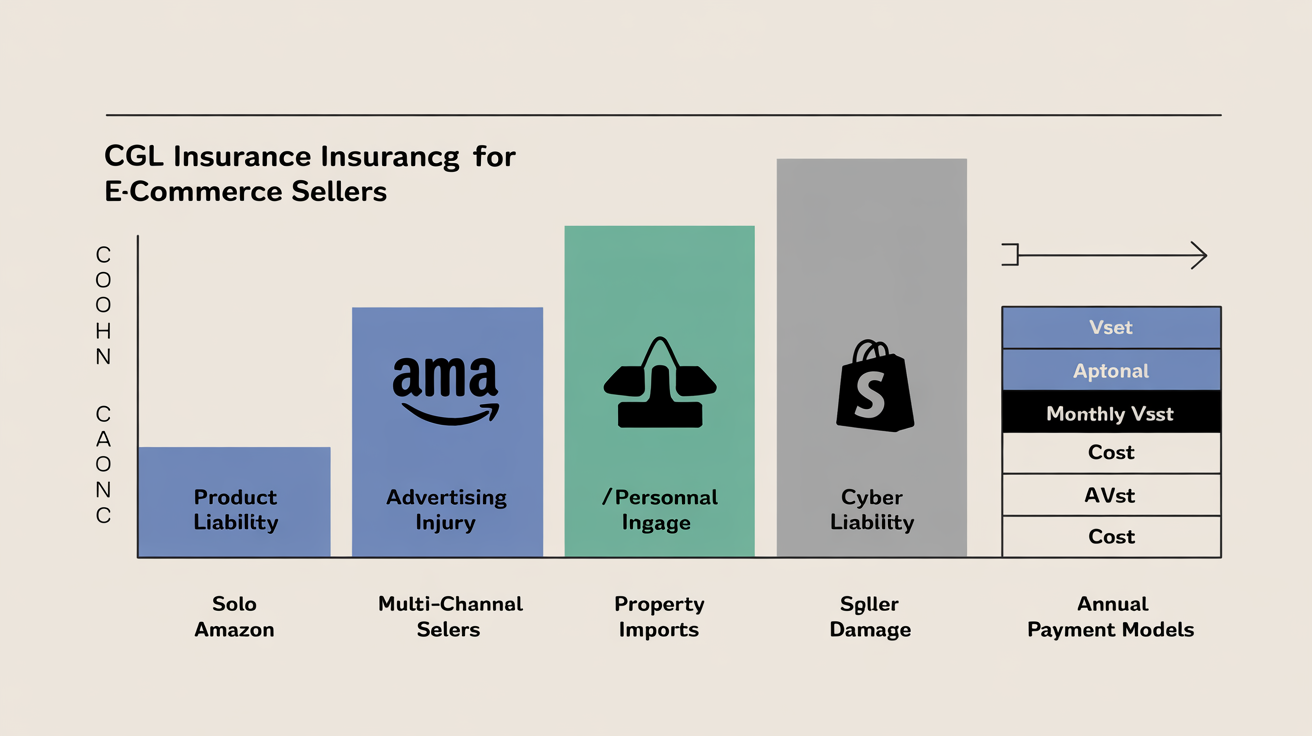
Breaking Down CGL Insurance Costs: Product Liability, Advertising Injury, Property Damage, and More
Product liability drives most of the premium for eCommerce sellers. Expect this coverage to account for 50-70% of your total cost, especially if you import, rebrand, or handle higher-risk products. More risk, more volume, or less control over manufacturing? Your product liability portion climbs fast.
| Coverage Category | Typical Cost Range (Monthly) | Main Cost Factors | Notes |
|---|---|---|---|
| Product Liability | $35, $110 | Product type, claims history, imports | Largest share for eCommerce sellers |
| Personal & Advertising Injury | $8, $23 | Sales channels, advertising spend | Copyright and slander risks |
| Property Damage | $6, $18 | Inventory, warehouse space | Third-party property only |
| Medical Payments | $3, $10 | Foot traffic, claims history | Low for online-only sellers |
| Cyber Liability (add-on) | $51, $64 | Data volume, cyber controls | Optional; can exceed $70 with retail/POS |
Product Liability
This is where most of your premium goes. Selling apparel or home decor? Expect $35, $55 per month. Supplements, electronics, cosmetics, or children's goods, especially with imports, push costs to $85, $110 and up. Claims history matters. One recall or lawsuit can raise your rates for years. For details, see our product liability insurance cost data.
Private label and imported products always cost more since you’re treated as the U.S. manufacturer. Selling on multiple platforms or under your own brand also increases your premium.
Personal & Advertising Injury
This covers slander, libel, and copyright claims tied to your marketing. Monthly rates fall between $8, $23. Paid ads, influencer campaigns, and branded content push costs higher. Marketplace-only sellers with simple listings pay less. Sellers with email, blogs, or social channels pay more due to added risk exposure.
Property Damage
CGL property damage covers claims for damage you cause to someone else’s property, never your own stock. Expect $6, $18 each month. Rates stay lowest for online-only sellers, but rise for those with warehouse staff or retail events. Coverage limits (often $100,000, $500,000) and your claims history affect price. For coverage on your own business property, see our guide to what CGL does not cover.
Medical Payments
Medical payments cover third-party injuries from your business operations, regardless of fault. Typical cost: $3, $10 per month. Online-only sellers pay at the low end. Warehouses or on-site events? Expect higher rates. Limits usually run $5,000, $10,000 per incident, built for minor accidents to avoid lawsuits.
Cyber Liability (Optional Add-On)
Cyber coverage isn’t standard in most CGL policies. If you store customer data, accept payments, or use connected devices, expect $51, $64 monthly. Retailers or sellers with high data volume can see $70 or more. Key drivers: multi-factor authentication, data encryption, past claims, and how much sensitive information you handle.
- Standalone cyber coverage: $57/month on average
- With BOP or bundled discount: $48, $54/month
- High-risk (medical or financial data): $80+/month
Bundling cyber with CGL or property can cut overall cost by 5-10%. Predictable pricing for stores with payment and data exposure.
Hidden and Unexpected Costs: Fees, Gaps, and Missed Savings in Your CGL Policy
The most costly surprise? Claims your policy doesn’t cover. One major loss outside your coverage, like a cyberattack or an international product lawsuit, can force you to pay $25,000 or more from your own pocket. Most sellers spot these gaps only after a claim gets denied and the bill arrives.
Policy Exclusions and Coverage Gaps
Most CGL policies leave out entire risk categories. Cyberattacks, product recalls, professional mistakes, and international shipping disputes often aren’t covered. A data breach with $50,000 in notification costs or regulatory fines? Unless you’ve added a cyber endorsement, your CGL pays nothing. An international lawsuit? If your policy only covers U.S. sales, that claim’s denied too. Review every exclusion, don’t just scan the summary. Expect to budget 15-30% above your premium for these risks, or price out add-on coverage before you commit.
Broker, Administrative, and Change Fees
Extra charges often hide in the fine print. With brokers or traditional carriers, expect:
- Broker commissions: 10-18% of your annual premium
- Policy issuance fee: $50, $150 each year
- Mid-term change fees: $25, $85 for updates, address, limits, additional insureds, and more
- Cancellation fee: $50, $200 if you exit before term ends
Run the numbers. Multiple policy changes or a switch at renewal can push your costs far above the sticker price.
Premium Increases After a Claim
File a claim, even for something minor, and your renewal premium can jump 15-40% the next year. Serious or repeat claims drive costs higher. Insurers rarely warn you about this up front. A $600 premium might spike to $800 or more after a slip-and-fall payout. Keep your record clean and use risk management best practices to avoid these hikes.
Business Interruptions and Uninsured Opportunity Costs
Lost sales from shutdowns? Standard CGL won’t help unless you’ve bought business interruption insurance. For eCommerce, a five-day site outage or warehouse closure means $5,000, $20,000 in lost revenue you won’t get back. Supply chain breakdowns triggered by a vendor? Usually not reimbursed. Factor these gaps into your planning, and check common product liability mistakes that drive uninsured costs.
How to Lower Your CGL Insurance Costs: Practical Steps for Sellers and Realistic Savings
The fastest way to cut your liability insurance bill: switch to pay-as-you-sell. Sellers moving from annual forecasts to monthly, sales-based billing typically save 35-42%. No inflated estimates. No waiting for credits, you pay for actual revenue, not a guess.
- Adopt pay-as-you-sell billing: Move to monthly billing tied to real sales instead of annual projections. This keeps insurance costs aligned with market cycles and cuts overpayment by 35-42% per year for most eCommerce sellers. (See a real-world case study here.)
- Choose only the coverage limits you need: Avoid defaulting to high aggregate limits unless your retail partners require them. Adjusting limits to fit your sales volume and risk can lower your premium by 20-30%.
- Bundle product and general liability policies: Combining coverages under one policy or carrier can qualify you for multi-policy discounts, usually saving 10-15% compared to separate plans.
- Provide detailed, accurate product documentation: Share full specs, quality controls, and supply chain details. Clear documentation lowers perceived risk, underwriters price you at the low end of their range, often 5-15% less than sellers with gaps.
- Maintain a clean claims history: Three or more years without a claim can access loss-free discounts or prevent renewal surcharges. A single claim can raise your next premium by 15-40%. Proactive risk management matters. See tactical steps in this guide to structure and compliance choices.
- Use platform integrations for compliance and admin automation: Linking your insurance to Amazon, Shopify, or similar channels automates certificate delivery and compliance checks. Expect $250, $500 in annual admin or broker fee savings.
Lowest cost isn’t always best value. Underinsuring, missing exclusions, or working with slow carriers can cost far more in denied claims or compliance penalties. Aim for the right coverage at the right price, not just the cheapest quote.

CGL Cost Recap: What Most Sellers Pay and the Top Tip for Affordable Protection
Most eCommerce sellers pay $400 to $1,200 per year for fully compliant commercial general liability (CGL) coverage, depending on product type, sales, and claims history. Those numbers reflect what online stores report on major platforms. Your premium depends on sales volume, risk profile, and coverage limits, there’s no universal rate, but this range captures the bulk of actual costs.
To keep premiums down, use a pay-as-you-sell method. Your coverage matches real monthly revenue, so you avoid overpaying for unused protection. On average, this approach cuts CGL insurance costs by around 40% compared to fixed annual plans.
Expect to budget $30 to $100 per month, with higher costs if you add riskier products or scale up operations. Before renewal, check your sales and policy details to avoid paying for coverage you don’t need or missing risks you now face. For a step-by-step on getting coverage and what to review, see our guide to buying business insurance.
Frequently Asked Questions
Does general liability cover cyberattacks or data breaches?
No, standard commercial general liability (CGL) policies typically exclude cyber liability and data breaches. Cyber insurance and data-breach policies are separate: data-breach coverage pays first-party costs like customer notification and credit monitoring, while cyber liability also covers third-party legal defense, regulatory fines, ransom payments and business-interruption losses (and many insurers offer combined cyber/data policies).
Is product liability included in standard CGL for eCommerce?
Yes, standard Commercial General Liability (CGL) policies typically include "products and completed operations" coverage that responds to third‑party claims for bodily injury or property damage caused by products you sell online. However, CGL commonly excludes product recalls and may have restrictive endorsements or low limits, so many e‑commerce sellers (especially importers, private‑label brands, food/children’s products or electronics) buy a standalone product liability policy or higher limits (marketplaces commonly require $1M+ per occurrence).
What coverage limits do Amazon and Shopify require?
Amazon: sellers are typically required to carry at least $1 million per occurrence commercial general liability (CGL) and to name Amazon as an additional insured (higher limits or proof of product liability may be required for certain categories or high‑volume/Pro merchants). Shopify: Shopify does not impose a platform‑wide minimum, insurance is the merchant’s responsibility, though payment processors and enterprise contracts commonly expect ≥$1M CGL and brokers recommend scaling limits for larger sellers (e.g., $10M+ GL, $25M product liability and $25M+ cyber) based on revenue and data exposure.
How does 'pay-as-you-sell' insurance billing actually work?
Pay-as-you-sell billing charges a monthly premium based on your actual sales (typically the prior month) instead of an annual forecast, so your cost scales down in slow periods and up as revenue increases. The insurer or platform usually integrates with your sales channels to verify revenue, an underwriting/pricing team applies the policy rate and exclusions to produce the monthly bill, and you’re billed monthly with the option to cancel on 30 days’ notice. Claims are handled like a normal policy, payouts equal the verified loss minus your deductible (and any depreciation), up to the policy limit, and these products are commonly directly underwritten by A‑rated carriers with instant quotes and automated certificates.
Does my CGL policy cover injuries or property damage that occur at trade shows, pop-up shops, or customer pickup locations?
Yes, a standard CGL typically covers third‑party bodily injury and third‑party property damage that occurs at trade shows, pop‑up shops, or customer pickup locations when the harm arises from your business operations or premises. It does not cover employee injuries (those are for workers’ compensation), damage to your own property, or losses excluded by endorsements (common exclusions include autos, professional services, and pollution), and coverage depends on your policy’s limits, territory and form (occurrence vs. claims‑made). Confirm additional‑insured status/certificates with event organizers and review endorsements or buy a short‑term event/product/completed‑operations endorsement if needed.
How does selling or shipping internationally affect my CGL premiums and are there limits or exclusions for overseas sales?
Yes, selling or shipping internationally usually raises CGL premiums because insurers view exports as higher legal exposure (different liability laws, larger damage awards) and added transit/handling risks, so carriers often charge surcharges or require higher limits. Standard ISO CGL territory is typically the U.S., its territories and Canada, and coverage for overseas sales is commonly restricted, sub-limited, or excluded unless you buy a worldwide products-liability endorsement, a foreign/local liability policy, or marine cargo insurance; many brokers recommend raising the common baseline limits (e.g., $1M per occurrence/$2M aggregate) for export-facing businesses. Also watch for specific exclusions (suits in foreign courts, punitive damages, war/sanctions, pollution) that may apply to overseas transactions.
Will a standard CGL policy cover purely financial losses (like warranty claims, refund demands, or contract disputes) when there is no bodily injury or property damage?
No, a standard Commercial General Liability (CGL) will not cover purely financial losses like warranty claims, refund demands, or contract disputes when there is no bodily injury or property damage. CGL coverage is triggered by bodily injury, property damage, or certain named “personal and advertising injury” claims; purely economic loss and contract/warranty breaches are generally excluded unless you have a specific contractual-liability endorsement or other tailored coverage. Those exposures are typically covered by contract liability endorsements, commercial crime, or professional/errors & omissions policies rather than a standard CGL.

Rohit Nair is the CEO and Founder of Assureful, an insurtech venture creating smart insurance products for ecommerce businesses. With a track record of launching and scaling successful ventures across health, wellness, ecommerce and consumer technology, with multiple exits and acquisitions, Rohit brings deep expertise in financial management, regulatory environments, and high-growth startups.
Related: What Is Not Covered By The Commercial General Liability (CGL).
Related: How Much Is Commercial General Liability Insurance? What It Covers.
Sources
- insureon.com
- fitsmallbusiness.com
- 1800insurance.com
- seo-pages-web.vercel.nerdwallet.com
- nerdwallet.com
- moneygeek.com
- assureful.com
- hotalinginsurance.com
- ecom.insure
- shopify.com
- flashpricer.com
- vouch.us
- jmg.com
- nextinsurance.com
- mailchimp.com
- payoneer.com
- moneygeek.com
- forbes.com
- policyape.com
- simplybusiness.com
- esportsinsurance.com
- geico.com
- geico.com
- investopedia.com
- thehartford.com
- progressivecommercial.com
- nextinsurance.com
- morganinsurancebrokers.com.au
- insureon.com
- gosuperscript.com
- aami.com.au
- progressivecommercial.com
- progressivecommercial.com
- progressivecommercial.com
- adventuresportsinsurance.cbiz.com
- assureful
- well-insurance.com
- levertylaw.com
- insureon.com
- uschamber.com
- uschamber.com
- checklistguro.com
- hubinternational.com
- uhc.com
- insureon.com
- hulettinsuranceblog.com
- quora.com
- noblepagroup.com
- connect.bcbsil.com
- getebm.com
- baldwin.com
- insureonthespot.com
- insureonthespot.com
- insurify.com
- insure.com
- kin.com
- cnbc.com
- allstate.com
- geico.com
- nerdwallet.com
- macombinjurylawyers.com
- statefarm.com
- progressivecommercial.com
- fastercapital.com
- travelers.com
- priceramey.com
- geico.com
- sharepointcu.com
- reddit.com
- usnews.com
- bankrate.com
- landesblosch.com