
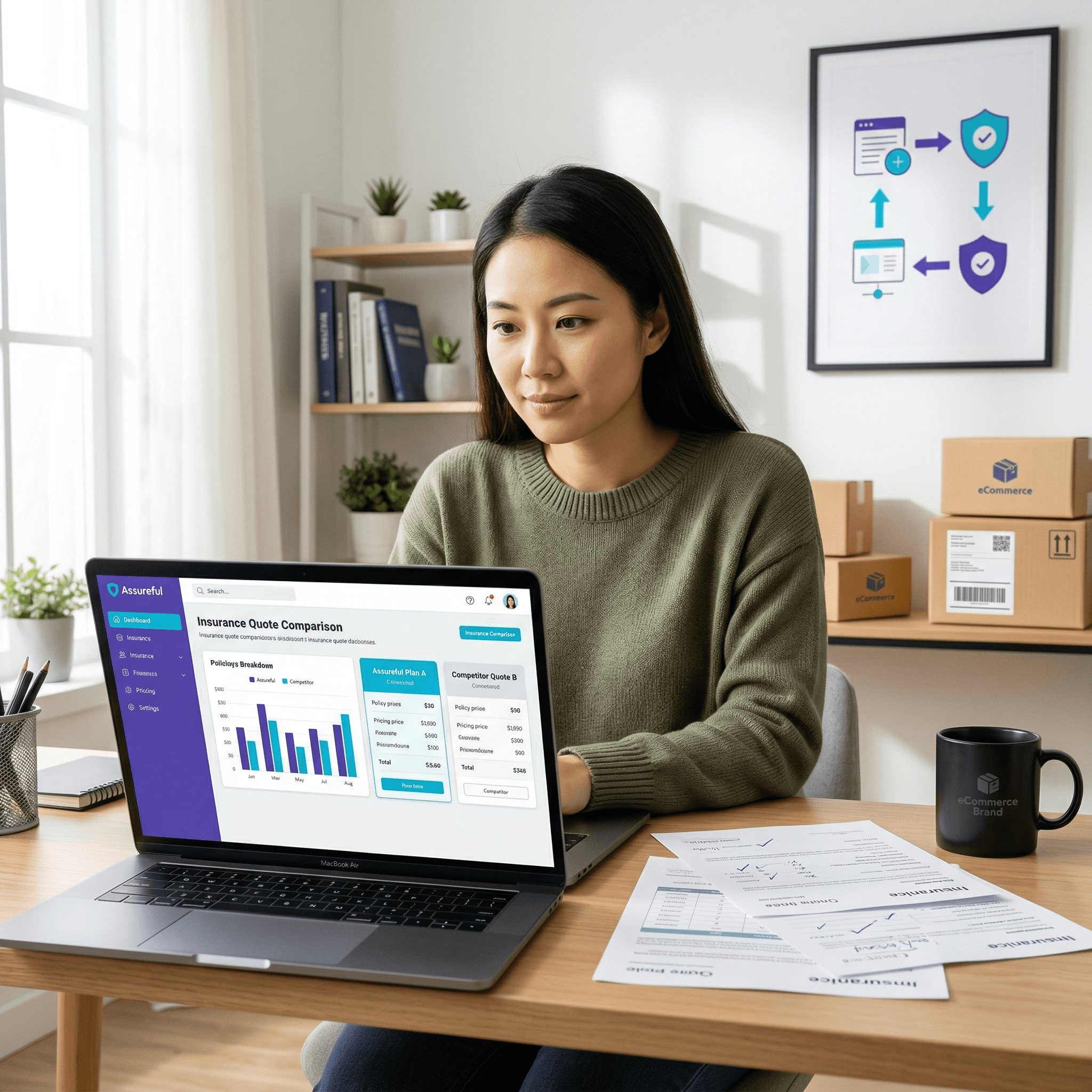
Most ecommerce businesses pay $350, $2,500/year for commercial general liability insurance (about $29, $208/month), with new stores usually at the lower end (often $350, $600/year for low‑risk goods like apparel or books). Premiums rise mainly with product risk (supplements, electronics, baby products), higher sales volume, marketplace requirements (Amazon/Shopify), and location (states like CA or NY can add ~20-40%), and high‑risk/high‑volume sellers commonly pay $3,000, $8,000/year.
- Ecommerce Business Insurance Costs: What Most New Stores...
- How Much Do Ecommerce Sellers Actually Pay? Averages,...
- Breaking Down Ecommerce Insurance Costs: General Liability, Product...
- The Hidden Costs of Ecommerce Insurance: Fees, Compliance,...
- How To Cut Your Ecommerce Insurance Costs: Real...
- Key Takeaways: What To Budget (And The Easiest...
Ecommerce Business Insurance Costs: What Most New Stores Spend (And Why It Varies)
Most ecommerce businesses pay between $350 and $2,500 per year for general liability insurance. Monthly premiums often start around $26. New stores usually land at the lower end, but costs can rise based on what you sell and where you’re located. These figures reflect typical pricing from A‑rated underwriters across the U.S.
Your premium depends on a few main factors. Product category matters most, selling supplements or electronics usually costs more than apparel or books. Projected or actual sales volume impacts your rate, too. Some platforms, like Amazon or Shopify, require specific coverage types or higher policy limits, which can increase your premium. Location makes a difference; insurance rates shift by state due to local legal requirements and claim trends.
Expect your quote to reflect product risk, sales volume, and platform compliance. For detailed benchmarks or a compliance checklist, see the linked resources for ecommerce sellers.
How Much Do Ecommerce Sellers Actually Pay? Averages, Typical Ranges, and Outliers
Ecommerce sellers usually pay $350 to $2,500 per year for commercial general liability insurance. That’s $29 to $208 monthly. Most new stores skew toward the lower end. Sellers handling higher revenue or riskier products, think supplements or electronics, often see prices top $3,000 annually.
Product category drives the biggest cost differences. Low-risk goods like books or apparel? Premiums often land in the $350, $500 range. Supplements, electronics, or baby products get quoted much higher, sometimes double or triple the baseline. Sales matter, too. A store earning $50,000 pays far less than one at $500,000, since most policies scale with either revenue or product risk.
Location and business structure factor in. States with higher litigation rates, such as California or New York, push rates 20-40% above the national average. Single-member LLCs or sole proprietors may see a small discount, but the gap closes as revenue rises. For a closer look at how liability types affect total cost, see this guide on how product and general liability affect your bottom line.
- Low-risk, low-volume (apparel, books): $350, $600/year ($29, $50/month)
- Average risk, moderate sales (home, kitchen, pet): $650, $1,200/year ($54, $100/month)
- Higher-risk (electronics, toys, supplements): $1,200, $2,500/year ($100, $208/month)
- High-volume or multi-channel: $2,000, $3,500/year ($167, $292/month)
- Outliers (high-risk, high-sales): $3,000, $8,000/year ($250, $667/month)
Premiums above these ranges reflect a blend of high product liability, rapid sales growth, or stricter marketplace insurance rules. For current benchmarks and details on what coverage includes, compare recent rates from other A‑rated providers and review typical commercial general liability costs.
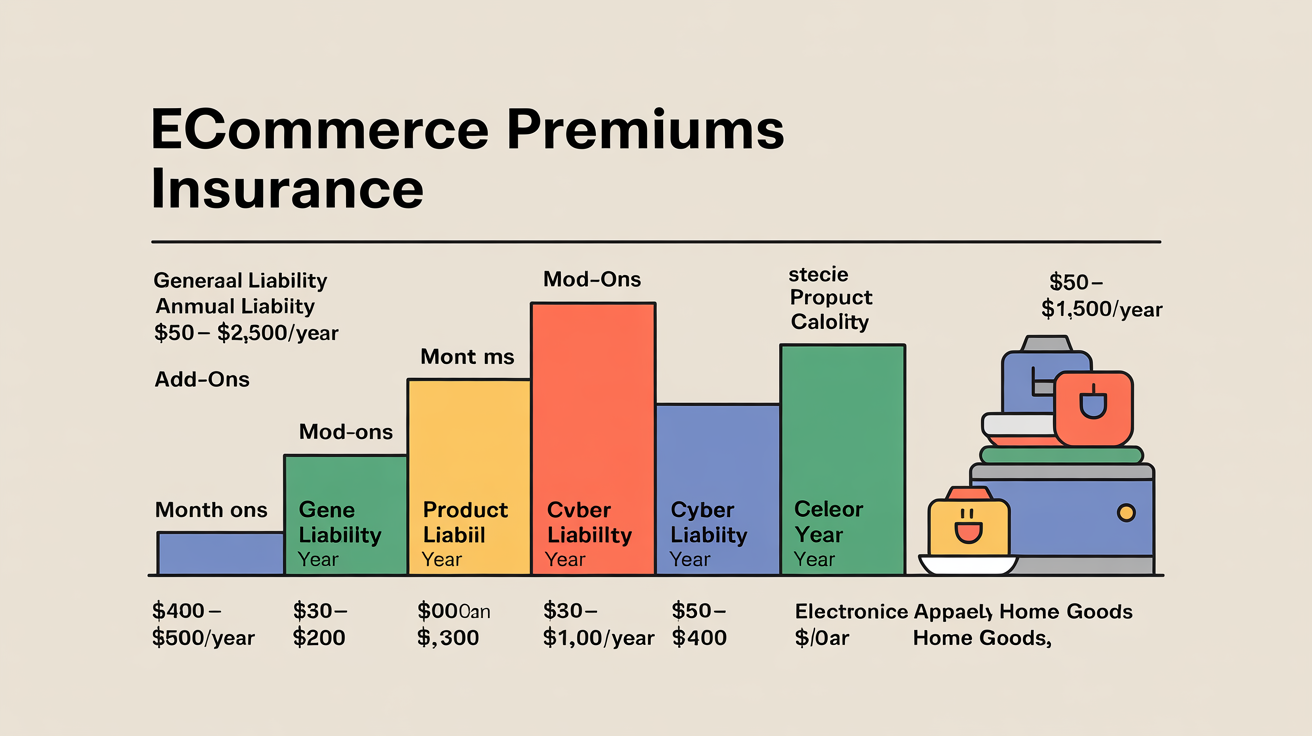
Breaking Down Ecommerce Insurance Costs: General Liability, Product Liability, and Add-Ons Compared
Product liability is usually the largest insurance expense for ecommerce sellers. Expect $700 to $3,000 per year, shaped by your product type, sales volume, and risk category. If you sell higher-risk goods or scale revenue, product liability quickly becomes the main driver of your total insurance spend.
| Coverage Type | Low-Risk Category (e.g., Apparel, Home) | High-Risk Category (e.g., Electronics, Supplements) | Typical Annual Sales Under $100K | Typical Annual Sales $100K, $500K |
|---|---|---|---|---|
| General Liability | $350, $600 | $700, $1,200 | $350, $500 | $800, $1,200 |
| Product Liability | $700, $1,000 | $1,500, $3,000 | $700, $1,200 | $1,500, $2,500 |
| Cyber Liability | $500, $900 | $1,200, $2,000 | $500, $1,000 | $1,200, $2,000 |
| Add-Ons (per rider) | $75, $250 | $150, $500 | $100, $250 | $200, $500 |
General Liability Insurance
General liability covers third-party bodily injury, property damage, and basic slip-and-fall claims. Most ecommerce businesses pay $350 to $1,200 per year, or $29 to $100 per month. Costs rise with higher web traffic, trade show participation, or inventory stored in commercial spaces. Adding coverage for rented property or advertising injury pushes premiums up. Marketplace contracts and warehouse leases often set minimum requirements, $1 million coverage is common and bumps rates by 10-20% above baseline.
Product Liability Insurance
Product liability insurance protects you from lawsuits over injury or damage caused by products you sell, even if you didn’t make them. Expect $700 to $3,000 each year. Sellers of children’s goods, electronics, or ingestible products pay at the top end. Premiums climb with sales volume: under $100,000 keeps your cost lower; above $500,000, rates can double or triple. Importing, private label sales, or operating in regulated categories also drive costs higher. Bundling with general liability usually saves 15-25% over separate policies.
Cyber Liability Insurance
Cyber liability covers costs tied to data breaches, ransomware, or payment system losses. Typical rates run $500 to $2,000 per year. Small stores with under $100,000 in sales start around $500, $900. Handling lots of customer data or high transaction volumes? You’ll pay closer to $2,000. Selling into Europe or handling medical/financial data increases premiums by 30-50% due to stricter regulations.
Common Add-Ons and Riders
Add-ons cover risks not included in standard policies: business interruption, inventory in transit, cyber extortion. Each rider adds $75, $500 per year, depending on scope and risk. The most common for ecommerce sellers:
- Business interruption: $150, $350/year
- Inventory/inland marine: $100, $400/year
- Additional insured endorsements (landlords/marketplaces): $75, $150/year
Stacking multiple riders can increase your premium by 10-25%.
How Platform Requirements Affect Your Cost
Amazon, Shopify, and other marketplaces usually require $1 million per occurrence for general and product liability. If your policy is below this, upgrading often adds $200, $500 per year. Selling internationally or using cross-border fulfillment pushes premiums up by 15-50%, depending on the regions you serve. Marketplaces also dictate some add-ons, like naming the platform as an additional insured. Staying fully compliant means factoring these costs in from the start.
The Hidden Costs of Ecommerce Insurance: Fees, Compliance, and Sneaky Price Traps
Miss a proof-of-insurance deadline and your Amazon or Shopify store can go dark, just one gap can halt sales for days. That lost revenue often dwarfs your yearly premium. Even careful sellers run into “small” charges: admin surcharges, change fees, compliance add-ons. These stack up fast, expect $100, $400 in extras over a year.
Administrative and Payment Processing Fees
Monthly payment plans tack on 4-10% in processing fees compared to annual pay. For a $1,200 policy, spreading payments adds $50, $120. Some insurers charge annual admin fees ($20, $75), reissuing documents ($15, $50 each), or rush certificate fees ($25, $50). These costs often hide in the fine print, scrutinize your itemized quote to avoid billing surprises.
Compliance and Platform-Driven Costs
Marketplaces demand strict paperwork: proof of insurance, specific limits, document uploads on time. Miss a deadline on Amazon and risk a 1-3 day suspension, hundreds or thousands lost. Each amended certificate or extra insured endorsement runs $75, $150. Expanding internationally or adding fulfillment centers triggers premium hikes of 15-50% as risk grows. Scrambling last minute? Expect extra fees.
Policy Changes, Endorsements, and Add-Ons
Mid-policy tweaks come at a cost. Adjusting coverage, raising limits, adding products, usually means a $25, $100 fee per change. Common add-ons:
- Additional insured endorsements: $75, $150 each
- Business interruption rider: $150, $350 per year
- Inventory/inland marine rider: $100, $400 per year
- Certificate reissuance: $15, $50 each
Need multiple changes in a year? These charges add up. Set coverage right at the start to avoid repeated adjustments.
The Cost of Under- or Over-Insuring
Underestimate your sales or risk and you look cheaper, until a claim exceeds your limit. Then, out-of-pocket losses can hit thousands. Platforms demanding higher limits mid-year drive instant premium jumps, often $100, $400. Over-insuring by buying every suggested rider or excessive limits quietly inflates your premium by 10-20% annually. Audit what you actually need before accepting upsells. For a breakdown of instant quote pitfalls, see our guide on instant quotes to final purchase.
How To Cut Your Ecommerce Insurance Costs: Real Strategies That Actually Work
Want a substantial cut in your insurance bill? Stop paying based on annual sales forecasts. With a pay-as-you-sell model, you pay only for actual sales each month. Most sellers save up to 42%, no more overpaying for projections that miss the mark. No big upfront payments. No chasing refunds.
- Switch to pay-as-you-sell billing. Annual policies require you to estimate sales and prepay for revenue you might never reach. Pay-as-you-sell plans charge monthly for last month’s actual sales, so you avoid high upfront costs and refund headaches. Estimated savings: 30-42% per year compared to fixed annual plans.
- Bundle policies for discounts. Combine general liability, property, and auto insurance under one provider. This approach often cuts 5-15% off your total premium, $80, $340 saved on a $1,200 policy isn’t unusual. Estimated savings: 5-15%.
- Raise your deductible, but plan for it. Moving from a $500 to $2,000 deductible can lower your premium by 10-18%. For an $800 policy, that’s $80, $140 less per year. Only do this if you have cash ready for a larger claim. Estimated savings: $80, $140 annually.
- Remove unnecessary riders and endorsements. Review your policy for add-ons you don’t use, like extra product coverage or seldom-needed endorsements. Cutting these can drop your costs by 10-20%. Estimated savings: $100, $250 per year.
- Shop insurers at every renewal. Rates for similar coverage vary widely. Get quotes each year and compare details side-by-side. Gaps here can mean $100, $400 in annual savings. Estimated savings: $100, $400 per year.
- Adjust coverage limits to fit your product risk. Selling low-risk products? You may not need top-tier aggregate limits. Match your coverage to real exposure, but don’t go below marketplace minimums. Estimated savings: $40, $100 per year.
Lowest price isn’t always the best value if it means slow claims or noncompliance. Stick with fully compliant insurance backed by A‑rated underwriters. Want to dig deeper? See how to lower your liability or compare coverage and claims handling before you switch.

Key Takeaways: What To Budget (And The Easiest Way To Avoid Overpaying)
Ecommerce insurance for new online stores usually costs $350 to $2,500 per year. Your actual monthly revenue drives the premium, not a generic average. Insurers look at your sales, product category, and the platform you use. Costs swing sharply from seller to seller, but predictable monthly billing keeps your budget in step with seasonal changes and growth.
To avoid overpaying, use a policy that adjusts to your real sales each month, not annual estimates. Pay-as-you-sell models prevent inflated upfront costs and skip refunds or audits. Match your coverage to your store’s risk, don’t skimp, but don’t overinsure.
For planning, set aside $30, $210 per month. Adjust upward as your sales and products grow. Review your policy at every renewal and compare options directly. If you’re deciding between insuring yourself or your LLC, weigh cost and liability before you commit.
Frequently Asked Questions
Do I need product liability insurance in addition to general liability, and how much does standalone product liability typically cost for an ecommerce store?
Yes, general liability usually excludes injuries or damage caused by your products after sale, and marketplaces (e.g., Amazon) and partners often require product liability coverage. Amazon.com requires commercial liability insurance within 30 days of exceeding USD $10,000 in gross proceeds in any month. From November 2, 2026, enhanced-safety listing categories require at least USD $1 million per occurrence and in aggregate regardless of sales.
Does dropshipping change my insurance needs or premiums compared to keeping and shipping my own inventory?
Yes, dropshipping usually changes your insurance needs and can lower some premiums: if you no longer transport or store inventory you can often remove commercial auto cargo and physical-damage coverages (collision/comprehensive for delivery vehicles), which can reduce auto/commercial premiums. However, you’ll still need commercial general liability and product liability (and possibly a Business Owners Policy, E&O or cyber/returns coverage), and those business-liability premiums may increase because your exposure shifts away from property/transport to product/operations risk. Always notify your insurer and get written quotes after the operational change, dropping coverages lowers cost but also eliminates protection, and failing to disclose business use can void claims.
How much does cyber liability (data breach) insurance cost for an ecommerce business that processes customer payments and stores customer data?
Typical cyber liability for an ecommerce merchant runs roughly $250, $1,750 per year depending on limits and coverages; for example, a quoted policy was $250/year for $250,000 aggregate with a $1,000 deductible (including $10,000 extortion and $50,000 forensic/legal limits). Market averages cite about $320, $500/year for basic small‑business coverage and ≈$1,750/year for $1M limits (deductibles commonly $1,000, $2,500); your final premium will hinge on revenue, customer count and data sensitivity, product category, claims history, and chosen limits/endorsements.
Can I buy ecommerce insurance before I have any revenue, and what documentation will insurers ask for if I’m pre-revenue?
Yes, most insurers and brokers will insure an e‑commerce startup before you have revenue, though premiums and cover limits are often priced on projected turnover (or for some providers, on last month’s sales once trading starts). Insurers commonly ask for company formation/registration documents (Articles of Incorporation/LLC filing), tax ID/EIN or VAT number, owner photo ID, website/marketplace URLs, product list/descriptions, supplier/manufacturer and fulfillment/warehouse agreements, estimated annual turnover or sales projections, payment‑processor/merchant account details, security/cyber controls and your returns/terms policy. Underwriters will also request prior claims/insurance history and any compliance or product‑testing certificates for regulated/high‑risk items, and may amend terms once actual revenue and loss experience are available.
What type of insurance covers lost, damaged, or stolen inventory in transit (cargo/inland marine/bailee’s) and how much does that usually add to premiums?
Cargo/transit insurance (commonly called inland marine or cargo insurance, or a bailee’s/bailee customer policy when covering goods held by a third party) covers inventory lost, damaged, or stolen in transit or while stored by others. Premiums are usually modest, carriers/insurers commonly charge about 0.1%, 2% of declared shipment value (typical ecommerce goods ~0.5%, 1% per shipment), and adding an inland marine endorsement to a BOP usually raises annual premiums by a few hundred dollars (commonly ~$100, $1,000 depending on limits, deductible, commodity and transit risk).
How do policy limits and deductibles affect my premium, can increasing the deductible or lowering limits meaningfully reduce my cost?
Yes, raising your deductible generally lowers your premium and lowering policy limits reduces premium, but the savings vary and may be small compared with the extra out‑of‑pocket exposure and risk of being underinsured. For example, on a $100,000 renters policy increasing the deductible from $1,000 to $2,000 cut annual premium only about $35 (from $517 to $479), while commercial policies show substantially higher premiums as limits rise (e.g., $1M → $2M → $5M) and commercial auto limits can run into the millions. Businesses that cross state lines also face higher federal minimums and added premium pressure, so balance premium savings against your ability to cover large claims.
How long does it usually take to get coverage and receive a certificate of insurance (COI) to satisfy marketplaces like Amazon or Shopify?
Typically you can get coverage and a COI immediately to same‑day (minutes, hours) with modern e‑commerce insurers, but traditional brokers or policies requiring extra underwriting usually take 24-72 hours or several business days. For example, Assureful advertises instant quotes and automated platform integrations that deliver certificates right away; Shopify does not require a COI, while Amazon does, so verify Amazon’s required limits and insurer proof. High‑risk products or bespoke policies can take several days to weeks for full underwriting.

Rohit Nair is the CEO and Founder of Assureful, an insurtech venture creating smart insurance products for ecommerce businesses. With a track record of launching and scaling successful ventures across health, wellness, ecommerce and consumer technology, with multiple exits and acquisitions, Rohit brings deep expertise in financial management, regulatory environments, and high-growth startups.
For more on this topic, see our guide to instant insurance calculator.
Related: Commercial Insurance Online Quote? What Happened When We Tested 5.
Related: Instant Business Insurance Quote Free? How Instant Quotes Work And.
Sources
- cnbc.com
- uschamber.com
- assureful.com
- bankrate.com
- blog.hubspot.com
- allstate.com
- marketveep.com
- insure.com
- finance.yahoo.com
- anthem.com
- 1800insurance.com
- hotalinginsurance.com
- fitsmallbusiness.com
- seo-pages-web.vercel.nerdwallet.com
- nerdwallet.com
- insurancecanopy.com
- shopify.com
- techinsurance.com
- moneygeek.com
- vouch.us
- nextinsurance.com
- mailchimp.com
- insureon.com
- forbes.com
- flashpricer.com
- marshcommercial.co.uk
- bankrate.com
- checklistguro.com
- coastgeneralinsurance.com
- esportsinsurance.com
- insureon.com
- assureful
- forbes.com
- piainsagency.com
- moneygeek.com
- cnbc.com
- policyape.com
- thehartford.com
- insureon.com
- well-insurance.com
- usnews.com
- insurify.com
- esportsinsurance.com
- esurance.com
- biberk.com
- dealhub.io