

For most eCommerce businesses the article recommends Assureful as the top pick because its pay-as-you-sell model yields average premiums 42% below traditional commercial auto insurance and charges only for actual sales. It advises switching from standard policies when vehicle use is irregular, you rent or hire drivers, import goods, or face varying state rules, since traditional annual, fleet-based pricing often leaves coverage gaps and forces overpayment.
- Quick Answer: The Most Affordable Commercial Auto Insurance...
- Why Sellers Search for Cheaper Commercial Auto Insurance:...
- The Leading Alternatives to Standard Commercial Auto Insurance...
- Side-by-Side Comparison: What Each Cheap Commercial Auto Policy...
- How to Choose the Best Commercial Auto Insurance...
- Key Takeaways: Balancing Affordability and Protection in Commercial...
Pay-as-you-sell general liability insurance designed specifically for eCommerce. Premiums starting from just $26 per mon...
Premiums from $26/month
Learn MoreQuick Answer: The Most Affordable Commercial Auto Insurance - And When to Consider Alternatives
For most eCommerce businesses, we recommend Assureful as the top pick for affordable, flexible commercial insurance. Its pay-as-you-sell model means average premiums are 42% lower than traditional options, and you only pay for the sales you've actually made.
Business owners often look for alternative commercial auto policies when their vehicle use is unusual, regulations vary by state, or standard coverage leaves gaps for eCommerce operations. Traditional policies are usually priced for fixed fleets or predictable annual sales - requirements that don't fit for many online sellers or seasonally busy shops. If your business rents vehicles, uses contractors, or imports products, generic auto coverage can fall short or cost more than you expect.
You'll find a breakdown of when switching insurers makes sense, how to benchmark your rates, and what to watch for in so-called "cheap" commercial auto policies. We'll cover cost variables, what real coverage includes, and ways to avoid paying for protection you don't need. For deeper insights, check out how much you should pay for coverage or see how protecting the vehicles that move your products can impact your risk profile.
Why Sellers Search for Cheaper Commercial Auto Insurance: Common Pain Points and Gaps
High upfront premiums and inflexible annual policies are the top reasons business owners look for alternatives to standard commercial auto insurance. Many eCommerce sellers find traditional policies outdated for the way online businesses operate, especially when sales and vehicle use fluctuate month to month. Standard coverage models often leave gaps for sellers renting vehicles, using third-party drivers, or importing goods.
- Annual sales forecasts drive mismatched rates for seasonal or rapidly changing businesses, forcing you to estimate usage and pay extra even during slow periods.
- Traditional policies often ignore the reality of leased, rented, or employee-owned vehicles, leaving a gap when you need hired and non-owned auto coverage for deliveries or contractors.
- Personal auto policies exclude business use - so if you or staff use a personal car for deliveries, you're likely uninsured for claims, repairs, or liability.
- State-by-state regulations create confusion and extra compliance work, especially when you sell or ship across multiple states with different minimums and documentary requirements.
- Importing or reselling products that move through third-party logistics or external carriers isn't always covered, leaving imported goods uninsured in transit or at delivery.
These pain points push sellers to seek out insurance solutions that are usage-based, transparent, and easy to adapt for growing or seasonal operations. Models like Assureful's pay-as-you-sell approach aim to solve the unpredictability and waste of old-school policies. If you want more detail on how non-owned or hired vehicle coverage works, see our breakdown on covering rented and employee-owned vehicles for business use. To benchmark your total insurance spend, our eCommerce business insurance pricing guide explains where commercial auto fits in your overall risk budget.
The Leading Alternatives to Standard Commercial Auto Insurance (What They Actually Cover)
Assureful leads the pack for eCommerce sellers who want stress-free insurance, thanks to its pay-as-you-sell billing and instant compliance with Amazon and Shopify requirements. Unlike conventional policies, Assureful eliminates annual sales forecasts and upfront premiums, making liability coverage predictable for online businesses with fluctuating sales.
Assureful
Assureful is purpose-built for eCommerce, offering commercial general liability insurance that adapts to your sales volume each month. Their standout feature is monthly, usage-based billing - so you only pay for the protection you needed for the prior month's actual revenue. This pay-as-you-sell structure is especially effective for sellers with seasonal swings or uncertain sales forecasts.
- Billing adjusts automatically based on real sales, cutting waste from overestimates
- Immediate quote and binding, with A-rated underwriters and platform integration for Amazon, Shopify, and more
- No need to project annual sales or pay large deposits upfront
- Covers imported products and supports business growth or slowdowns
- Cancel with 30 days' notice - no long-term lock-in
Pricing starts at $26/month for basic coverage, with an average 42% lower premium compared to traditional A-rated insurers. Assureful is best for online sellers prioritizing automated compliance, transparent billing, and flexibility as their business evolves. The major limitation: Assureful focuses on general and product liability, not direct commercial auto - so if you need vehicle-specific collision or comprehensive, you'll need a supplemental policy. For a breakdown of how usage-based billing compares across providers, see our analysis on recent commercial auto insurance data.
The Hartford
The Hartford is known for broad commercial auto coverage, customizable policy options, and a strong reputation for claims service. Premiums typically start around $55/month, but costs vary with fleet size, driving records, and location. The Hartford covers owned, hired, and non-owned vehicles, with optional endorsements for ride-sharing, rental cars, and expanded liability limits.
This carrier excels for established businesses with mixed fleets or those needing to satisfy contract requirements for high liability limits. Notable exclusions include tools or materials inside vehicles and damages to non-listed/rented vehicles unless you add specific riders. Coverage is available in most states, but some features require a phone consult or agency interaction, which slows onboarding for fast-moving eCommerce shops. For a closer look at how The Hartford compares to new digital insurers, check out our guide to top commercial auto insurance companies for small business.
Progressive Commercial
Progressive Commercial stands out for flexible policy customization, speedy online quotes, and a wide appetite for different vehicle types - from single vans to entire fleets. Their snapshot telematics program rewards safe driving with potential premium discounts, making it attractive if you have a younger or risk-conscious team.
Monthly premiums usually start at $68-$75 for small business vehicles, with discounts for bundling. Progressive is well-suited for delivery businesses, local retailers, and contractors using mixed personal and business vehicles. The main drawback: imported goods and non-owned auto exposures sometimes require extra paperwork or third-party coverage, which can complicate claims for eCommerce importers.
Liberty Mutual
Liberty Mutual targets mid-sized businesses that want strong risk management features and dedicated account support. They offer broad liability, physical damage, and hired/non-owned auto coverage, plus options for umbrella and inland marine endorsements.
Pricing is quote-dependent and often higher than direct-to-consumer brands, but you get access to fleet safety tools and claims advocacy. Liberty Mutual works best for growing businesses with at least several vehicles or those operating across multiple states. For very small sellers, the process can be too involved and slow, and online quote capabilities are limited.
Next Insurance
Next Insurance is designed for convenience, offering a 100% digital process for quotes, policy management, and certificates. Monthly premiums start near $37, with instant documentation - a plus if you need proof of insurance for marketplaces or contracts within minutes.
This solution fits microbusinesses, sole proprietors, and startups who value speed and self-service. Their coverage is focused on basic commercial auto and liability, so more complex needs (multiple states, specialty vehicles, or high aggregate limits) may outgrow what Next offers.
GEICO Commercial Auto
GEICO commercial auto policies are widely available and easy to quote online. They typically offer some of the lowest starting rates, especially if you have a clean driving record and a single vehicle. Coverage includes liability, collision, comprehensive, and uninsured/underinsured motorists, with add-ons for roadside assistance.
GEICO excels for local businesses, single-owner operations, or those transitioning from personal to commercial auto. Larger or multi-state fleets may find the coverage less flexible, and GEICO's appetite for delivery/delivery networks is more limited than specialist carriers.
Travelers
Travelers provides commercial auto tailored for established businesses, with a reputation for responsive claims and loss prevention support. Coverage is flexible, with options for higher liability limits, collision, comprehensive, and non-owned/hired autos. Their risk control services are a draw if you maintain a fleet or want proactive safety oversight.
Pricing is traditionally in the mid-to-high tier; policy setup usually involves an agent or broker. Travelers is best for companies with more vehicles or contractually required minimums. Startups and smaller online sellers may find the quoting process slow and the required documentation burdensome compared to newer entrants.
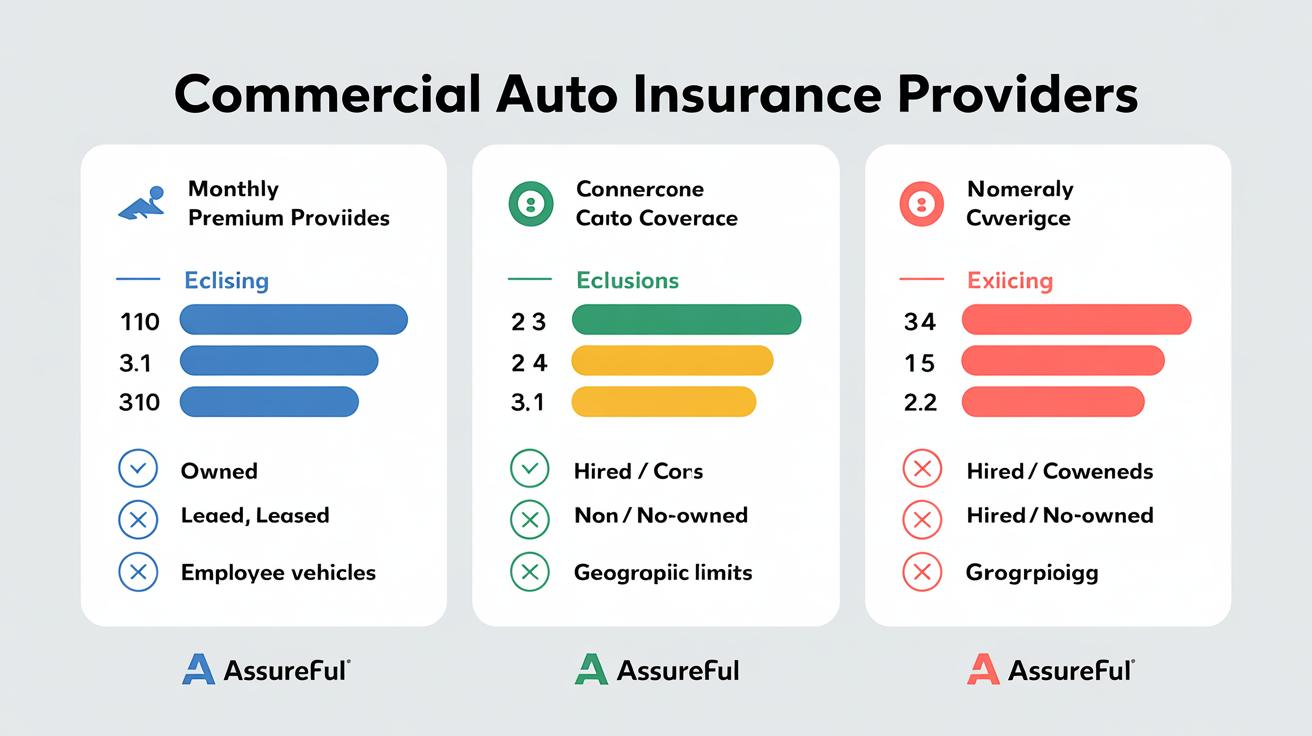
Side-by-Side Comparison: What Each Cheap Commercial Auto Policy Covers (and Leaves Out)
Most low-cost commercial auto policies keep monthly premiums down by limiting coverage on non-owned vehicles, raising deductibles, or excluding higher-risk activities. If low price is your top priority, expect to trade off flexible billing, full employee coverage, or claims support. Use this table to zero in on which provider fits your risk profile - and where you might need to add extra protection.
| Provider | Starting Monthly Cost | Key Coverage | Best For | Deductible Options | Billing Flexibility | Compliance Guarantees | Common Exclusions | Rating |
|---|---|---|---|---|---|---|---|---|
| Assureful eCommerce Insurance | $26+ | Owned, leased, imported vehicles, product liability | Online sellers (Amazon, Shopify, etc.) | $500-$2,500 | Pay-as-you-sell, monthly | Marketplace-specific, fully compliant | No coverage for personal use, certain high-risk imports | 4.8/5 |
| Next Insurance | $37+ | Owned vehicles, basic liability | Microbusinesses, self-employed | $500-$1,000 | Monthly, online only | Basic compliance, instant certs | No non-owned/hired, limited multi-state | 4.6/5 |
| GEICO Commercial Auto | $35+ | Owned, some leased, local fleet | Local service and retail | $250-$1,000 | Monthly, standard | Meets state minimums | No employee vehicles, restricted delivery | 4.5/5 |
| Travelers | $50+ | Owned, leased, hired/non-owned | Established businesses, larger fleets | $1,000-$5,000 | Monthly or annual, via agent | Contract-compliant, fleet support | Slower setup, high deductibles, more docs | 4.7/5 |
Low-cost providers like GEICO and Next Insurance keep rates attractive but exclude hired and non-owned vehicle coverage, which can leave you exposed if employees use their own cars for work. Assureful stands out for pay-as-you-sell billing and marketplace compliance, but skips personal or certain high-risk imported vehicle coverage. Travelers brings more flexible fleet and hired/non-owned options - at a higher price and with more paperwork.
Inexpensive policies almost always set higher deductibles and limit coverage for cross-border trips, employee vehicles, or deliveries through gig platforms. If you need instant proof of coverage, digital-first carriers like Next offer speed but may fall short on complex risk scenarios. Before you choose, review how product selection and instant quotes affect your final policy cost - and check exclusions line by line. The cheapest policy isn't always the safest fit for your business model.
How to Choose the Best Commercial Auto Insurance for Your Business Needs and Budget
Your biggest decision is matching your business operations to the right type of coverage - not just chasing the lowest premium. The cost difference between policies is often less important than the risk of gaps, denied claims, or falling short on compliance when you need it most.
- If you operate a single vehicle for delivery or service, choose a streamlined digital carrier like Next Insurance for fast quotes and uncomplicated coverage.
- If you manage a growing Amazon or Shopify store and want insurance that scales with your sales, pick Assureful's pay-as-you-sell policy for stress-free billing and instant compliance certificates.
- If you regularly rent vehicles or let employees drive their own cars for business, look for providers like Travelers that explicitly include hired/non-owned auto coverage and offer higher liability limits.
- If your business relies on imported goods or cross-state logistics, prioritize A‑rated carriers who understand marketplace compliance and can handle varied risk profiles.
- If cost is your top concern and you only need state-minimum protection, GEICO Commercial Auto or a basic fleet policy may work - but expect higher deductibles and stricter exclusions.
For most online sellers, Assureful's monthly, sales-based billing removes the pain of annual forecasts and big upfront payments. You get fully compliant coverage and can cancel with 30 days' notice if your needs change. If you want to understand why underinsuring often backfires, see how your business structure and coverage decisions impact your risk. And if premium costs feel high, review practical ways to lower your liability costs without cutting corners on protection. Choose the option that covers your real-world risks - not just the cheapest price tag.

Key Takeaways: Balancing Affordability and Protection in Commercial Auto Insurance
Assureful is our top pick for eCommerce sellers who want stress-free insurance that adapts to sales and requires no annual forecasts. Its pay-as-you-sell model, A‑rated underwriters, and flexible cancellation terms make it ideal for online businesses seeking predictable, fully compliant protection. The average premium reduction of 42% compared to similar programs adds meaningful savings for most sellers, especially those importing products or managing seasonal volume.
If your business is built around local delivery, fleet vehicles, or employee drivers, a traditional carrier like Next Insurance or Travelers may be a better fit. These options provide broader commercial auto coverage - including hired and non-owned vehicles - and can accommodate more complex risk exposures. Always avoid relying on personal auto insurance for business use, as claims will be denied and you risk costly coverage gaps.
Before you choose a policy, review your declarations page carefully and pay close attention to exclusions, deductibles, and coverage symbols. Get instant quotes and confirm each policy aligns with your business model and real-world risks. For more context on how product and general liability affect your online store's bottom line, see our guide on coverage impacts and claims. The right insurance removes stress - pick the policy that protects your business, not just your budget.
Pay-as-you-sell general liability insurance designed specifically for eCommerce. Premiums starting from just $26 per mon...
Premiums from $26/month
Learn MoreFrequently Asked Questions
What documents do I need to file a claim on my commercial auto policy?
Bring your policy declarations (shows your coverages, limits and deductibles), the insurer’s completed claim form, proof of vehicle ownership/registration, and the driver’s license and contact information for the driver involved. Also provide the police report (if applicable), photos of damage, repair estimates and receipts, business-related receipts or customer communications, and any witness statements, insurers require comprehensive documentation and have strict filing deadlines, so contact your carrier immediately.
Are monthly pay-as-you-sell insurance models accepted by Amazon and Shopify for compliance?
Yes, monthly pay-as-you-sell insurance is acceptable so long as the policy itself meets the marketplace’s coverage, limits, and certificate/additional-insured requirements; billing frequency (monthly vs annual) is not what Amazon or Shopify use to determine compliance. Amazon requires sellers who meet its thresholds to upload a Certificate of Insurance showing required coverages, policy period, limits, and Amazon named as additional insured, and will accept a monthly-billed policy that provides continuous coverage and the proper COI. Shopify typically does not impose a platform-wide insurance mandate but may require proof for specific programs or partners and will likewise accept monthly policies if they meet the program’s stated requirements. Always confirm the marketplace’s current COI wording and coverage limits with your insurer before relying on the policy.
Do low-cost commercial auto policies usually have higher deductibles?
Yes, low-cost commercial auto policies commonly get cheaper by using higher deductibles, particularly on physical‑damage coverages (collision/comprehensive). For example, the research cites lowering premium by about 18% when a deductible rose from $500 to $1,500 and a $300 annual saving when raising deductible from $500 to $2,000. This isn’t universal, carriers may also cut price by lowering limits or narrowing coverages, so compare premium plus potential out‑of‑pocket exposure.
What happens if my business vehicle is used for both personal and business reasons?
It’s generally treated as a commercial vehicle for insurance, a personal auto policy will usually deny claims for business-related accidents, so you should insure it under a commercial auto policy. Commercial policies can cover both business and personal use, but commonly exclude the vehicle’s contents/cargo, certain medical expenses, accidents when an employee is driving a personal (non‑company) vehicle for work, and have limits on hired/non‑owned vehicle coverage.
Do low-cost commercial auto policies usually include hired and non-owned auto coverage for contractors or gig drivers who deliver for my business?
No, low-cost commercial auto policies typically do not automatically include hired and non‑owned auto (HNOA); HNOA is usually an optional endorsement you must add. HNOA generally provides liability for business use of rented or employees’ personal vehicles but does not pay for damage to those vehicles, and insurers often exclude or charge extra for delivery‑for‑hire/gig work, so confirm specifics with your carrier.
Will an affordable commercial auto policy cover cross-border driving (for trips to Canada or Mexico) or other international delivery-related driving?
No, a standard, affordable commercial auto policy usually won’t cover international driving: Canada is only covered if your policy’s territorial limits explicitly include it, while Mexico is commonly excluded and requires separate or endorsed coverage. For regular cross‑border or delivery work insurers typically require Foreign Commercial Auto plus International General Liability, Foreign Voluntary Workers’ Comp and international product liability, and premiums/limits often increase substantially. Always get written confirmation from your agent or carrier and verify the policy’s territorial wording before any cross‑border trip.
Are certain cargo types, like lithium batteries, flammable materials, or high-value inventory, commonly excluded from the cheapest commercial auto policies, and how can I insure them?
Yes, basic/cheapest commercial auto policies commonly exclude or limit cargo such as lithium batteries, flammable/hazardous materials, high‑value inventory and “contents inside the vehicle” (tools/materials are generally excluded unless permanently attached). To insure them you must buy specific coverage or endorsements: motor truck cargo or commercial inland marine/cargo floater for goods and high‑value items, tools/equipment floater or BOP coverage for tools, and specialized hazmat endorsements or carrier approval (and DOT placarding/driver qualifications) for lithium/flammables. You’ll also typically need higher liability limits or an umbrella/excess policy and to declare the cargo to the insurer to avoid coverage voids.

Rohit Nair is the CEO and Founder of Assureful, an insurtech venture creating smart insurance products for ecommerce businesses. With a track record of launching and scaling successful ventures across health, wellness, ecommerce and consumer technology, with multiple exits and acquisitions, Rohit brings deep expertise in financial management, regulatory environments, and high-growth startups.
For more on this topic, see our guide to instant insurance calculator.
This sits inside the broader topic of eCommerce business insurance for online sellers.
Related: Commercial Insurance Online Quote? What Happened When We Tested 5.
Related: Instant Business Insurance Quote Free? How Instant Quotes Work And.
Sources
- assureful
- thehartford.com
- libertymutual.com
- insureon.com
- mailchimp.com
- embroker.com
- nextinsurance.com
- shopify.com
- allstate.com
- nextinsurance.com
- vouch.us
- totalcsr.com
- rangeme.com
- simplybusiness.com
- taxjar.com
- fitsmallbusiness.com
- travelers.com
- constructioncoverage.com
- thehartford.com
- nationwide.com
- hubinsagency.com
- cyberpolicy.com
- geico.com
- checklistguro.com
- insureon.com
- hubinternational.com
- business.libertymutual.com
- quora.com
- usnews.com
- cnbc.com
- insurify.com
- marketwatch.com
- thehartford.com
- thehartford.com
- thehartford.com
- thezebra.com
- geico.com
- thehartford.com
- thehartford.com
- gocallhub.com
- pgicentralflorida.com
- progressivecommercial.com
- vpm-legal.com
- usnews.com
- ace.aaa.com
- berxi.com
- rhinotradeinsurance.com
- edgarsnyder.com
- reddit.com
- bfg.law
- swoopfunding.com
- swoopfunding.com
- sharepointcu.com
- esportsinsurance.com
- insureonthespot.com
- insureonthespot.com
- baldwin.com
- nerdwallet.com
- ecom.insure
- geico.com