

Most eCommerce sellers pay $24, $73 per month for general liability insurance, with LLC policies typically averaging $42, $72/month and personal policies roughly $55, $85/month. Key takeaway: insuring an LLC usually lowers premiums and provides stronger legal protection and marketplace compliance, while premiums rise with higher‑risk products, certain states, claims history, revenue, employees, and added coverages (e.g., cyber or product liability) that commonly add several dozen dollars monthly.
- LLC vs. Personal Insurance: What Most Sellers Pay...
- Average Insurance Costs for Ecommerce Sellers: Personal vs....
- Cost Breakdown: Comparing Coverage Types and Entity Setups
- Hidden Insurance Costs: Fees, Gaps, and Compliance Traps...
- How to Lower Your Insurance Costs: Entity Strategies...
- Key Takeaways: Typical Costs and the Smartest Way...
LLC vs. Personal Insurance: What Most Sellers Pay and Why the Difference Matters
Most small eCommerce sellers pay $24-$73 per month for general liability insurance, with LLCs sometimes seeing rates at the lower end of that range. Your exact premium depends on whether you insure yourself or your LLC, the coverage limits you select, and your risk profile as a seller.
Pricing shifts based on your business structure, what you sell, where you operate, and even your sales history. LLCs often qualify for business discounts and may meet marketplace requirements more easily, while personal policies tend to cost more and offer less legal protection. Claims history, annual revenue, and state regulations all play a role. High-risk products, higher sales, or operating in certain states will nudge your premium up.
Choosing between personal and LLC insurance isn't just about saving money - it affects your legal shield and marketplace compliance. You'll see how structure, risk, and location impact your costs, and how making the right choice can help you avoid common pitfalls. For a deeper look at why your structure matters, check out should you insure the business or yourself, and if you want more details on typical pricing, see how much you should pay for eCommerce insurance.
Average Insurance Costs for Ecommerce Sellers: Personal vs. LLC Coverage
General liability insurance for eCommerce sellers typically costs between $24 and $73 per month, with the national average landing near $42-$72 monthly for policies in an LLC's name. These figures reflect the most common coverage levels and apply to online sellers with clean claims histories and moderate risk profiles. Outliers, especially those operating in high-risk states or selling higher-liability products, can see premiums exceeding $100 per month.
Several factors drive where your premium lands within that range. Your business structure matters: LLC policies usually cost less per dollar of coverage than personal policies, thanks to business discounts and underwriting preferences. State regulations have a noticeable impact; for example, Maine averages just $64 monthly, while New York or California can push close to $85 per month. The type of products you sell also matters - selling supplements, electronics, or anything for children tends to push costs toward the upper end.
Bundled business owner's policies (BOPs) that combine general liability and property coverage range from $88 per month in Alaska to $121 in Pennsylvania. Adding cyber liability coverage increases costs by about $40-$60 monthly on average, and specialized product liability coverage for importers or private label sellers may add another $35-$55. If your business has employees, owns inventory, or stores goods in a warehouse, these factors will move your premium up as well.
- General liability (LLC or business): $42-$72/month nationally; as low as $24/month for home-based sellers with clean records
- General liability (personal policy): $55-$85/month for individuals, often with limited marketplace compliance
- BOP (bundled liability + property): $88-$121/month depending on state; median annual cost $2,000
- Product liability add-on: +$35-$55/month (higher for high-risk or imported products)
- Cyber liability: +$40-$60/month, median annual cost $1,500
Most small eCommerce sellers operating as LLCs and selling lower-risk products will see rates at the lower end of these ranges. High-risk categories, previous claims, larger workforces, or locations in states like California or Pennsylvania can push your insurance costs well above $100 per month. For more detail on specific pricing bands and how your choices affect your premium, see how much you should pay for eCommerce insurance or learn how LLC status shifts your monthly insurance range.
Cost Breakdown: Comparing Coverage Types and Entity Setups
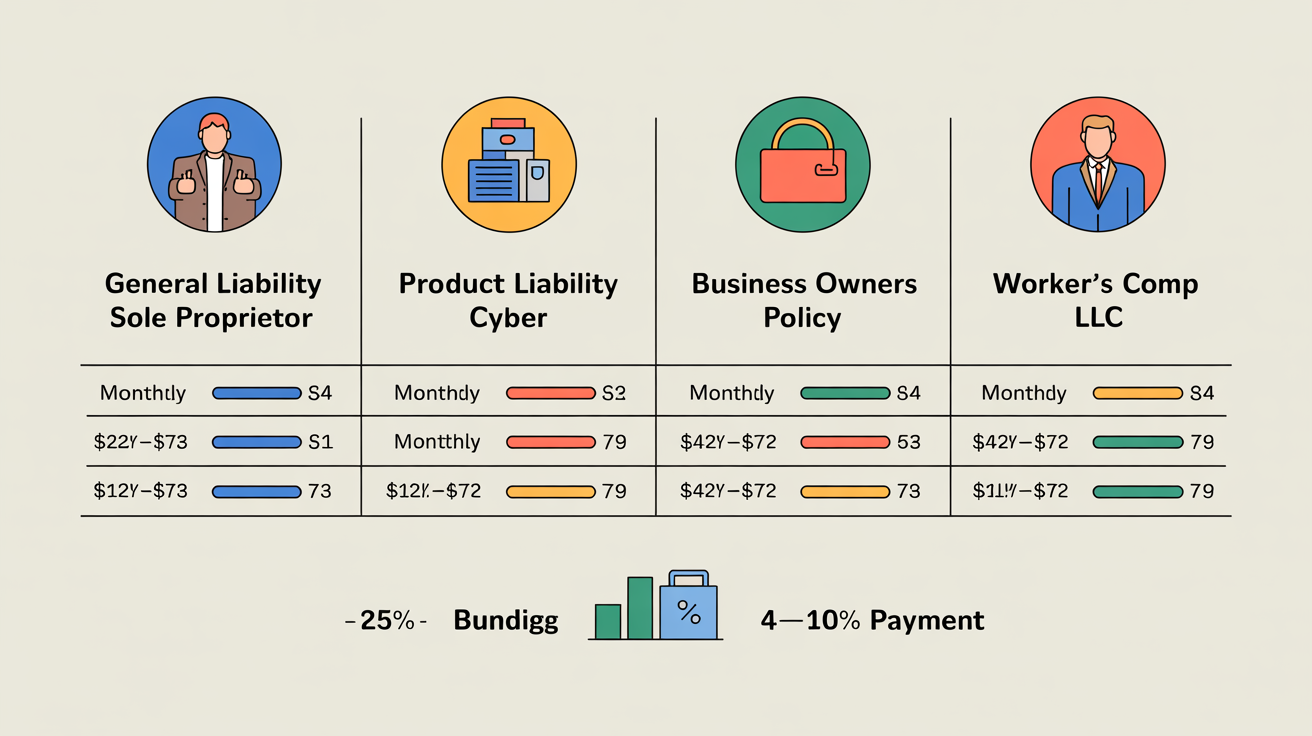
General liability is the largest insurance cost for most small online sellers, but switching from a personal policy to an LLC setup typically cuts your monthly premium by 15-30%. Bundling policies - like pairing general liability with property coverage - can drop your combined spend by another 15-25%. Whether you pay monthly or annually also affects your out-of-pocket cost: annual payments often save 4-10% in processing fees.
| Coverage Type | Sole Proprietor (Monthly) | LLC (Monthly) | Sole Proprietor (Annual) | LLC (Annual) |
|---|---|---|---|---|
| General Liability | $55-$85 | $42-$72 | $634-$925 | $480-$830 |
| Product Liability (Add-On) | +$45-$65 | +$35-$55 | +$515-$750 | +$410-$650 |
| BOP (Bundled GL+Property) | $98-$135 | $88-$121 | $1,120-$1,560 | $1,050-$1,400 |
| Cyber Liability | $45-$70 | $40-$60 | $520-$800 | $470-$720 |
| Workers' Comp | $65-$110 | $54-$95 | $780-$1,300 | $650-$1,100 |
General Liability Insurance Costs
General liability protects you against lawsuits over injuries, property damage, and advertising claims. For sole proprietors, expect $55-$85 per month. If you operate as an LLC, rates drop to $42-$72 monthly, mainly due to business discounts and improved risk profiles. Your industry, claims history, and location drive the price most. High-risk products or activity, past claims, or a storefront presence will push your premium higher. For more insight, see how product and general liability affect your online store's bottom line.
Product Liability Insurance Costs
Product liability is usually bundled with general liability but you might pay extra if you manufacture, import, or sell higher-risk products. As a stand-alone add-on, expect $35-$55 monthly for LLCs and $45-$65 for sole proprietors. Factors like product type, sales volume, and prior claims matter most. Children's goods, supplements, or electronics increase your costs. For detailed pricing bands and risk factors, review how much does product liability insurance cost.
Business Owner's Policy (BOP) Bundles
A BOP combines general liability and property coverage, often with built-in savings of 15-25% versus buying policies separately. For LLCs, BOPs average $88-$121 per month, or $1,050-$1,400 annually if paid upfront. Sole proprietors usually pay $98-$135 per month. BOPs appeal if you own or rent inventory, equipment, or workspace. High property values, risky locations, or extra endorsements (like business interruption) drive up the price.
Cyber Liability Insurance Costs
Cyber liability covers data breaches, customer notifications, investigations, and PR after an attack. LLCs pay $40-$60 monthly; sole proprietors pay $45-$70. Storing sensitive customer data, accepting card payments, or running a high-traffic site makes this coverage more expensive. Annual payment can trim costs by up to 10%.
Workers' Compensation Costs
Once you hire employees, workers' comp becomes mandatory in most states. LLCs often receive lower rates - usually $54-$95 per month compared to $65-$110 for sole proprietors. Your state, payroll size, job risk level, and claims history have the biggest impact. Office staff cost less to insure than warehouse or delivery workers.
Hidden Insurance Costs: Fees, Gaps, and Compliance Traps to Watch For
The most surprising hidden cost for ecommerce sellers is monthly payment processing fees - which can quietly add $100-$250 a year to your insurance bill. If you pay premiums monthly instead of annually, these fees often stack up without you realizing the true annualized impact. For many sellers, these extras push insurance costs well above the headline "monthly rate."
Monthly Payment and Processing Fees
Paying insurance premiums monthly instead of upfront comes with processing fees typically ranging from 4% to 10% annually. For a policy with a base premium of $1,200 per year, this means you'll pay an extra $48-$120 just for the convenience of spreading out payments. Most insurers add these on top of your monthly invoice, but they're rarely highlighted in quotes. Factor these charges into your operating budget if cash flow dictates monthly payments.
Penalties for Under-Insuring or Outdated Coverage
If your sales grow but you fail to update your policy, you risk penalties or reduced claim payouts. Many insurers require you to report annual sales accurately; under-reporting can mean costly "back-billing" at audit. For example, if your actual sales exceed projections by $100,000, you might owe an additional $120-$180 post-audit - plus risk denied claims. Staying fully compliant with marketplace minimums (like Amazon's $1M liability rule) can prevent both surprise bills and lost sales. For a deeper look at the financial risks, see what is product liability insurance for and how gaps expose your business.
Extra Costs of Unbundled or Add-On Policies
Buying separate policies for property, liability, and cyber coverage often costs 15-25% more per year than a bundled business owner's policy (BOP). For a seller paying $1,200 for liability and $800 for property, separate policies could total $2,300, compared to $1,700-$1,900 bundled. Missing out on multi-policy discounts quickly adds $100-$400 a year in avoidable expense if you don't bundle where possible.
Opportunity and Compliance Costs
Insurance gaps don't just cost you at renewal - they can trigger lost sales or account suspensions. For example, failing to maintain $1M in product liability coverage can get your Amazon store suspended, leading to hundreds or thousands in unrealized revenue while you scramble to fix compliance. Marketplace audits, claim denials, or regulatory penalties can add another $100-$300+ per incident. Ignoring these risks can turn minor oversights into major business disruption. Explore whether it is illegal to run your business without proper insurance to understand the true compliance stakes.
How to Lower Your Insurance Costs: Entity Strategies and Smart Savings
Bundling your policies into a business owner's policy (BOP) is the single biggest way to cut your insurance bill - expect 15-25% savings compared to buying coverage separately. For many ecommerce sellers, that means $300-$600 per year back in your pocket, with no reduction in core protection. This strategy works whether you use an LLC or operate under your personal name.
- Bundle policies with a BOP. Combine general liability, property, and business interruption insurance into one package. This typically costs $95-$105 monthly, versus $130+ for the same coverage unbundled - saving $400-$600 per year.
- Choose annual payments. Paying your premium in full each year instead of monthly can reduce your total cost by 4-10%. For a $1,500 policy, that's $60-$150 saved annually. Only opt for monthly if cash flow is a bigger concern than long-term savings.
- Raise your deductible strategically. Increasing your deductible from $500 to $1,000 can lower your premium by 10-20%. For a typical policy, that's $120-$240 saved per year, but only do this if you can manage the higher out-of-pocket cost for claims.
- Maintain a clean claims history. Every year you go without a claim can earn you 5-10% loyalty discounts, with long-term savings up to 42% compared to sellers with frequent claims. This adds up to hundreds saved each year and lower future renewal rates.
- Compare quotes and adjust limits. Comparing policies from at least three insurers and adjusting coverage limits to match actual risk (not inflated "just in case" amounts) often yields 10-20% savings, or $150-$300 per year. Make sure to review coverage apples-to-apples - see how to lower your liability premiums without sacrificing coverage for a step-by-step approach.
- Operate as an LLC for business discounts. Switching from personal to LLC status gives you access to business insurer pricing, which can reduce your premium by 5-15%. That's an extra $75-$225 saved on a $1,500 policy, plus added legal separation for your assets.
Chasing the lowest premium makes sense, but there's a point where savings come at the cost of real protection. Underinsuring - by shrinking your coverage limits or skipping essential protections - can turn minor claims into major financial setbacks. Always compare coverage details, not just price, and make sure your policy is fully compliant with marketplace requirements. For a detailed guide to quoting and finalizing your coverage, see how the process works from instant quotes to final purchase.

Key Takeaways: Typical Costs and the Smartest Way to Save on Insurance
For most ecommerce sellers, the average monthly insurance cost falls between $24 and $73, with LLCs often paying closer to the lower end thanks to business discounts and streamlined underwriting. Your actual rate will depend on coverage, product risk, and sales volume, but this is the typical range for compliant general liability and product liability policies. While some sellers pay more for extra coverage or high-risk items, most small businesses can budget safely within this bracket.
The single most effective way to lower your insurance bill is bundling key policies like general liability, product liability, and cyber coverage into one package. Bundling saves 15-25% over separate policies. Paying your premium annually instead of monthly eliminates 4-10% in processing fees and can qualify you for additional discounts. These two steps together typically yield the largest savings without sacrificing core protections.
Budget for at least the low end of the average range to stay compliant and avoid surprise costs, especially if you sell through major platforms. If you're deciding between insuring yourself or the business directly, see how coverage choices affect your costs and legal risk, and review the specific advantages of operating as an LLC before sealing your final insurance plan.
Frequently Asked Questions
What happens if I don’t carry the required insurance for my LLC?
You risk fines, stop‑work orders, license suspension and even criminal penalties (commonly for failing to carry required workers’ compensation), and you can breach contracts or loan/lease requirements that mandate insurance. Any judgments or defense costs must be paid from the LLC’s assets and can force sale of business property; courts may pierce the corporate veil for undercapitalization or fraud and expose your personal assets. Lenders, landlords and clients may also refuse to do business or call loans, effectively crippling the company.
Can I switch from personal to LLC insurance mid-policy?
Yes, but you usually must purchase a new commercial/LLC policy (or add a commercial endorsement) rather than simply converting a personal policy mid-term. Carriers differ: some will issue the commercial policy effective immediately and refund the personal policy pro rata, others require underwriting and a new effective date, and certain coverages (for example, personal auto) won’t cover business use and must be replaced to avoid gaps. Contact your agent/insurer to confirm timing, premiums and endorsements, and maintain LLC formalities since insurance doesn’t replace protections lost by mixing finances or personally guaranteeing obligations.
If I’m sued for a product-related injury, will having insurance in my LLC’s name completely protect my personal assets, or are there circumstances where my personal assets could still be exposed?
No, an LLC plus insurance usually protects your personal assets, but it does not guarantee complete protection. Personal assets can be exposed if a court pierces the corporate veil for fraud, commingling of funds, undercapitalization, or failure to follow LLC formalities; if you personally guaranteed loans or contracts; or if you committed intentional wrongdoing or gross negligence. Insurance can also fail (policy limits exhausted, coverage denied for exclusions like known defects or recall, or the claim falls outside the policy), so maintain adequate product‑liability coverage and proper corporate formalities.
Can a single insurance policy cover both me personally and my LLC (or multiple LLCs), and is that usually cheaper than buying separate policies?
Yes, a single commercial policy (or a business owner’s policy/BOP) can be written to cover multiple related LLCs or a sole proprietor if the insurer names each entity as an insured, but your personal homeowner/auto policies normally exclude business exposures. BOPs bundle general liability and commercial property (and often business interruption) and are typically cheaper than buying those coverages separately, though some coverages (workers’ compensation, professional liability, personal umbrella) often require separate policies or endorsements. Confirm available endorsements, limits, and pricing with your broker because cost savings depend on the insurer and each entity’s risk profile.
If I sell across multiple marketplaces (Amazon, Etsy, my own site), will one LLC general liability policy typically meet all marketplace insurance requirements or do I need endorsements/separate policies?
Yes, one LLC commercial general liability policy will often meet multiple marketplaces’ requirements, provided that same policy actually carries each platform’s required limits and endorsements. Confirm your policy includes required coverages (products/completed operations/product liability, bodily injury, broad form property damage), the platform’s limits (e.g., Amazon Seller thresholds often expect $1M per occurrence, Vendor Central/Walmart/vendor agreements may require up to $10M), and endorsements such as naming the marketplace as additional insured, primary & noncontributory status, and waiver of subrogation (and add an umbrella if higher limits are required). Always verify each marketplace contract and supply a certificate of insurance from an A‑rated carrier, since requirements vary by platform and country.
Do premiums or coverage options change if I drop‑ship products versus holding my own inventory, and should that operational difference influence whether I insure the LLC or myself?
Yes, premiums and coverages commonly change: drop‑shipping usually removes property/inventory exposures (so you can often drop or reduce commercial property, stock/inland‑marine or warehousing coverage and lower premiums) but does not eliminate general liability or product‑liability risk because customers can still sue the seller. You should name and insure the LLC as the primary insured to protect the entity and help preserve the corporate veil; personal insurance isn’t a substitute, though a personal umbrella or endorsements can supplement owner coverage. Because workers’‑comp rules vary by state and single‑member LLCs face greater scrutiny, review your specific operations and limits with a broker to tailor policies to drop‑ship versus held‑inventory risks.
Are premiums for LLC insurance tax deductible as a business expense, and how does that compare to deducting personal insurance premiums when used for my eCommerce business?
Yes, premiums for insurance that cover LLC business activities (general liability, product liability, commercial property, workers’ comp, professional liability, etc.) are deductible as ordinary and necessary business expenses on the business return (IRC §162) when paid by the business. Personal insurance premiums are generally not deductible, except to the extent you can allocate them to business use (e.g., business miles on a personal auto policy or a home‑office percentage); self‑employed health insurance is instead deducted on Form 1040 as an adjustment to income and S‑corp >2% shareholders face special W‑2 treatment for employer‑paid health premiums. Keep detailed allocations and receipts and consult a tax professional for entity‑specific and policy‑specific rules.

Rohit Nair is the CEO and Founder of Assureful, an insurtech venture creating smart insurance products for ecommerce businesses. With a track record of launching and scaling successful ventures across health, wellness, ecommerce and consumer technology, with multiple exits and acquisitions, Rohit brings deep expertise in financial management, regulatory environments, and high-growth startups.
For more on this topic, see our guide to instant insurance calculator.
Related: Commercial Insurance Online Quote? What Happened When We Tested 5.
Related: Instant Business Insurance Quote Free? How Instant Quotes Work And.
Sources
- insureon.com
- fitsmallbusiness.com
- 1800insurance.com
- insureon.com
- seo-pages-web.vercel.nerdwallet.com
- nerdwallet.com
- moneygeek.com
- nerdwallet.com
- insureon.com
- hotalinginsurance.com
- moneygeek.com
- techinsurance.com
- progressivecommercial.com
- nextinsurance.com
- forbes.com
- shopify.com
- vouch.us
- insureon.com
- assureful.com
- moneygeek.com
- policyape.com
- embroker.com
- nextinsurance.com
- insureon.com
- njm.com
- pieinsurance.com
- thehartford.com
- thehartford.com
- travelers.com
- progressivecommercial.com
- nerdwallet.com
- thecoylegroup.com
- thimble.com
- uschamber.com
- assureful
- hulettinsuranceblog.com
- hubinternational.com
- uhc.com
- hubinternational.com
- insureon.com
- checklistguro.com
- marshcommercial.co.uk
- bluecrossnc.com
- progressivecommercial.com
- quora.com
- connect.bcbsil.com
- guardianlife.com
- insureonthespot.com
- insureonthespot.com
- flashpricer.com
- pattersonlawfirm.com
- getebm.com
- uschamber.com
- simplybusiness.com
- progressivecommercial.com
- insureon.com
- hippo.com
- rmcgp.com
- insuredbetter.com
- statefarm.com
- coastgeneralinsurance.com
- score.org
- sharepointcu.com
- forbes.com
- chubb.com
- thehartford.com
- geico.com
- esurance.com