

in 2026 most small businesses pay $900, $2,400 per vehicle annually (about $75, $200/month), with solo operators typically at the high end and fleet policies cutting per-vehicle costs by roughly 10-30%. Actual premiums hinge on vehicle type/value, business use and mileage, location, and claims history, and usage-based or pay-as-you-sell models (e.g., Assureful) can lower costs for seasonal or variable fleets.
- Average Small Business Auto Insurance Costs: What Sellers...
- How Much Does Fleet vs. Individual Commercial Auto...
- Commercial Auto Insurance Cost Breakdown: By Vehicle Type,...
- Hidden and Unexpected Costs in Small Business Auto...
- Smart Strategies to Lower Your Commercial Auto Insurance...
- Key Takeaways: Typical Costs and the Top Way...

Pay-as-you-sell general liability insurance designed specifically for eCommerce. Premiums starting from just $26 per mon...
Premiums from $26/month
Learn MoreAverage Small Business Auto Insurance Costs: What Sellers Actually Pay in 2026
in 2026, most small businesses pay between $900 and $2,400 per vehicle annually for commercial auto insurance. Solo operators and small-scale sellers typically see higher premiums per vehicle, while fleet policies can lower the cost for each vehicle. If you use vans or light trucks for eCommerce deliveries, your rate usually lands in this range, your specific premium depends on your risk profile.
Several factors drive what you’ll pay: the number and type of vehicles, how often you use them for business, your business location, and your claims history. States with higher accident rates or stricter insurance rules mean higher costs. A clean driving record helps lower your rate. So does operating lower-value vehicles. What you transport matters too, daily delivery schedules or higher-risk goods push premiums up.
Your actual insurance bill reflects usage, geography, and your coverage choices. Specialized options like Assureful’s pay-as-you-sell model can shift the pricing structure compared to traditional annual plans. For more on protecting the vehicles that move your business or details on choosing business insurance for sellers, check our guides. Compare commercial auto insurance stats and pricing benchmarks and ways to lower your coverage costs before committing to a policy.
How Much Does Fleet vs. Individual Commercial Auto Insurance Cost?
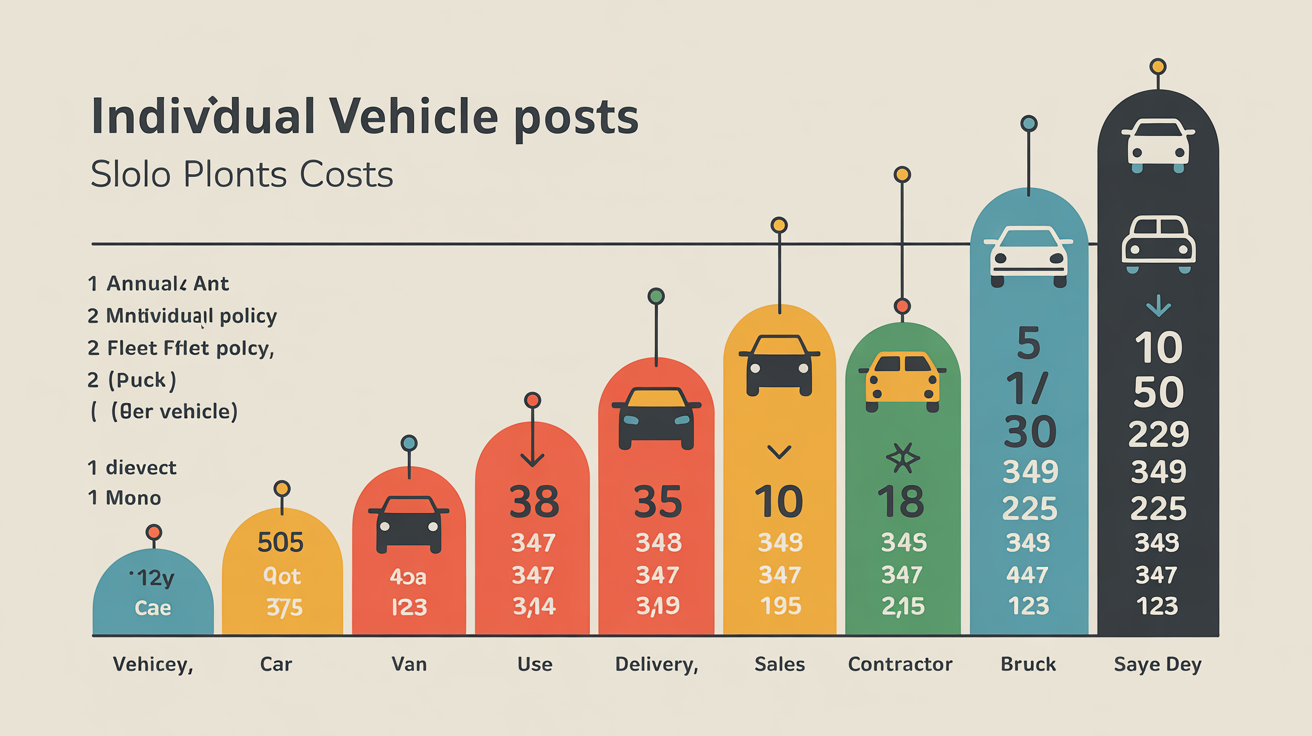
Fleet policies typically cut your per-vehicle premium by 10-30% compared to insuring vehicles separately. Most small businesses pay $75, $200 per month per vehicle. High-risk operations, like hazmat or heavy truck fleets, often see $350 or more. Light-duty vans for eCommerce deliveries usually land at the lower end, especially if drivers keep a clean record and mileage stays moderate.
Scale matters. Insurers offer better rates to fleets because managing multiple vehicles as a group means fewer transactions, simplified risk, and the ability to spread losses across drivers and routes. Well-maintained fleets, driven by experienced operators, get extra pricing power. Individual plans, on the other hand, treat each vehicle and driver as an isolated risk. One claim can send rates up fast.
Your industry impacts pricing too. Delivery vans running local, predictable routes generally cost less to insure than vehicles hauling valuable cargo or working in dense urban areas. Age and claims history for both vehicles and drivers shape your rates more than most factors. Newer models with safety tech and GPS tracking reduce costs. Prior commercial claims? Expect a sharp hike. If your fleet size changes with the season, pay-as-you-sell or usage-based options, like those from Assureful, help avoid paying for idle vehicles, though not every insurer offers instant changes or automated billing.
- Solo vehicle, standard use: $90, $220/month (higher if young or high-risk driver)
- Fleet of 3-5 vehicles, clean record: $75, $160/month per vehicle
- Fleet of 10+ vehicles, delivery-focused: $65, $140/month per vehicle (volume discounts)
- High-risk or specialty vehicles (hazmat, heavy truck): $225, $350+/month per vehicle
- Usage-based (eCommerce, pay-as-you-sell): $60, $120/month per vehicle with strict mileage limits
To benchmark or trim costs, align your coverage with business needs and policy flexibility. Products like Assureful offer stress-free insurance for vehicles that move your business and track usage monthly, ideal for eCommerce and seasonal sellers. For specifics on what drives your rate, see our complete buyer’s guide to business insurance. Compare multiple commercial auto insurance quotes, review pricing benchmarks and ways to lower your coverage costs, or get guidance on how to structure your policy before you choose an insurer.
Commercial Auto Insurance Cost Breakdown: By Vehicle Type, Usage, and Policy Features
Liability drives most of the cost in commercial auto insurance. For small businesses, liability alone often accounts for 50-70% of the total premium, especially with delivery vans and light trucks. Higher risk of injury or property damage means higher premiums. Claims history and vehicle type can change your rate by several hundred dollars per year.
| Scenario | Vehicle Type | Primary Use | Annual Premium (USD) | Key Coverage Features |
|---|---|---|---|---|
| Small eCommerce seller | Light van | Last-mile delivery | $1,100, $1,700 | Liability, collision, uninsured motorist |
| Contractor (general) | Heavy-duty truck | Tools/materials transport | $2,100, $3,500 | Higher liability, physical damage, hired/non-owned |
| Retailer with fleet (5 vehicles) | Cargo vans | Deliveries, errands | $6,000, $9,000 (total) | Fleet liability, comp/collision, med pay |
| Seasonal/part-time use | Box truck | Events, shows | $950, $1,400 | Reduced mileage, liability only |
| Pay-as-you-sell (Assureful) | Light commercial | eCommerce | $780, $1,400 | No annual forecast, usage billed monthly |
Liability Coverage
Liability insurance pays for injuries or property damage you or your drivers cause to others. This is required for commercial vehicles. Typical premiums range from $700, $1,500 per vehicle each year for standard risks. Businesses in high-risk industries or with trucks that have a history of large claims can see liability alone exceed $2,000 per vehicle. Vehicle class, routes, and your claims record push these numbers up or down.
Physical Damage: Collision and Comprehensive
Collision pays for repairs to your own vehicle after an accident. Comprehensive covers theft, fire, and weather damage. Together, these add $400, $900 per year for each vehicle. Newer or high-value vehicles sit at the top end. Choosing a higher deductible, say, $1,000 instead of $500, can lower premiums by 10-20%. But your out-of-pocket cost rises if you file a claim.
Uninsured and Underinsured Motorist Protection
If your driver is hit by someone with too little insurance, this coverage pays out. Most policies charge $120, $250 per vehicle each year for this. Businesses operating in cities or states with more uninsured drivers see higher costs.
Hired and Non-Owned Auto Coverage
If employees rent vehicles or use their own cars for work, you’ll need this add-on. Expect to pay $200, $600 per year based on how often you rent, how many people drive, and your claims history. Short-term rentals and frequent contract drivers push costs higher.
- Hired vehicle coverage: $120, $350 per year
- Non-owned auto liability: $80, $250 per year
- Bundling (BOP with auto): saves 8-15% compared to standalone coverage
Policy Limits, Deductibles, and Optional Features
Raising coverage limits increases premiums. Doubling liability from $500,000 to $1 million can mean 8-20% more per year. Add-ons like roadside assistance or rental reimbursement cost $50, $150 per vehicle annually. Some providers, such as Assureful, offer pay-as-you-sell billing with no annual forecast, ideal for seasonal or lower-volume sellers.
For details on stress-free insurance for vehicles that move your business, see our complete buyer’s guide to commercial insurance. You can benchmark rates, review pricing benchmarks and ways to lower your coverage costs, or compare commercial auto insurance stats to find the right balance of cost and protection.
Hidden and Unexpected Costs in Small Business Auto Insurance
The biggest hidden cost in commercial auto insurance isn’t a line-item fee, it’s the jump in what you pay out-of-pocket after a claim. Higher deductibles look attractive because they can lower your annual premium by 10-20%. But choose $1,000 instead of $500, and your immediate expense doubles when your vehicle gets damaged. Multiply that by every vehicle in your fleet. Most owners don’t plan for that kind of hit.
Administrative and Policy Change Fees
Insurers often tack on fees for mid-term changes, late payments, and paperwork. Swap a vehicle, add a driver, or adjust coverage, expect $25, $75 per change. Miss a payment? You’ll see $10, $35 per missed deadline. If your policy lapses, reinstatement runs $50, $150, plus the risk of being uninsured during the gap. Staying on top of payments and changes helps avoid these charges.
Endorsement and Filing Surcharges
Special endorsements, required filings, and state-mandated surcharges drive up costs. Need an SR-22 for a high-risk driver? That’s $15, $25 each time, sometimes per vehicle. Non-owned auto endorsements, vital if employees use personal or rented cars, add $80, $250 each year. Some states (like California) tack on $1, $3 per vehicle per month. These extras slip past if you only budget for the base premium.
- SR-22 filing: $15, $25 each time
- Non-owned/hired auto: $80, $250 per year
- State surcharges: $12, $36 per vehicle annually
- Policy add-ons (roadside/rental): $50, $150 per vehicle annually
Coverage Gaps and Proof of Insurance Penalties
A lapse in coverage or slow proof of insurance can trigger fines, $100, $500 per incident, depending on state. Worse, some marketplaces or shipping partners suspend contracts if you can’t show valid insurance instantly. That hits revenue hard. Providers who offer instant digital certificates help you avoid these gaps.
Deductible Shock and Claims-Driven Premium Increases
A higher deductible means you pay less up front, but a claim puts all the cost on you, $1,000 to $2,500 per event is standard. After a claim, renewal premiums often jump 15%, 40% for three to five years, depending on severity and claims history. Small fleets feel that pain quickly. Transparent providers like Assureful bill monthly with no annual forecast, which limits some exposure, but deductibles and post-claim hikes still apply.
For a detailed breakdown of policy costs, fee structures, and ways to keep coverage stress-free, see our insurance hub for business vehicles and the complete commercial insurance buyer’s guide. To compare premiums and see all the variables, check pricing benchmarks and cost-reduction strategies.

Smart Strategies to Lower Your Commercial Auto Insurance Premiums
Telematics and GPS tracking offer the fastest path to premium reductions. Carriers reward verified safe driving and route transparency with discounts up to 20%. These systems also reduce accident risk, helping to keep rates in check over time. For delivery-heavy fleets, this is the most dependable way to secure automatic savings.
- Install telematics or GPS monitoring. Require every vehicle to use these devices and submit usage data directly to your insurer. Most A-rated carriers cut premiums by 10-20%, amounting to $250, $600 saved per vehicle each year.
- Bundle auto with general liability or property coverage. Consolidate policies under the same provider if you already have product liability or property insurance. Bundling typically yields a 10-15% discount, $200, $400 per vehicle per year, and simplifies compliance reviews.
- Request three or more quotes after any employee violation or at each renewal. Even a minor ticket can trigger a rate hike. Shopping around after incidents often saves 15-30% compared to automatic renewals.
- Audit and remove unnecessary add-ons. Review extras like rental reimbursement or roadside assistance. If these duplicate perks you already have (credit card coverage, for example), dropping them cuts $100, $300 per vehicle from annual spend.
- Increase deductibles with caution. If you can handle a $2,000, $2,500 out-of-pocket claim, raising deductibles from $500 or $1,000 drops premiums by 8-12%. That’s $120, $240 off a $2,000 policy, but only do this if you have cash reserves for surprise claims.
- Enforce clean driving records. Require MVR checks for all drivers and set a strict no-incident policy. This helps avoid 15-40% premium hikes after a claim, especially in states with steep post-accident increases.
Cheaper coverage isn’t always safer. Choosing low-limit or non-compliant policies risks contract suspension or expensive out-of-pocket claims far beyond any savings. Always prioritize fully compliant coverage from reputable, A-rated underwriters. Review the insurance essentials for your business vehicles and consult the comprehensive insurance buyer’s guide before finalizing coverage. For a detailed look at premium levels and cost drivers, see our coverage cost benchmarks and reduction tips.
Key Takeaways: Typical Costs and the Top Way to Save on Business Auto Insurance
Most eCommerce and retail businesses pay between $75 and $200 per month for commercial auto insurance. The average is $171 per month. Your rate depends on fleet size, how you use your vehicles, risk history, and policy limits. Clean records and modest vehicle values keep costs down. Claims or specialty vehicles push rates higher.
To keep costs in check, shop for new quotes each year and use telematics or usage-based monitoring if your provider offers it. Insurers give better rates for consistent, low-risk driving and tracking actual mileage. Comparing quotes regularly keeps you from overpaying after automatic renewals. This beats relying on loyalty discounts or just raising your deductible.
Plan for $100, $200 per month per business vehicle to stay compliant and protected. For more detail, check the insurance essentials for your business vehicles and the comprehensive insurance buyer’s guide before your next renewal.
Pay-as-you-sell general liability insurance designed specifically for eCommerce. Premiums starting from just $26 per mon...
Premiums from $26/month
Learn MoreFrequently Asked Questions
Do I need commercial auto insurance if I use my personal vehicle for business?
Yes, if you regularly use your personal vehicle for business (beyond commuting or occasional client meetings) you need commercial auto coverage or a hired-and-non-owned (HNOA) endorsement, because most personal auto policies exclude incidents that occur during business use. If the vehicle is owned, leased, or operated by the business, or is used to haul tools, transport clients, or make deliveries, you generally must carry commercial auto insurance; occasional errands or rare meetings may still be covered by a personal policy, so confirm your situation with your agent.
What happens if my insurance lapses during a busy sales period?
You will be uninsured and any business-interruption losses (lost sales, employee pay, rent, loan payments) that a policy would have covered can be denied, leaving you to absorb potentially large peak‑season losses. Amazon.com requires commercial liability insurance within 30 days of exceeding USD $10,000 in gross proceeds in any month. From November 2, 2026, enhanced-safety listing categories require at least USD $1 million per occurrence and in aggregate regardless of sales. Renew or purchase coverage immediately and consider short‑term seller‑suspension or contingent business‑interruption products to avoid a coverage gap.
What type and amount of cargo (goods-in-transit) coverage do I need for eCommerce deliveries, and how much will it add to my premium?
Buy Inland Marine (goods‑in‑transit/cargo) insurance with limits at least equal to the maximum value of a single shipment (and consider an aggregate or declared‑value limit for pallets/containers and international transit). This coverage is typically inexpensive for ecommerce, commonly adding about $100, $600 per year ($8, $50/month) for small sellers, though high‑value or international shippers can see several hundred to a few thousand dollars annually; exact cost depends on per‑shipment value, product type, deductible and claims history. Because carrier liability limits are often far below replacement cost, insure to your replacement value and get quotes from multiple carriers or brokers to tailor limits and deductibles.
Can I add temporary or seasonal vehicles and short‑term drivers to a fleet policy, and how are those additions priced?
Yes, most carriers allow temporary/seasonal vehicles and short‑term drivers via endorsements (temporary substitution, scheduled vehicle, or named operator endorsements). Pricing is typically pro rata for the time on risk (daily/weekly/monthly) and set by vehicle class, use (business vs. personal), value/limits, garaging/location and driver histories, often quoted as a percentage of the annual premium or a per‑vehicle/per‑day rate with minimums and possible surcharges for inexperienced or high‑risk drivers. Carriers may require prior notice, documentation and underwriting approval, and some policies permit short substitutions at no extra charge, so confirm exact rules and rates with your broker or insurer.
How do deductible levels and liability/property damage limits affect my commercial auto premiums for seller vehicles?
Raising your physical‑damage deductible lowers your commercial auto premium because you accept more out‑of‑pocket cost after a loss, while lowering liability or property‑damage limits also reduces premium because the insurer’s potential payout is smaller. For example, dropping a combined single limit (CSL) from $300,000 to $100,000 will lower your premium but reduces coverage for multi‑person accidents from $300,000 to $100,000; conversely, increasing limits or adding comprehensive/collision and endorsements (PIP, UM/UIM, bobtail, umbrella) raises premiums. Balance any savings against the greater financial exposure you and your employees would face after a claim.
What driver records, vehicle documents, and business information do insurers require when applying for a fleet policy to secure the best rate?
Insurers require driver-identifying details (full name, DOB, license number/class/state), 3-5 years of Motor Vehicle Records (MVRs) showing violations/accidents, and, for commercial CDL drivers, complete DOT driver qualification files (medical card, drug/alcohol test results), background-check and training/hiring records. For each vehicle provide VIN, year/make/model, GVWR, current registration/title, odometer/annual mileage, physical-damage valuations, anti-theft/safety equipment, maintenance logs, photos and any lease/loan or trailer-interchange agreements. For the business supply legal name and EIN, years in business, fleet size and garaging addresses, DOT/MC and U.S. DOT numbers (if applicable), NAICS code, typical routes/interstate exposure, declared cargo values, annual revenue/payroll, requested limits/deductibles and 3-5 years of prior insurance declarations and loss runs plus your written safety/risk‑management program, underwriters use accurate MVRs, loss runs and maintenance records to qualify the best rates.
Do telematics, GPS tracking, or mileage reporting programs (including pay‑as‑you‑sell models) meaningfully lower premiums, and how do I set them up with an insurer?
Yes, telematics/GPS and pay‑per‑mile programs often cut premiums for low‑mileage and safe drivers; insurers commonly offer usage‑based discounts (e.g., Progressive Snapshot) and observed differences can be meaningful (one dataset showed drivers <2,500 mi/yr averaging $68/mo vs $77/mo for 10,000+ mi, with typical savings often in the low‑teens percent and larger for very low mileage/perfect driving). To set one up, shop insurers that advertise usage‑based or pay‑per‑mile policies, get quotes, request enrollment, install the insurer’s app, OBD‑II dongle or GPS device and authorize data sharing, then confirm billing, odometer/mileage reporting, trial/opt‑out rules and privacy protections before activating.

Rohit Nair is the CEO and Founder of Assureful, an insurtech venture creating smart insurance products for ecommerce businesses. With a track record of launching and scaling successful ventures across health, wellness, ecommerce and consumer technology, with multiple exits and acquisitions, Rohit brings deep expertise in financial management, regulatory environments, and high-growth startups.
For more on this topic, see our guide to instant insurance calculator.
This sits inside the broader topic of eCommerce business insurance for online sellers.
Related: Commercial Insurance Online Quote? What Happened When We Tested 5.
Related: Instant Business Insurance Quote Free? How Instant Quotes Work And.
Sources
- moneygeek.com
- moneygeek.com
- fitsmallbusiness.com
- 1800insurance.com
- policyape.com
- seo-pages-web.vercel.nerdwallet.com
- nerdwallet.com
- co-opinsurance.com
- insureon.com
- hubinternational.com
- nextinsurance.com
- shopify.com
- insureon.com
- vouch.us
- forbes.com
- insureon.com
- mailchimp.com
- hotalinginsurance.com
- flashpricer.com
- thehartford.com
- travelers.com
- allstate.com
- usnews.com
- ace.aaa.com
- berxi.com
- rhinotradeinsurance.com
- cnbc.com
- quora.com
- reddit.com
- edgarsnyder.com
- vpm-legal.com
- cyberpolicy.com
- bfg.law
- constructioncoverage.com
- thehartford.com
- thehartford.com
- investopedia.com
- insuredbetter.com
- geico.com
- levertylaw.com
- nationwide.com
- nextinsurance.com
- nextinsurance.com
- thehartford.com
- progressivecommercial.com
- insureon.com
- gocallhub.com
- irmi.com
- pattersonlawfirm.com
- moneygeek.com
- moneygeek.com
- insureon.com
- insureonthespot.com
- insureonthespot.com
- progressivecommercial.com
- cnbc.com
- kin.com
- progressivecommercial.com
- bankrate.com
- insure.com
- dealhub.io
- blog.hubspot.com
- bankrate.com
- assureful.com
- allstate.com
- anthem.com
- uschamber.com
- progressivecommercial.com
- score.org
- assureful
- esportsinsurance.com
- prosperops.com
- cullancarey.medium.com
- deloitte.com
- jencapgroup.com
- colonialinsurance.net
- holori.com