

One bad insurance quote can shave $400, $2,000 from your profits annually, and nearly 20% of eCommerce sellers face out-of-pocket costs or denied claims because of quoting errors, most commonly wrong sales estimates, misunderstood policy exclusions, or failure to meet Amazon/Shopify marketplace requirements, any of which can trigger denied claims, retroactive bills, or account suspension. The key takeaway: base quotes on actual historic sales or use pay-as-you-sell plans, read and get written confirmation on all exclusions, and verify marketplace-specific insurance requirements to close coverage gaps and avoid surprise costs.
Hidden Costs: Why Quotation Mistakes Cost eCommerce Sellers Thousands
One bad insurance quote can drain $400 to $2,000 straight from your profits each year, gone before you notice. Nearly 20% of eCommerce businesses end up paying out-of-pocket or seeing claims denied because of avoidable insurance gaps at the quoting stage.
The impact runs deeper than lost money. Wrong policy details or old sales estimates can trigger claim denials, leave you covering expensive damages, or even prompt a sudden account suspension on platforms like Amazon or Shopify. Rushing quotes or guessing at your numbers leaves your business exposed before you ever file a claim.
See which quoting errors cost sellers most, why policy accuracy matters, and how to sidestep the mistakes that quietly put your business at risk. For a closer look at coverage costs and how to avoid overpaying, compare pricing benchmarks and cost reduction strategies, or review the legal and financial risks of running without proper insurance.
The First Three Traps: Common Quote Mistakes That Jeopardize Coverage
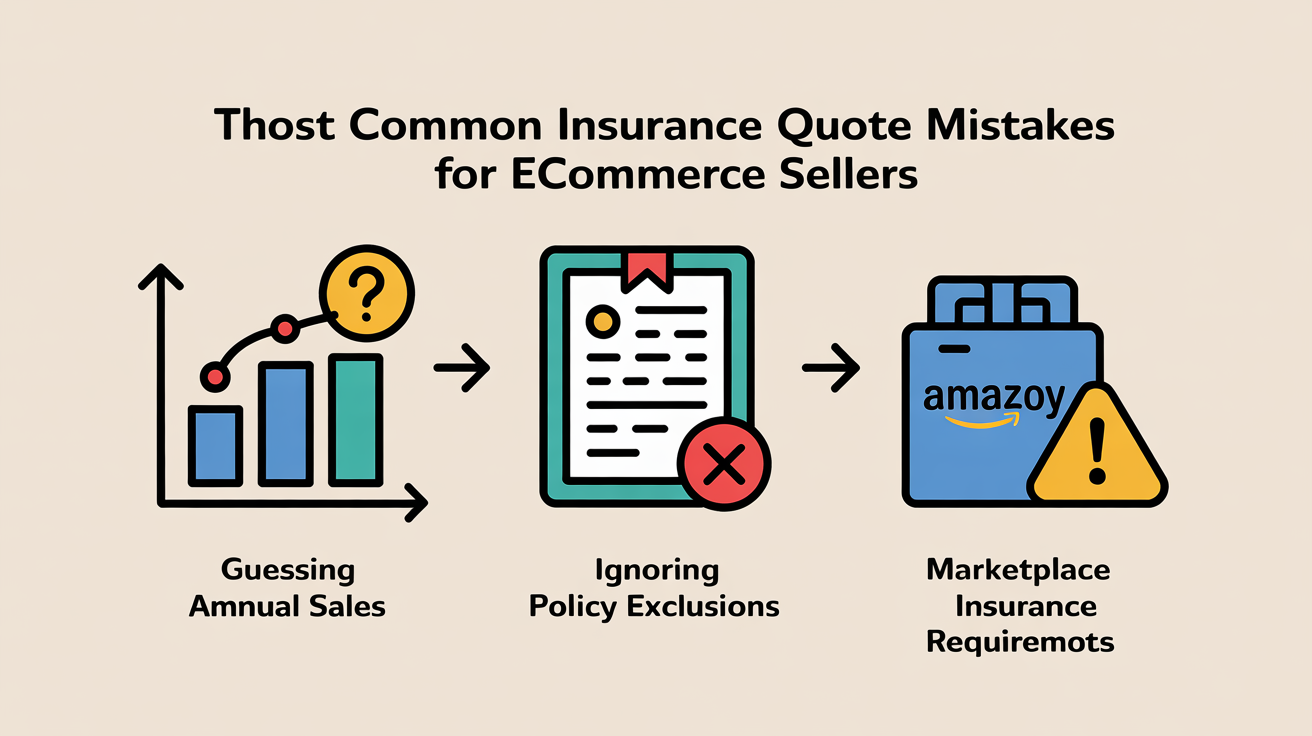
Guessing your sales volume locks you into higher premiums or risks denied claims. A single bad estimate can drain profits or leave you exposed if sales spike past your coverage limit.
1. Relying on Sales Forecasts Instead of Actual Numbers
Traditional insurers usually want an annual sales estimate. Many eCommerce sellers guess or use outdated numbers. Underestimate, and your limit may fall short when you need it, leading to denied claims or surprise retroactive bills. Overshoot, and you pay for coverage you never use, cutting into margins.
Use actual, historic sales data from your platform whenever possible. Avoid policies that demand future projections unless absolutely necessary. Pay-as-you-sell models charge monthly, based on real sales, so you only pay for what you sell. That protects your cash flow and closes gaps as your business grows. For step-by-step guidance, see how your quote flows from instant entry to final coverage decision.
2. Accepting Policy Exclusions You Don’t Fully Understand
Exclusions hidden in policy details can strip away protection for the risks you actually face, like product liability, cyber events, or shipping losses. Many sellers skim these sections or assume “general liability” covers everything, only to be blindsided later. Exclusion lists are long, dense, and often unclear.
- Read every exclusion in your quote and policy summary, not just the highlights.
- Ask your insurer or agent how each exclusion applies to your actual operations and products.
- Get written confirmation if an exclusion removes coverage for anything your selling platform requires. Don’t guess, verify compliance.
- If you sell physical goods, check that product liability isn’t excluded or capped below marketplace minimums. For stores handling customer data, confirm cyber and data breach coverage is included.
3. Missing or Misreading Amazon, Shopify, or Marketplace Requirements
Amazon, Shopify, and other marketplaces set strict insurance rules, like minimum general liability limits, product liability, and listing themselves as an additional insured. Many sellers buy generic policies that miss these details or overlook fine print in the marketplace terms. That leads to non-compliance and possible account suspension.
Amazon.com requires commercial liability insurance within 30 days of exceeding USD $10,000 in gross proceeds in any month. From November 2, 2026, enhanced-safety listing categories require at least USD $1 million per occurrence and in aggregate regardless of sales. Cross-check your quote and policy against every requirement published by your marketplace. For Amazon, that means at least $1 million per occurrence and naming Amazon as an additional insured. Upload proof of insurance before hitting required sales thresholds to avoid sudden suspension. See common ways product liability coverage falls short and how to meet every platform rule in detail.
Subtle Pitfalls: Advanced Quotation Mistakes Even Experienced Sellers Make
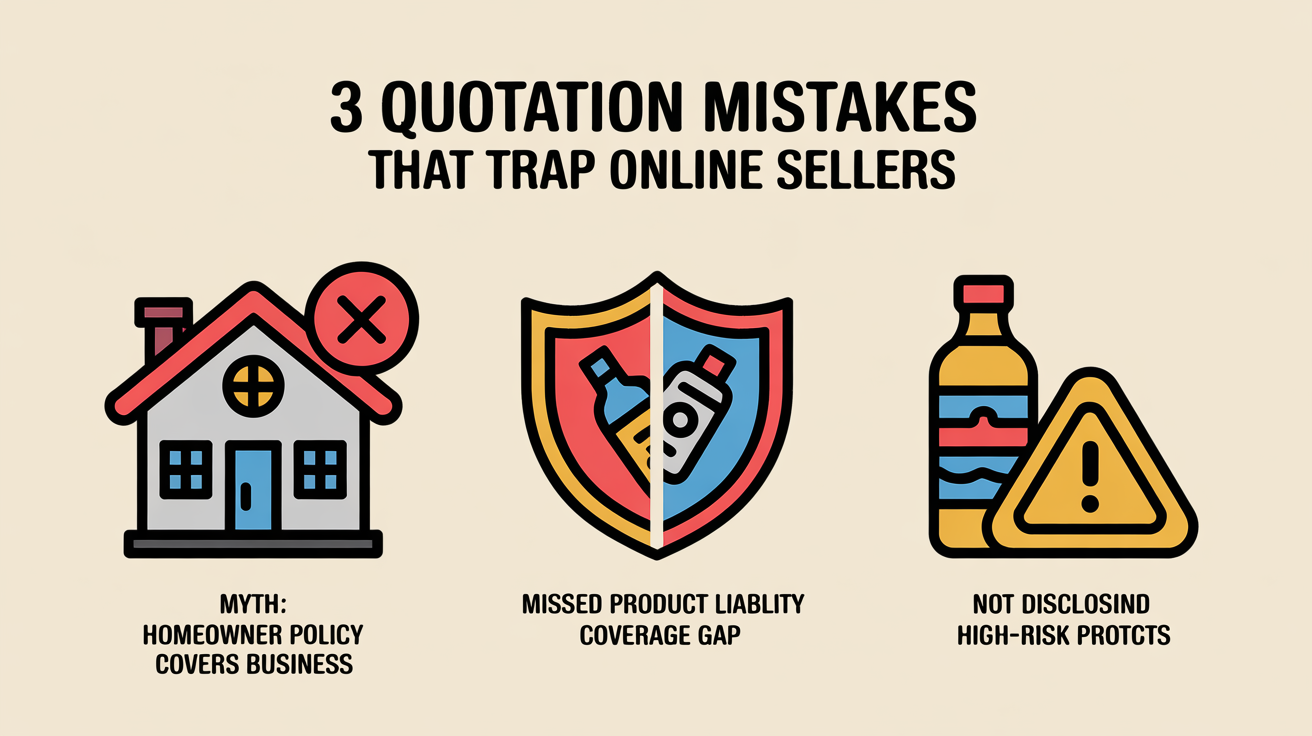
Many sellers with years of experience still trip up on coverage details. One common risk: assuming a bundled quote handles every liability. Product claims get denied, even after years of paying premiums, because the actual policy left out product liability. Another trap, expanding into new regions or channels without revisiting your coverage, can leave hidden gaps that only show up after a loss.
Mistaking Bundled Coverage for Comprehensive Protection
One seller lost nearly their entire savings after a customer injury. The policy looked like “full coverage,” but only combined general liability and property protection, no product liability. Many bundled eCommerce insurance packages offer basic protections but quietly exclude product-related risks, often buried in the fine print or offered as optional add-ons. If your policy skips product liability, you’ll pay out of pocket for injuries, recalls, or lawsuits tied to your inventory, private label, or imports.
Request a clear breakdown of what’s covered and what’s not. Push for sample claims in writing, ask if your specific products and sales channels are protected in scenarios that happen in your category. Comparing product and general liability side by side reveals where most sellers find gaps. See our guide on how product and general liability affect your online store's bottom line.
Overlooking Location-Specific Risks and Regulatory Rules
Expanding to a new state or country? Many sellers get caught out when their quote ignores local rules, required coverages, or regional exclusions. Insurance requirements shift by state, city, and product type. Failing to check details leads to noncompliance, fines, and denied claims, especially if you ship internationally or split inventory across warehouses.
- Share all fulfillment and inventory locations with your insurer, not just your HQ.
- Ask about state and local insurance requirements for your business and your products.
- Get written confirmation that your policy meets the rules in every region you sell or operate.
- Review exclusions for local risks, like flood, fire, or privacy laws. Overlooked here, claims get denied. For common gaps, check what is not covered by the commercial general liability policy.
Failing to Update Your Quote as Your Business Changes
Insurance needs shift fast, hit a sales milestone, add new products, or open a second warehouse, and your old coverage might not fit. Many sellers stick with their original policy after major changes, then get surprised by denied claims tied to new inventory or channels. Growth, international shipping, even a spike in SKUs, each one changes your risk profile.
Best practice: review your policy every time you hit a growth milestone or change operations. Double your SKUs? Start selling in another country? Update your quote now, not just at renewal. That keeps your coverage compliant and limits out-of-pocket losses. Industry data shows that annual and post-expansion reviews catch most exposures before they become expensive mistakes.
How to Lock In Accurate Quotes: A Seller’s Prevention Framework
Accurate insurance quotes don’t happen by accident. Sellers who build routines around regular data updates, policy reviews, and compliance checks report up to 40% fewer coverage gaps. Treat risk management as continuous, not a box to check once a year.
- Keep sales and inventory data current. Update your insurance records with real sales and product info each month. Not just at renewal. This closes gaps and avoids surprise premium jumps.
- Review policy documents for exclusions and endorsements. Scan each section for missing product types, excluded regions, or required add-ons. Don’t expect your coverage to match every risk by default.
- Schedule annual insurance reviews, especially after major changes. New SKUs, international sales, or added warehouses all call for a fresh policy review. Growth triggers new risks, don’t just focus on sales numbers.
- Cross-check compliance with marketplace rules before each renewal. Marketplace requirements change often. Use a compliance checklist before you renew or update policies. See the ultimate insurance checklist for new store owners for guidance.
Make these checks routine. Errors drop. Confidence builds. Each habit strengthens the rest, closing gaps before they get expensive. Over time, you’ll spend less effort fixing mistakes, and more running your store stress-free. See how these habits can also lower your liability premiums without sacrificing coverage long-term.
The Critical Takeaway: One Quoting Habit That Shields Your Business
The most expensive mistake for eCommerce sellers? Treating the insurance quote as a one-off task. If you only review your coverage once a year, you risk outdated protection, denied claims, and even losing your ability to sell. Gaps appear when business details get neglected, often surfacing only when you file a claim and it’s too late to fix the paperwork.
Protection starts with a single habit: treat quoting as a routine. Update your business info, check your policy for compliance, and confirm coverage every time you change operations or add products. Sellers with this habit see fewer unresolved claims and faster dispute resolution, industry data shows claims with up-to-date records are settled up to 30% faster.
Give insurance quoting the same priority as inventory or customer service. You’ll sidestep last-minute stress and keep your business shielded against costly surprises. Want to see how these routines match your business structure and coverage? See our guidance on whether to insure the business or yourself.


Frequently Asked Questions
What specific documents, sales reports, and records should I prepare to get an accurate eCommerce insurance quote?
Prepare company formation documents (Articles of Incorporation/LLC filing), EIN, business license/DBA, 2-3 years of tax returns, year‑to‑date profit & loss and balance sheet, and bank and merchant‑processor statements showing monthly and channel‑specific gross sales. Provide detailed sales reports and records: monthly/annual revenue by channel (website, Amazon, Etsy, wholesale), SKU/inventory lists with valuations, sales by product/category, return/warranty and chargeback rates, customer complaints, and loss runs/claims history. For product liability and cyber quotes include product descriptions/photos, SDS/CE/UL/testing/certification reports, supplier/manufacturer contracts, fulfillment/warehouse leases and photos, proof of PCI compliance/SOC2/pen tests, privacy policy and incident response plan, and any prior breach or claim reports.
Does a standard policy cover inventory stored at third‑party logistics (3PL) providers or Amazon FBA, and how should I disclose that when requesting a quote?
No, standard commercial property policies (and CGL) usually do not cover loss to your own inventory at 3PLs or Amazon FBA unless you add specific off‑premises/bailee or warehouse legal liability endorsements; CGL covers third‑party BI/PD but not your own stock. When quoting, disclose each 3PL/FBA facility by name and address, the average and peak inventory values stored there, transit frequency/values, types of goods, and any contractual insurance requirements, and ask the broker for bailee/warehouse legal liability, off‑premises stock and transit (or contingent cargo/stock‑throughput) limits, deductibles, and whether the 3PL must be named on the policy.
How does selling or shipping internationally affect my insurance quote, coverage limits, and exclusions?
Selling or shipping internationally typically raises your premium and often pushes underwriters to require higher limits (many e‑commerce policies use $1M/$2M as a common baseline) because of larger exposure, foreign legal costs, and higher defense/claims expenses. Carriers frequently add territory restrictions or specific exclusions for sanctioned or high‑risk countries, require export/foreign‑sales endorsements, or shift coverage to excess & surplus markets for unusual exposures. Underwriting will scrutinize product compliance, testing, packaging and shipping controls and may require separate cargo, political‑risk, or specialty endorsements, compare multiple insurers or an independent agent for the best terms.
How do insurers evaluate high‑risk product categories (electronics, cosmetics, supplements), and what actions can reduce the premium quoted for those items?
Insurers underwrite electronics, cosmetics and supplements by measuring frequency/severity of past losses (theft, fraud, returns, chargebacks, product‑liability/recall and bodily‑injury claims), sales metrics (average order value, return/chargeback rates), supplier/manufacturer quality, regulatory compliance (GMP, COAs, MSDS) and physical/e‑commerce controls (warehouse security, 3PL insurance, fraud tools). To lower the quoted premium you can document and strengthen controls, provide third‑party lab reports/COAs, GMP/ISO certificates, supplier liability insurance, move inventory to insured 3PLs, add CCTV/EAS/cycle counts, implement fraud prevention (3‑D Secure, AVS) and tighten returns/warranty policies, insurers reduce rates when loss runs, chargeback/return rates and regulatory exposure are demonstrably low. You can also accept higher deductibles or product‑specific sublimits, or buy a separate product‑liability endorsement, to materially reduce the premium.
What’s the difference between an insurance quote, a binder, and a certificate of insurance, and how long is a typical quote valid?
A quote is an insurer’s non‑binding estimate of cost and proposed coverages based on the information you provided, typically valid about 30 days (commonly 15-90 days depending on the carrier). A binder is a short‑term, binding document issued by the insurer or agent that provides immediate legal coverage until the formal policy is issued (commonly 30 days, sometimes extendable to 60-90 days). A certificate of insurance (COI) is a third‑party summary that verifies a policy’s types, limits and effective/expiration dates for someone else (e.g., a landlord or client) but is not the policy and does not change coverage.
Can insurance cover lost revenue from marketplace account suspensions, delisted listings, or chargeback disputes, and how is that reflected in quotes?
No, standard general liability and property policies generally do not cover lost revenue from marketplace account suspensions, delisted listings, or routine chargeback disputes because those are contractual/operational or non‑physical/cyber risks excluded by GL. You can purchase specialized coverage (contingent business interruption or non‑physical business interruption endorsements, cyber/business interruption, merchant‑fraud or marketplace‑seller insurance) but insurers quote them as separate endorsements or standalone policies with sublimits, waiting periods/deductibles, and higher premiums tied to your revenue and loss history. Quotes therefore show these coverages as distinct line items or add‑ons (not included in a standard GL quote) with explicit exclusions and limits.
When comparing quotes, how should I weigh liability limits, sublimits, deductibles, and endorsements to choose the best value for my business?
Prioritize adequate per‑occurrence and aggregate limits (most small businesses carry $1M per‑occurrence / $2M aggregate) and pick limits at least equal to your personal/business net worth or higher if you face product‑liability or high defense‑cost exposure. Inspect sublimits (e.g., product recall, cyber, bodily injury from specific products) because they cap payouts for key risks and may require endorsements or separate policies to fill gaps. Balance premium vs deductible by getting at least three apples‑to‑apples quotes (same limits/deductible) and choose a deductible that meaningfully lowers premium but you can afford to pay out of pocket.

Rohit Nair is the CEO and Founder of Assureful, an insurtech venture creating smart insurance products for ecommerce businesses. With a track record of launching and scaling successful ventures across health, wellness, ecommerce and consumer technology, with multiple exits and acquisitions, Rohit brings deep expertise in financial management, regulatory environments, and high-growth startups.
For more on this topic, see our guide to instant insurance calculator.
Related: Commercial Insurance Online Quote? What Happened When We Tested 5.
Related: Instant Business Insurance Quote Free? How Instant Quotes Work And.