

# Summary eCommerce insurance quotes vary dramatically ($26, $99/month) not just in price but in coverage scope, claims handling, and underwriting quality, making lowest-cost selection risky. eCommerce sellers face specific exposures, product liability, marketplace compliance, customer data, inventory concentration, that generic policies often exclude or underprice, creating invisible gaps until claims occur. The key is matching coverage types (general liability, product liability, cyber liability, bundled BOPs) to your actual business model and sales volume rather than chasing the cheapest premium.
Pay-as-you-sell general liability insurance designed specifically for eCommerce. Premiums starting from just $26 per mon...
Premiums from $26/month
Learn MoreWhy Comparing eCommerce Insurance Quotes Is More Complex Than It Looks
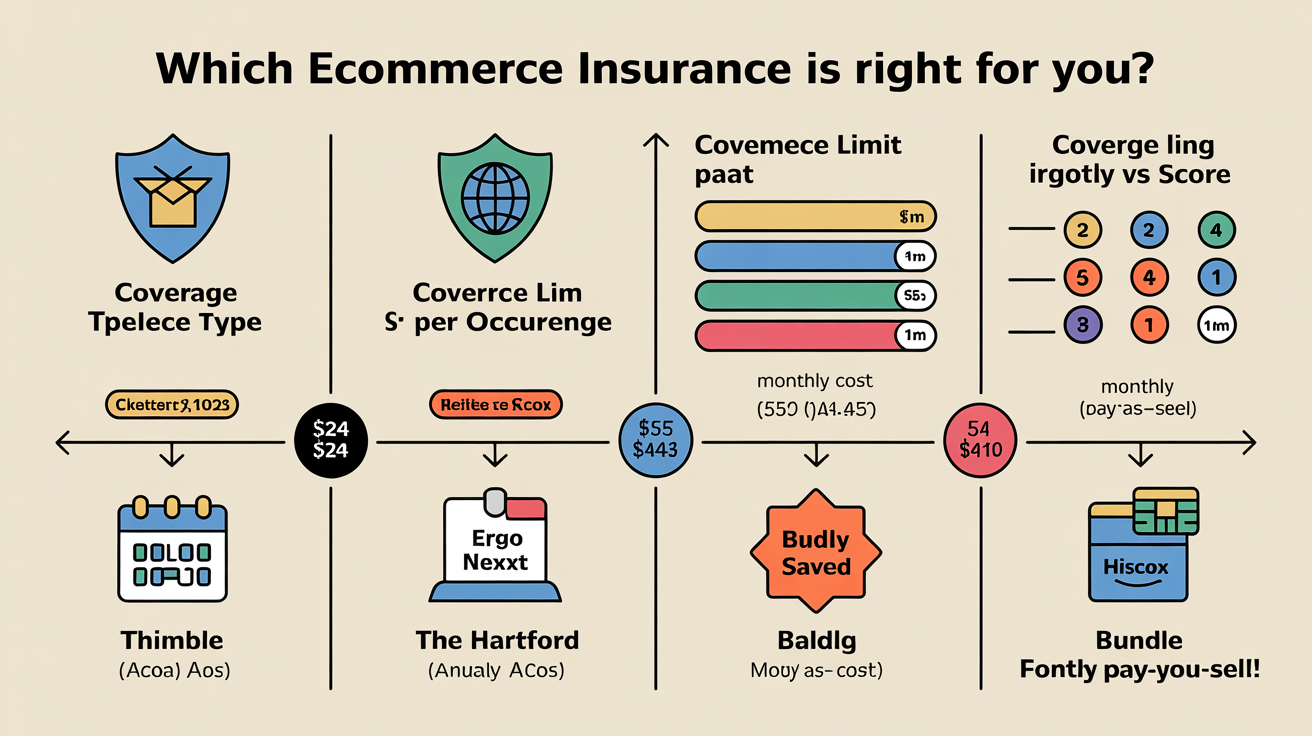
General liability insurance for eCommerce sellers ranges from $24 to $99 per month across major providers. The lowest premium is rarely the best choice for your business.
You might assume insurance shopping works like comparing airfare: find the lowest price, buy it, done. eCommerce insurance doesn't work that way. A $26 monthly quote and a $99 monthly quote aren't pricing the same protection. They differ in what they cover, how claims get handled, who underwrites the policy, and whether the terms fit how you actually sell.
Your risks are specific. You handle product liability, marketplace compliance requirements, customer data, and inventory concentration - exposures that generic business policies often exclude or underprice. Picking coverage based solely on monthly cost leaves gaps that feel invisible until you need them.
This guide walks you through what separates a cheap quote from a protective one. You'll learn what actually drives pricing differences across providers, how to assess whether a policy matches your business model, and how to set coverage limits based on real downside rather than industry defaults. By the end, you'll move from your first instant quote to a fully informed purchase decision without overpaying or underprotecting your store.
The eCommerce Insurance Market: What Types Of Coverage Exist And Who Offers Them
eCommerce sellers typically need three to five core coverage types: general liability, product liability, cyber liability, and often a bundled Business Owner's Policy (BOP) that combines multiple protections. The specific mix depends on your product category, sales volume, and whether you operate from a dedicated location or home office.
You have three main ways to shop for coverage: buy directly from an insurer, use an online marketplace that aggregates quotes from multiple carriers, or work with a broker who handles the paperwork. Online routes tend to be fastest for most sellers, though some larger carriers still require agent contact for quotes above certain revenue thresholds.
Bundling related coverages into a single BOP typically saves 15-25% compared to purchasing policies separately. That savings matters when you're managing cash flow on thin margins.
General Liability Insurance
General liability covers bodily injury and property damage claims arising from your business operations - for example, a customer trips on your warehouse steps or a delivery vehicle damages someone's fence. It's foundational coverage that most platforms require, though it does not cover damage caused by the products you sell.
This is where most eCommerce sellers start. Costs typically range from $20-$50 per month for small to mid-sized operations, though the actual premium depends on your sales volume, product category, and claims history.
Product Liability Insurance
Product liability protects against claims that your products caused injury or property damage. If you sell electronics, supplements, clothing, toys, or imported goods, this coverage is essential - and often required by Amazon, Shopify, and other platforms as a condition of selling.
Product liability premiums vary widely based on product risk. A seller of low-risk items like books or office supplies may pay $15-$30 monthly, while someone selling kitchen appliances or children's products typically pays $40-$100 or more. Claims history and product sourcing (domestic vs. imported) both influence pricing.
Cyber Liability Insurance
Cyber liability covers losses from data breaches, ransomware attacks, and other digital threats. Since you handle customer payment data, email addresses, and shipping information, a breach can expose you to notification costs, regulatory fines, and customer lawsuits.
Cyber coverage is increasingly critical for eCommerce. Standalone policies range from $25-$75 per month depending on your annual revenue and security practices. Many insurers now offer it as an add-on to a BOP, which keeps costs lower than buying separately.
Business Owner's Policy (BOP)
A BOP bundles general liability, commercial property, and business interruption coverage into a single policy. You can customize it by adding cyber liability, professional liability, or workers' compensation as endorsements. This approach reduces your premium by consolidating underwriting and simplifies administration with one bill and renewal date.
BOPs are particularly cost-effective for home-based sellers or those with modest inventory. A basic BOP typically starts around $40-$60 monthly and scales with your sales and property value.
How and Where to Shop
Direct insurers like Progressive, Nationwide, and Chubb let you get quotes online in minutes. Online marketplaces like Simply Business aggregate quotes from multiple carriers in one application, saving you time if you want to compare options side-by-side. Brokers provide personalized guidance but typically charge fees or earn commissions, which may increase your premium.
For most eCommerce sellers under $1 million in annual revenue, online quoting is fast and transparent. Larger operations sometimes need agent consultation, particularly if your product category falls outside standard underwriting guidelines or if you're seeking specialized coverage.
Who Offers eCommerce Insurance
The major carriers - Progressive, Nationwide, Chubb, Westfield, and ERGO - each target different seller profiles. Progressive emphasizes customization and online quoting. Chubb offers high financial strength and extensive add-on options. Westfield is strong for home-based businesses. The "best" insurer for you depends on your revenue, product type, and whether you need fast online quoting or prefer working with an agent.
Smaller, specialized carriers like Thimble and Coverdash focus specifically on eCommerce and gig economy sellers, often with faster underwriting and platform integrations. Your choice should align with how you sell and what coverage gaps matter most to your business.
The Six Decisions That Determine Which Policy You Should Actually Buy
You face a cascade of choices when comparing insurance quotes, and each one trades cost against protection or convenience. The decisions you make now - about coverage types, limits, billing frequency, and how you buy - will determine whether your premium feels affordable or wasteful 12 months from now.
Decision 1: Which Coverage Types Do You Actually Need?
Your product category and sales platform dictate which coverages are non-negotiable. If you sell physical goods on Amazon or Shopify, product liability and general liability form the foundation. If you also process customer payment data or store customer information, cyber liability becomes essential, not optional. If you import goods from overseas, confirm your policy explicitly covers imported products - many standard policies exclude them.
Start by identifying product liability versus general liability differences so you know what each protects. Then layer on cyber, professional liability, or crime coverage only if your specific operations create that risk. Bundling unneeded coverage inflates your premium without reducing your actual exposure.
Decision 2: What Coverage Limits Should You Choose?
Amazon's Pro Merchant program requires $1 million per occurrence in general liability coverage, making that a common baseline for sellers on that platform. Shopify and eBay have no mandatory minimums, but most underwriters will recommend $1 million per occurrence as standard for eCommerce operations with any meaningful sales volume.
Higher limits increase your premium, but the cost difference between $1 million and $2 million is often smaller than you expect. The real question is whether a single claim could exceed your chosen limit and bankrupt the business. If a product defect injures a customer and they sue for $3 million in damages, a $1 million policy leaves you personally liable for the gap. Choose limits based on your worst-case loss scenario, not on what feels cheap today.
Decision 3: Monthly or Annual Billing - and Why It Matters for Your Cash Flow
Annual policies require a large upfront premium, which strains cash flow if your revenue is seasonal or unpredictable. Monthly billing spreads that cost across 12 payments and ties your premium to your actual prior-month sales, not a forecast you made six months ago.
If your Q4 revenue is 40% of your annual total, monthly billing means you pay proportionally less in slow months and more when sales spike. This alignment reduces the risk of overpaying in lean periods or facing an audit adjustment if your actual sales exceed your forecast. For sellers with variable revenue, monthly billing is a material financial advantage.
Decision 4: Bundled Policy or Standalone Coverage?
A bundled business owners policy (BOP) combines general liability, commercial property, and business interruption into one package. Bundling typically saves 15-25% compared to buying each coverage separately, because underwriters consolidate their underwriting costs and offer a discount for your loyalty.
The tradeoff is customization. A BOP gives you less granular control over individual coverage limits and may include property coverage you don't need if you operate from home with minimal inventory. For most eCommerce sellers, the savings justify the trade. If you have unusual coverage needs - for example, high-value inventory or specialized equipment - a standalone product liability policy may offer better precision and value.
Decision 5: Price Versus Provider Quality and Claims Experience
The cheapest quote is rarely the best deal if the insurer has slow claims handling, poor customer service, or a weak financial rating. Research shows that cost and customer satisfaction don't always move together. A carrier that undercuts competitors by 30% may do so by hiring fewer claims adjusters or by denying claims at higher rates.
Compare quotes using pricing benchmarks and cost-reduction tactics to identify where you can negotiate or bundle for savings. But also check the insurer's financial strength rating (A-rated underwriters are standard; avoid anything below A-) and read recent customer reviews about claims processing. A premium that's $10 more per month is worthless if the insurer takes six months to settle a claim or denies it outright.
Decision 6: Direct Insurer, Marketplace, or Broker?
Direct insurers like Progressive or Chubb let you quote and bind coverage online in minutes with full transparency on pricing. Online marketplaces aggregate quotes from multiple carriers in one application, saving time if you want to compare side-by-side. Brokers provide personalized guidance and handle underwriting on your behalf, but they typically earn commissions that may be reflected in your premium.
For sellers under $1 million in annual revenue with straightforward operations, direct or marketplace quoting is fast and cost-effective. If your product category is unusual, you import goods, or you need specialized add-ons, a broker's expertise and relationships can coverage you won't find online. Choose the channel that matches your complexity and preference for speed versus personalization.
7 Mistakes Sellers Make When Comparing Insurance Quotes Online
Most sellers choose coverage based on price alone, but the cheapest quote often masks dangerous coverage gaps. A $24 monthly general liability policy may sound attractive until a customer injury claim arrives and you the policy excludes your sales channel or product category.
The mistakes below cost sellers thousands in denied claims, uninsured losses, and renewal surprises. Each links to detailed analysis so you can avoid them.
- Mistake 1: Choosing on price alone. Insurance quotes vary dramatically by underwriter and product category, but the lowest premium often means lower limits, higher deductibles, or excluded coverage types that match your actual risk.
- Mistake 2: Assuming platform coverage protects you. Amazon, Shopify, and Etsy do not cover customer lawsuits from product defects or injuries - you must buy product liability insurance separately to be legally compliant.
- Mistake 3: Skipping cyber liability insurance. Nearly 43% of cyberattacks target small businesses, and a single data breach costs $50,000 or more in customer notification, legal fees, and system recovery - yet many sellers omit this coverage entirely.
- Mistake 4: Underestimating product liability exposure. In 2021 alone, emergency rooms treated 11.1 million consumers for product-related injuries, and online sellers were named in many of those lawsuits.
- Mistake 5: Not checking AM Best financial ratings. An insurer with poor financial strength (below A-) may deny your claim or collapse before paying, leaving you unprotected when you need coverage most.
- Mistake 6: Comparing fewer than three quotes. Insurance pricing varies by product category - electronics and supplements cost far more than clothing or home décor - so quotes from at least three carriers true market pricing for your risk profile.
- Mistake 7: Missing renewal traps. Deductibles, limits, and exclusions can shift at renewal without warning, and past claims (even small ones) can trigger higher premiums or non-renewal.
Why Price Alone Fails You
Low-cost carriers cut premiums by restricting coverage, raising deductibles, or targeting lower-risk product categories. A $24 monthly general liability policy may exclude imported goods, digital products, or multi-channel sales - exactly what you need as an eCommerce seller. When you file a claim and your product category or sales channel isn't covered, the "savings" evaporate.
Compare total cost of ownership: premium plus deductible plus coverage limits. A policy costing $50 monthly with a $500 deductible and $1 million limit often protects you better than a $24 policy with a $2,500 deductible and $250,000 limit.
The Platform Coverage Myth
Amazon, Shopify, Etsy, and other platforms provide seller protection policies, but they cover platform-specific disputes - account suspension, payment holds, transaction disputes. They do not cover customer injuries from defective products or property damage claims. You remain personally liable for product liability lawsuits, and the platform will not defend you.
If a customer is injured by your product and sues, the platform's insurance protects the platform, not you. You must carry your own product liability coverage to be fully protected and compliant with state consumer protection laws.
Cyber Liability: The Overlooked Risk
Most eCommerce sellers collect customer payment data, email addresses, and shipping information. A data breach doesn't just damage your reputation - it triggers legal notification requirements, credit monitoring costs, forensics fees, and potential regulatory fines. A single breach can cost $50,000 to $100,000 or more, yet 42% of small business owners have no cyber incident response plan.
Cyber liability insurance pays for breach notification, customer credit monitoring, legal defense, and business interruption losses while you recover systems. Basic coverage costs around $500 annually or $57 monthly, far less than the cost of a breach. Without it, a single incident can force you to close.
Product Liability Exposure Is Real
The 11.1 million product-related injury emergency room visits in 2021 represent real lawsuits against sellers. If your product causes injury - a defective phone charger starts a fire, a children's toy has a sharp edge, supplements trigger an allergic reaction - you face medical bills, legal defense costs, and settlement liability. Product liability insurance covers these costs and your legal defense.
Many sellers underestimate exposure because they assume their supplier or manufacturer covers liability. Most supplier contracts explicitly exclude liability for your sales and marketing. You are responsible for the safety of products you sell, regardless of who manufactured them.
Financial Strength Ratings Matter for Claims
An insurer with an A- or higher AM Best rating has the financial resources to pay large claims. Insurers rated below A- have higher failure rates and slower claims processing. If you file a $250,000 claim and your insurer is financially weak, you may wait months or years for payment - or receive nothing if the company collapses.
Always verify your insurer's AM Best rating before purchasing. It's a quick lookup and one of the strongest predictors of claim payment reliability.
Why Three Quotes Is the Minimum
Insurance underwriters price the same risk very differently based on product category, sales volume, and claims history. Electronics and supplements typically cost 2-3 times more than clothing or home décor. A $500,000 annual revenue electronics seller might receive quotes ranging from $60 to $180 monthly for the same coverage limits - a 200% difference.
Getting quotes from at least three carriers ensures you identify market pricing for your specific risk. It also reveals which underwriters specialize in your product category and offer the best terms. One carrier may offer better cyber coverage while another excels at product liability.
Renewal Traps and Silent Changes
At renewal, insurers often increase deductibles, lower limits, or add exclusions without explicit notice. If you had a small claim - even one you didn't think was significant - your renewal premium may spike 50% or higher. Some insurers will non-renew you entirely if your claims history doesn't match their underwriting appetite.
Read your renewal notice carefully. Compare it to your current policy. If deductibles or limits changed, ask your agent why. If the premium jumped unexpectedly, request a breakdown and shop for competing quotes. Past claims are among the strongest predictors of future pricing, so even minor losses can affect renewal terms.
How to Protect Yourself
Start by understanding the common mistakes that turn quotes into traps, then screen each quote for the red flags that signal inadequate or overpriced policies. Request quotes from at least three carriers and ensure each covers all your sales channels (website, Amazon, Shopify, social media). Verify that cyber liability, product liability, and general liability are all included or available as add-ons.
Ask each insurer about their claims process, average settlement time, and AM Best rating. Request sample policies so you can compare coverage details side-by-side. Don't rely on a broker's summary - read the actual policy language for exclusions and limits. Finally, set a calendar reminder 60 days before renewal to review your current policy and shop competing quotes before your renewal date arrives.
--- ## Sources [1] "How to Reduce Ecommerce Business Insurance Costs," NerdWallet, accessed March 2026. [2] "Ecommerce Insurance Quotes and Pricing Analysis," NerdWallet, accessed March 2026. [3] Cyber liability insurance coverage overview, NerdWallet, accessed March 2026. [4] "Ecommerce Business Insurance Overview," NerdWallet, accessed March 2026. [5] "Cyber Insurance for Ecommerce Businesses," NerdWallet, accessed March 2026. [6] "Increasing Deductibles to Lower Premiums," NerdWallet, accessed March 2026. [7] "Technology Errors and Omissions Insurance," NerdWallet, accessed March 2026. [8] "Ecommerce Business Insurance and Cyber Risk," NerdWallet, accessed March 2026. [9] "Ecommerce Insurance Evaluation Criteria," NerdWallet, accessed March 2026. [10] "Professional Liability Insurance for Ecommerce," NerdWallet, accessed March 2026. [11] "Product Liability and Cyber Insurance Costs," NerdWallet, accessed March 2026. [12] "Business Owner's Policy Coverage Options," NerdWallet, accessed March 2026. [13] "Bundling Insurance Coverage for Ecommerce," NerdWallet, accessed March 2026. [14] "Ecommerce Insurance Provider Comparison," NerdWallet, accessed March 2026. [15] "Professional Liability Insurance for Online Retailers," NerdWallet, accessed March 2026. [16] "Affordable Professional Liability Insurance Providers," NerdWallet, accessed March 2026. [17] "How to Compare Insurance Quotes," NerdWallet, accessed March 2026. [18] "Cyber Insurance and Business Interruption Coverage," NerdWallet, accessed March 2026. [19] "Enterprise Ecommerce Insurance Coverage Requirements," accessed March 2026. [20] "Coverage Limits for High-Revenue Ecommerce Businesses," accessed March 2026. [21] "Commercial Property Insurance for Ecommerce Inventory," NerdWallet, accessed March 2026. [22] "Cyber Liability Claims and Business Continuity," NerdWallet, accessed March 2026. [23] "Claims History and Insurance Renewal Pricing," NerdWallet, accessed March 2026. [24] "Online Insurance Quote and Purchase Options," NerdWallet, accessed March 2026. [25] "Finding the Right Insurance Coverage for Your Store," NerdWallet, accessed March 2026. [26] "Calculating Cyber Insurance Coverage Needs," accessed March 2026. [27] "General Liability and Cyber Insurance Bundling Costs," NerdWallet, accessed March 2026. [28] "Business Owner's Policy Quote Example," NerdWallet, accessed March 2026. [29] "Errors and Omissions Insurance for Online Businesses," NerdWallet, accessed March 2026. [30] "Ecommerce Insurance Coverage Types and Comparison," NerdWallet, accessed March 2026. [31] "When to Purchase Additional Insurance Coverage," NerdWallet, accessed March 2026. [32] "Specialized Insurance Coverage for Scaling Ecommerce," NerdWallet, accessed March 2026. [33] "Insurance Coverage Options by Business Size," accessed March 2026. [34] "Cybersecurity Controls and Insurance Premiums," accessed March 2026. [35] "Enterprise Cyber Insurance Claims Example," accessed March 2026. [36] "Midsize Business Insurance Provider Quotes," accessed March 2026. [37] "Small Business Insurance Provider Ratings," NerdWallet, accessed March 2026. [38] "Small Business Insurance Editorial Standards," NerdWallet, accessed March 2026. [39] "Ecommerce Property Insurance and Coverage," accessed March 2026. [40] "Online Insurance Quote and Support Channels," accessed March 2026.Where To Start: Matching Your Store's Situation To The Right Next Read
If you're unsure whether your store needs coverage at all, start with the insurance checklist. That article walks you through the specific situations that trigger a legal or contractual requirement - marketplace mandates, product types, customer agreements - so you can make a confident yes-or-no decision before spending time on quotes. Most new sellers and those selling low-risk products find clarity there in five minutes.
If you've already decided you need coverage and want to understand pricing before you commit, move to the pricing guide for ecommerce business insurance. That resource breaks down what typical policies cost, what drives those costs up or down, and how to budget for your first year. Sellers focused on managing cash flow or comparing options against other insurers should read that next. If you sell on Amazon or Shopify specifically, the platform-specific coverage requirements article addresses mandatory limits and certificate deadlines unique to each marketplace, so you can avoid compliance gaps.
Once you know what you need and what it should cost, consider a pay-as-you-sell option that matches your actual sales. With Assureful, you get an instant quote and pay monthly based on the previous month's revenue - no annual forecasts, no large upfront premiums. Policies start from $26 per month and are backed by A-rated underwriters, with platform integrations that automate certificate delivery and cancel with 30 days' notice if your needs change. Get an instant quote to see your personalized rate in under two minutes.

Frequently Asked Questions

Rohit Nair is the CEO and Founder of Assureful, an insurtech venture creating smart insurance products for ecommerce businesses. With a track record of launching and scaling successful ventures across health, wellness, ecommerce and consumer technology, with multiple exits and acquisitions, Rohit brings deep expertise in financial management, regulatory environments, and high-growth startups.
For more on this topic, see our guide to instant insurance calculator.
Related: Commercial Insurance Online Quote? What Happened When We Tested 5.
Related: Instant Business Insurance Quote Free? How Instant Quotes Work And.
Sources
- forbes.com
- insureon.com
- assureful.com
- fitsmallbusiness.com
- vouch.us
- thimble.com
- taxjar.com
- moneygeek.com
- irmi.com
- thesmokedrop.com
- controlhub.com
- dealhub.io
- blog.hubspot.com
- policyape.com
- co-opinsurance.com
- well-insurance.com
- geico.com
- thehartford.com
- embroker.com
- progressivecommercial.com
- thehartford.com
- progressivecommercial.com
- progressivecommercial.com
- progressivecommercial.com
- progressivecommercial.com
- progressivecommercial.com
- insureon.com
- insureon.com
- morganinsurancebrokers.com.au
- shopify.com
- quora.com
- moneygeek.com
- thehartford.com
- moneygeek.com
- insureon.com
- 1800insurance.com
- seo-pages-web.vercel.nerdwallet.com
- nerdwallet.com
- landesblosch.com
- hotalinginsurance.com
- nextinsurance.com
- assureful
- dealhub.io
- hubifi.com