

Amazon.com requires commercial liability insurance within 30 days of exceeding USD $10,000 in gross proceeds in any month. From November 2, 2026, enhanced-safety listing categories require at least USD $1 million per occurrence and in aggregate regardless of sales. Typical premiums vary by business size, product category, and marketplace rules; this guide provides real-world price ranges, key cost drivers, and practical steps to estimate and obtain a compliant $1M policy so sellers can budget accurately and avoid revenue disruption.
- Understanding the True Cost of a $1 Million...
- General Liability Insurance Basics: Coverage, Minimums, and Compliance...
- How to Get Your First $1 Million Policy:...
- Essential Tools and Resources for Managing eCommerce Insurance...
- Common Mistakes When Buying Your First $1 Million...
- Next Steps: Confidently Your First eCommerce Insurance Policy
Understanding the True Cost of a $1 Million Liability Insurance Policy for eCommerce
Missing or underestimating your insurance requirements as an eCommerce seller can lead to account suspension or unexpected out-of-pocket losses. From November 2, 2026, Amazon.com enhanced-safety listing categories require $1M per occurrence and in aggregate regardless of sales; the existing $10,000 monthly-sales trigger also remains.
Even if you have zero experience with insurance, understanding what a $1 million liability policy costs (and why) is simpler than it sounds. Here, you'll learn what general liability insurance covers, how much typical eCommerce sellers actually pay, and what drives those costs up or down - including your business size, product category, and marketplace rules. By the end, you'll know how to estimate your own costs, what to budget for, and how to start the process with confidence.
This guide breaks insurance down step by step - starting with the basics, then walking through real-world price ranges, the variables that influence premiums, and compliance details for major platforms like Amazon. If you want to go deeper, you'll find a link to more tips on how much you should pay and ways to lower your coverage costs. You don't need to be an insurance expert - this is practical, stress-free guidance for busy sellers who need quick, actionable answers.
General Liability Insurance Basics: Coverage, Minimums, and Compliance Triggers
General liability insurance protects your business if someone claims you caused injury or property damage. This coverage acts as a financial shield - covering legal fees, settlements, and certain medical costs. For eCommerce sellers, a $1 million policy is usually the minimum requirement to meet marketplace demands and safeguard against lawsuits.
What General Liability Insurance Covers
General liability insurance covers claims made by third parties - like customers or visitors - who say your business caused them harm. This includes injuries, property damage, and some advertising issues. For example, if a customer trips over packing materials in your warehouse and breaks an ankle, your policy can help cover medical bills and legal defense. If a shipment damages a customer's property, those repair costs may also be covered.
Your coverage can also extend to lawsuits over things like slander, libel, or copyright infringement in your product descriptions or ads. Read more about how product and general liability affect your online store's bottom line if you want concrete claim examples in the eCommerce setting.
Industry Standard Coverage Minimums and Marketplace Rules
For eCommerce, $1 million per occurrence is the standard minimum because it aligns with platform requirements and typical claim costs. "Per occurrence" means the insurer will pay up to $1 million for any single claim. Most marketplace contracts, like Amazon's, require at least $1 million per occurrence and $1 million aggregate (total for all claims in a year).
The trigger for needing this insurance is often a monthly sales milestone. From November 2, 2026, Amazon.com enhanced-safety listing categories require $1M per occurrence and in aggregate regardless of sales; the existing $10,000 monthly-sales trigger also remains. Other platforms have similar triggers, so your insurance needs may change as your business grows.
- Bodily Injury: Covers medical bills and legal fees if someone is injured due to your business activities or products.
- Property Damage: Pays for damage your business causes to someone else's property - like a customer's home during delivery.
- Personal and Advertising Injury: Protects against claims of slander, libel, or copyright infringement in your advertising.
- Product Liability: Handles claims that your product caused harm after sale, such as a faulty item injuring a customer.
- Medical Payments: Pays immediate medical bills for minor injuries, even before fault is established. Common limits are $5,000-$10,000.
Understanding Policy Limits: Per Occurrence and Aggregate
Your policy has two key limits: per occurrence and aggregate. The per occurrence limit is the most the insurer will pay for any one claim. The aggregate limit is the maximum the insurer will pay during the entire policy year - across all claims.
For example, if you have a "$1 million / $2 million" policy, you're covered for up to $1 million for a single lawsuit, and up to $2 million total for all claims made in that year. If you face three claims of $800,000 each, the third would only pay $400,000; the rest would come out of your own pocket.
What Influences the Cost of Your Policy?
The cost of a $1 million general liability policy for eCommerce sellers usually falls between $42 and $73 per month. Your premium depends on factors like your revenue, what you sell, and whether you've had past claims. Higher sales mean more exposure, so larger businesses pay more. If you sell high-risk products (like electronics or supplements), your rates will also be higher than for low-risk categories.
Your business structure, location, and even how you ship products can influence your rates. Choosing the right business insurance structure and coverage helps you balance protection with cost.
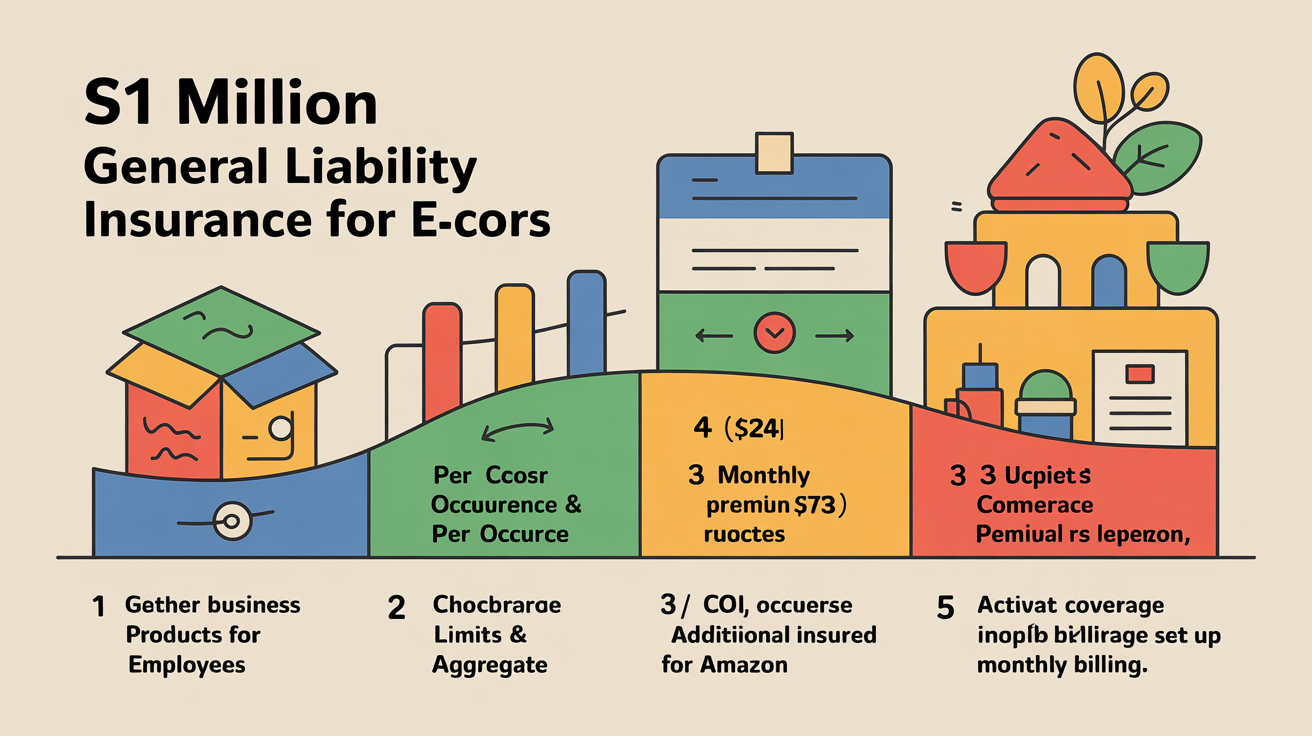
How to Get Your First $1 Million Policy: Step-by-Step for eCommerce Beginners
By following these steps, you'll secure a $1 million liability policy that meets marketplace requirements and protects your online business. You'll also understand what documents to prepare, what information insurers need, and how to avoid the most common mistakes first-time sellers make.
- Gather your business details. Start by collecting your legal business name, physical address, contact information, federal tax ID (if you have one), and business structure (sole proprietor, LLC, corporation). List your main sales channels (Amazon, Shopify, etc.), the categories of products you sell, and your fulfillment methods (in-house, FBA, dropshipping). Success here means you have all details organized in a single document or spreadsheet before requesting any quotes. Many beginners get delayed here by missing addresses or not knowing their full product mix - double-check before moving on.
- Estimate your monthly or annual sales. Insurers need your current or projected sales volume to generate an accurate price. For beginners, use your past 3-6 months of sales data, or a realistic monthly estimate if you're just launching. Write this number down. If you guess too high or too low, you risk overpaying or getting a policy that doesn't match your risk. The goal is to provide a number you can support with basic records.
- Request online quotes from multiple insurers. Use instant-quote platforms designed for eCommerce sellers, entering your details exactly as you've prepared them. Compare at least two offers to see differences in price, included coverages, and exclusions. Success means you have two or more quotes in writing to compare side-by-side. If a site asks confusing questions (like "business personal property" or "aggregate limit"), look for explanatory tooltips or check our page on instant quote platforms step by step.
- Check for platform requirements. Before you buy, review the insurance requirements for each marketplace you sell on. Amazon, for example, often requires you to list them as an "additional insured" and submit a Certificate of Insurance (COI) that matches their language exactly. Shopify may have different thresholds or forms. Done right, you'll have a checklist of platform requirements ready to provide to your insurer - avoiding the most common reason for policy rejection.
- Understand policy limits and billing options. Make sure your quote offers at least $1 million per occurrence and $2 million aggregate, which is the standard for most platforms. Confirm whether your premium is billed monthly (pay-as-you-sell based on actual sales) or as an annual lump sum. If you're unsure about terms or what level of coverage you need, reference our guide to how business structure affects your insurance requirements. Success means you know exactly what you'll pay and when - and can plan your cash flow.
- Prepare your Certificate of Insurance (COI). Once you've purchased your policy, request a COI from your insurer. Review it to make sure your business name, policy number, and additional insured wording all match the marketplace's requirements. Upload this COI to your seller portal or compliance dashboard as needed. If the document is rejected, check for small errors in the business name or missing endorsements - the top causes of delays.
After completing these steps, your business is protected and eligible to sell on major platforms. Your next milestones are to review your policy annually, keep sales and product information up to date with your insurer, and watch for new requirements as your business grows. As you become more advanced, you'll want to compare additional coverages (like business property or cyber insurance) and revisit your policy if you add new products, employees, or warehouse locations. Prioritizing these early steps puts you ahead of most new sellers and sets a strong foundation for stress-free insurance compliance.
Essential Tools and Resources for Managing eCommerce Insurance Costs
Your top priority as a beginner is finding tools that keep insurance simple, compliant, and cost-effective. The most important resource is a reputable online insurance quote platform. This lets you compare policies instantly and see how monthly or annual premiums stack up, so you avoid overpaying or buying the wrong coverage.
Online Quote Platforms and Premium Calculators
Start with a user-friendly online quote tool that specializes in eCommerce or small business insurance. These platforms allow you to enter your business details and receive instant, transparent pricing. Look for calculators that break down monthly versus annual costs and factor in pay-as-you-sell billing. As an alternative, some insurance providers offer direct quote portals with side-by-side comparisons, helping you estimate your insurance costs before you commit. For more detail, see strategies for estimating eCommerce insurance costs based on your store's projected sales.
Marketplace Compliance Checklists
Compliance checklists are essential for meeting Amazon, Shopify, and other marketplace insurance requirements. These documents outline the minimum coverage amounts, required policy types, and specific endorsement language you must include. Following a checklist minimizes the risk of having your Certificate of Insurance (COI) rejected and keeps your store active. If you plan to sell on multiple platforms, create a combined checklist to avoid missing any unique stipulations. For a ready-made resource, reference this step-by-step compliance checklist for new store owners.
COI Templates and Submission Guides
Having access to a sample Certificate of Insurance template and a submission walkthrough helps you prepare documents exactly as marketplaces expect. Many sellers get delayed at this step due to small formatting errors or missing additional insured wording. Use a template that matches Amazon's or Shopify's requirements, and follow a guide that explains the upload process, renewal timelines, and what to check if your COI is rejected. Some insurers provide downloadable templates as part of their onboarding materials.
Risk Assessment and Bundling Resources
Risk assessment checklists and bundling guides help you identify gaps and keep costs low as your business expands. Start with a simple risk checklist that flags high-risk products, overseas suppliers, or countries with higher claims frequency. For beginners, there are three key things to look for:
- Clear identification of product categories that may require extra coverage or higher premiums
- Location-based risk flags, such as fulfillment or shipping from regions with higher theft or damage rates
- Guidance on when to consider a bundled policy (like a Business Owner's Policy, or BOP) that rolls liability, property, and cyber protections into a single package
Many online business support sites and insurance providers offer free risk assessment tools and explain how bundles affect pricing and compliance. These resources are essential for planning coverage as your operations grow or diversify.
Common Mistakes When Buying Your First $1 Million Policy (And How to Avoid Them)
The most common mistake new sellers make is underestimating required coverage or choosing the cheapest policy without reading the details. This often leaves large gaps - especially if you skip product liability or cyber coverage. Gaps like these can result in denied claims, non-compliance, or account suspension.
Forgetting to Name Platforms as Additional Insured
Many first-time buyers forget to list Amazon, Walmart, or Shopify as "additional insured" on their Certificate of Insurance. This step is required by most marketplaces. Beginners often miss it because the online insurance forms make it optional or don't explain the consequences.
Always check your marketplace insurance requirements and confirm your insurer will issue an endorsement, not just a generic certificate. Ask for written confirmation and a copy of the endorsement page that shows each platform named correctly. This step prevents your policy from being rejected or your store from being suspended.
Skipping Product Liability or Cyber Insurance
Some sellers omit product liability or cyber insurance, thinking these are only for large businesses or high-tech brands. But product claims and data breaches can hit any seller, and most states now require breach notifications if you store customer information. Missing these coverages leaves your store exposed to expensive legal and regulatory claims.
Before you buy, review which exposures your business faces. If you sell physical goods, you need product liability at minimum. If you handle customer data (even email addresses), add cyber coverage. For a deeper look at how product liability affects your bottom line, review common oversights for eCommerce sellers.
Relying on Outdated or Inaccurate Business Details
It's easy to rely on estimates or old sales data when filling out insurance forms. But reporting incorrect revenue, product type, or fulfillment details can result in denied claims or non-compliance with marketplace rules. Insurers check this info during underwriting and at claim time - discrepancies are a red flag.
Update your business details before requesting a quote. Use your most recent sales numbers, double-check your product categories, and clarify if you import or fulfill through a third-party. This keeps your policy valid and your coverage stress-free if you need to make a claim.
Missing Out on Policy Bundling or Payment Discounts
Many beginners buy policies one-by-one as they scale, missing out on the savings from combining business, cyber, and property coverage. Others automatically choose monthly payment plans, not realizing some insurers offer a lower rate for paying annually.
Ask your insurer if bundling or annual payments will reduce your premium. You can see more ways to lower your liability premiums without sacrificing coverage by reviewing common tactics other sellers overlook.

Next Steps: Confidently Your First eCommerce Insurance Policy
Your first step is simple: confirm your need for product liability and general liability coverage the moment you start selling online. These policies protect you from lawsuits tied to injuries, property damage, or product issues - even if you never see the customer in person. Skipping coverage leaves you exposed from day one, since most claims are triggered by product sales or even a single fulfillment error.
In your first week, focus on understanding what $1 million general liability actually covers, what product liability excludes, and how your monthly costs will be calculated. Typical combined premiums for new stores range from $40 to $120 monthly, but rates depend on your sales and risk profile. Take time to update your business details, check requirements for every sales channel, and watch for common gaps - such as assuming general liability includes product claims or missing out on bundled discounts. For a deeper dive on policy limits and exclusions, review the differences in what is not covered by your general liability policy.
Securing the right coverage is manageable when you start with the essentials and stay proactive as you grow. Keep learning, ask questions, and build compliance into your workflow - this puts you in control and protects your business for the long term.
Frequently Asked Questions
Is $1 million in coverage enough for all eCommerce businesses?
No, $1 million may be enough for small, low‑risk eCommerce sellers, but it’s not universally sufficient. Businesses with higher revenue, risky products (supplements, electronics, toys), significant inventory or employees, cross‑border sales, or contractual demands from retailers/marketplaces often need $2-5+ million (or umbrella policies) plus separate cyber and product‑liability limits because single claims can exceed $1 million.
How do I know if Amazon or other platforms require additional insured status?
Check the platform contract and the platform’s insurance/requirements page, Amazon’s Seller Central and Vendor Central agreements and the Insurance Requirements page will state whether you must name the platform as an additional insured (Amazon.com Services LLC and its affiliates). From November 2, 2026, Amazon.com enhanced-safety listing categories require $1M per occurrence and in aggregate regardless of sales; the existing $10,000 monthly-sales trigger also remains. If the language is ambiguous, compare your COI to the contract, check Seller Central > Account Info/Insurance, or get written confirmation from platform support or your broker.
Can I cancel my general liability policy if I stop selling?
Yes, you can cancel. Many commercial general liability policies are cancellable with notice (for example, Assureful allows cancellation with 30 days' notice) and monthly/pay-as-you-sell programs stop future billing once cancelled. Check your specific policy for the required notice period, any minimum earned-premium or refund rules, and whether past sales remain exposed to claims after cancellation; keep cancellation proof and premium records since premiums are tax-deductible.
Does a $1 million general liability policy cover product recalls or the cost to replace defective products?
No, a $1 million general liability policy will typically cover third‑party bodily injury or property damage caused by a defective product up to the policy limits, but it does not cover product recall expenses, replacement costs, or recall logistics/notification. Product recall, withdrawal, or contamination expenses require a separate product‑recall/withdrawal policy (or specialized product recall/addendum) because those costs are generally excluded from standard GL.
Are general liability premiums for a $1 million policy tax-deductible as a business expense for eCommerce sellers?
Yes, general liability insurance premiums (including a $1 million policy) are generally tax-deductible as an “ordinary and necessary” business expense for eCommerce sellers. Claim the deduction on your business tax return (e.g., Schedule C for sole proprietors or on your entity’s return), keep records of premiums paid, and consult a tax professional for any situation-specific rules or mixed personal-use issues.
How long does it typically take to obtain a Certificate of Insurance (COI) to prove a $1 million policy to marketplaces like Amazon?
If you already have an active $1M general liability policy, your insurer or broker can usually issue a Certificate of Insurance the same day (often within hours) and certainly within 24-48 hours. If you need to buy and bind a new policy, many carriers can bind coverage and produce a COI within 24-72 hours for routine small-business risks, though complex underwriting, high‑risk industries, or adverse claims history can extend that to several days or up to one, two weeks; note marketplaces like Amazon often also require being named as certificate holder and/or additional insured, which your broker can add when issuing the COI.
How do business models like dropshipping or using third-party manufacturers affect the premium for a $1 million policy?
Generally it won’t raise your life‑insurance rate: dropshipping or using third‑party manufacturers is low on physical risk and underwriters set premiums mainly by age, health, occupation and hazardous exposures, so a dropshipper normally won’t pay more for a $1M policy. However, if you’re self‑employed and your business involves higher physical or liability exposure (eg. construction/trades or heavy manufacturing) insurers will apply extra scrutiny, may rate the policy higher, and will require the usual medical exam and proof of income for large ($1M) coverage.

Rohit Nair is the CEO and Founder of Assureful, an insurtech venture creating smart insurance products for ecommerce businesses. With a track record of launching and scaling successful ventures across health, wellness, ecommerce and consumer technology, with multiple exits and acquisitions, Rohit brings deep expertise in financial management, regulatory environments, and high-growth startups.
For more on this topic, see our guide to instant insurance calculator.
Related: Commercial Insurance Online Quote? What Happened When We Tested 5.
Related: Instant Business Insurance Quote Free? How Instant Quotes Work And.
Sources
- ecom.insure
- forbes.com
- taxjar.com
- 1800insurance.com
- flashpricer.com
- payoneer.com
- hotalinginsurance.com
- policyape.com
- fitsmallbusiness.com
- seo-pages-web.vercel.nerdwallet.com
- assureful.com
- nerdwallet.com
- techinsurance.com
- insureon.com
- insurancecanopy.com
- insureon.com
- thehartford.com
- vouch.us
- progressivecommercial.com
- hubinternational.com
- piainsagency.com
- insureon.com
- landesblosch.com
- uschamber.com
- thegeneral.com
- redrockinsure.com
- progressivecommercial.com
- thehartford.com
- insureon.com
- thehartford.com
- progressivecommercial.com
- co-opinsurance.com
- mailchimp.com
- shopify.com
- moneygeek.com
- embroker.com
- nextinsurance.com
- insureon.com
- insureon.com
- hippo.com
- esurance.com
- thehartford.com
- chubb.com
- allstate.com
- simplybusiness.com
- usaa.com
- dealhub.io
- statefarm.com
- forbes.com
- controlhub.com
- businessnewsdaily.com
- security.org
- blog.hubspot.com
- score.org
- iwillteachyoutoberich.com
- baldwin.com
- dealhub.io
- eslaw.com
- bfg.law
- allenmatkins.com
- content.naic.org
- business.com
- nationwide.com
- saylordotorg.github.io
- docs.saltproject.io
- nerdwallet.com
- moneygeek.com